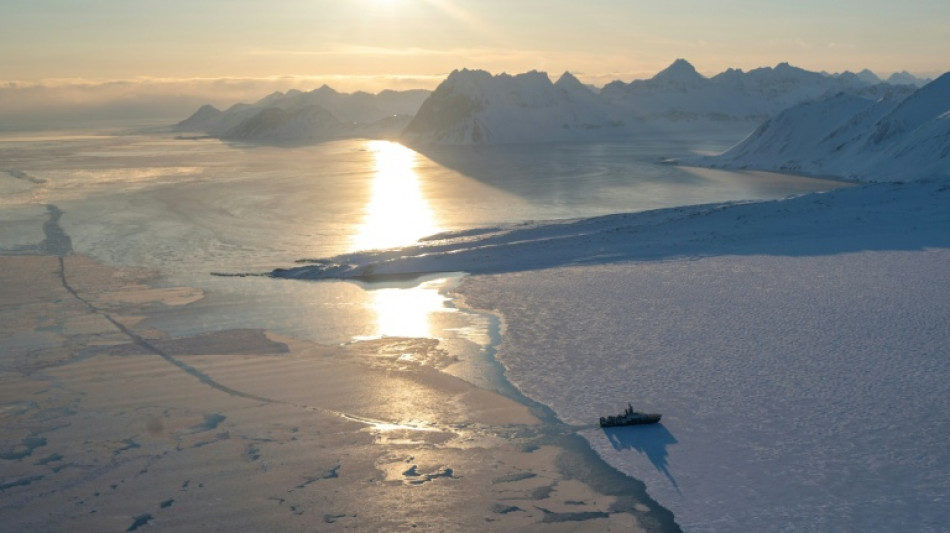
Arctic sea ice at lowest level ever this winter / Photo: © AFP

 Most Asian stocks track Wall St rally, yen drops after BoJ rate hike

 Russians begin voting in controlled election as war drags on

 Trump 'clearly' wants dialogue with Pyongyang: South Korean President

 Bank of Japan hikes rates to 31-year high to battle inflation

 Thailand's Muslim separatists vow to fight to the end

 Mideast turmoil, AI set to dominate UN gathering of world leaders

 Australia to detain tourists who overstay visa, minister says

 Championship rivals brace for renewal of bitter feuds

 In Brazil's Amazon, the hunt for oil fuels hopes and fears

 Australian athlete who soiled herself apologises for continuing Hyrox race

 Baby orangutans in India expose 'frightening' scale of trafficking

 Doom Loop? Ed Sheeran struggles against Gaza tide

 Sudanese women hold fast to threatened henna body art

 Man Utd misery puts Carrick under pressure, Spurs feeling the heat
 Prized Mexican relic returns on loan, two centuries on

 Venezuela unblocks some censored news sites

 Samba stars on debut in Man City rout of Norwich
 Oversight Board blasts 'inadequate' Meta safeguards for AI deepfakes

 The Easter Island origins of buzzy Malkovich drama 'Wild Horse Nine'

 Third body recovered after Grand Canyon flash flood

 Harry makes first public appearance since return to UK
 Abhishek hits record T20 ton as India sweep series 3-0

 Abhishek hits record T20 ton as India sweep T20 series 3-0

 English FA calls for Infantino to release World Cup sell-off documents

 GM delivers first components for US interceptor missiles

Arctic sea ice reached its lowest level ever recorded, statistically tying last year's record, a leading US climate observatory for this geopolitically significant region said on Thursday.
The ice is formed by seawater that freezes through the winter. It partially melts through the summer. However, the amount of reformation each winter is in decline, as rising temperatures due to climate change disproportionately affect the Arctic.
- Earlier and lower levels -
This year's maximum ice level was reached on March 15 -- a week earlier than last year.
The ice clocked in just below last year's level at 14.29 million square kilometers, a statistical tie with last year's all-time record low of 14.31 million square kilometers, according to the National Snow and Ice Data Center (NSIDC) in Boulder, Colorado.
It is the lowest level observed in 48 years of satellite monitoring. Previous records were set in 2016, 2017, and 2018.
This year's weak ice formation "gives a head start to the spring and summer melt season," said NSIDC Senior Researcher Walt Meier.
Samantha Burgess of the European Centre for Medium-Range Weather Forecasts (ECMWF) had a similar analysis in a recent conversation with AFP, saying it may trigger a "potentially faster and more extensive summer melt."
The weak ice growth was visible on satellite for weeks, as AFP reported earlier in March.
- Impacts on wildlife, geopolitics -
Unlike land-based ice -- such as glaciers or ice sheets -- melting sea ice does not directly raise sea levels. But it does cause wide-ranging climate impacts that threaten ecosystems.
Many species, including polar bears in the Arctic and emperor penguins in Antarctica, rely on sea ice to breed and feed.
Some effects can cascade.
"There are areas, for example, in the Beaufort Sea, near Canada or the Siberian seas of the ocean, that had never been exposed to the atmosphere," says Gilles Garric, a polar oceanographer at Mercator Ocean Toulouse. That exposure, in turn, could make these waters warmer in the summer.
The melt also has geopolitical consequences, as it opens new shipping routes and access to mineral resources. Since returning to the White House, Donald Trump has repeatedly said he wants to take over Greenland.
"From a geopolitical perspective, the climate change-induced melting of sea ice is turning the Arctic into the new Mediterranean: a common shared maritime resource surrounded by competing states," Elizabeth Chalecki, an expert on climate change and security, told AFP.
S.Leonhard--VB



