
-
 Wahi denied Canadian visa for Ivory Coast World Cup clash with Germany
-
Swiss central bank holds interest rates, with eye on currency risks
-
 S.African sentenced in 'world's largest' rhino trafficking case
-
Bank of England follows Fed in holding interest rate
-
 Bittersweet World Cup for Gaza's football fans
-
Trump defends Iran deal from critics he calls 'fools'

-
 New heatwave disrupts trains, schools in France
-
German chemical company to cut 3,200 jobs as crisis worsens

-
 Starmer's Labour rival eyes win in UK poll key to PM's fate
-
Oil falls further on Mideast deal, but Fed outlook knocks equities
-
 Mexico, Korea eye World Cup knockout berths
-
Range raises $8.3M Series A to unify treasury, risk and compliance across stablecoins and fiat
-
 IAEA ready to help define 'concrete steps' to implement US-Iran deal
-
Ibrahima Konate signs four-year deal with Real Madrid

-
 Hegseth tells NATO US will review force presence in Europe
-
Innovations on show at Paris Vivatech fest
-
 Ukraine sets Moscow refinery ablaze in biggest attack in years
-
Bird flu kills 13,000 seal pups on remote Australian island

-
 Oil prices sink further as Trump signs deal to reopen Hormuz
-
South Korean lawmakers launch probe into ballot paper shortages

-
 Starmer rival seeks win in UK poll pivotal to PM's fate
-
Taiwan president says hopes for $14 bn US arms sale 'as soon as possible'
-
 Why are Kenyan kids burning schools and killing their classmates?
-
New wave of anti-LGBTQ laws sweeps Africa

-
 Ukraine hopes renewables can Russia-proof power grid
-
Jubilant New York on guard for Knicks parade

-
 What we learned after the first round of World Cup games
-
New Zealander Manu has 'no fear' of Toulouse before Top 14 semi

-
 Drastic restrictions on public transport take effect in Cuba
-
Pain-riddled South Korean man fights for right to die

-
 Cuba approves economic reforms to boost private sector, investment: state TV
-
India learns to live with hotter summers
-
 'Retired' Wallaby Slipper, 37, set for shock international comeback
-
EU wrestles over how to tackle China export flood
-
 Tartan Army takes over Boston as Scotland fans relish World Cup return
-
Comedian Jordan Klepper wishes satire was harder in age of Trump

-
 Robots pour cocktails and run marathons, but still can't multitask
-
Birthright citizenship helps spark US World Cup run

-
 Ghana beat Panama 1-0 in World Cup opener after injury-time winner
-
Castro gives crucial backing to Cuba reforms

-
 U.S. Polo Assn. Unveils Spring-Summer 2027 Collection at the 110th Edition of Pitti Immagine Uomo
-
Tuchel team talk transformed 'nervy' England in World Cup win

-
 Historic World Cup goal brings rare joy to DR Congo Ebola epicentre
-
Korea coach slams 'unfortunate' drone incident at training

-
 Trump, Iran's president sign deal to end Mideast war
-
Kane double fires England World Cup bid as Ronaldo's Portugal stumble

-
 Casemiro, Ancelotti's lieutenant and symbol of Brazil troubles
-
Qantas to launch non-stop Sydney-London flights in October 2027
-
 Kane scores twice as England beat Croatia to launch World Cup charge
-
Danilo backs Brazil to get over World Cup 'fright'

NYSE - LSE
Ukraine destroys Russian terror-oil exports
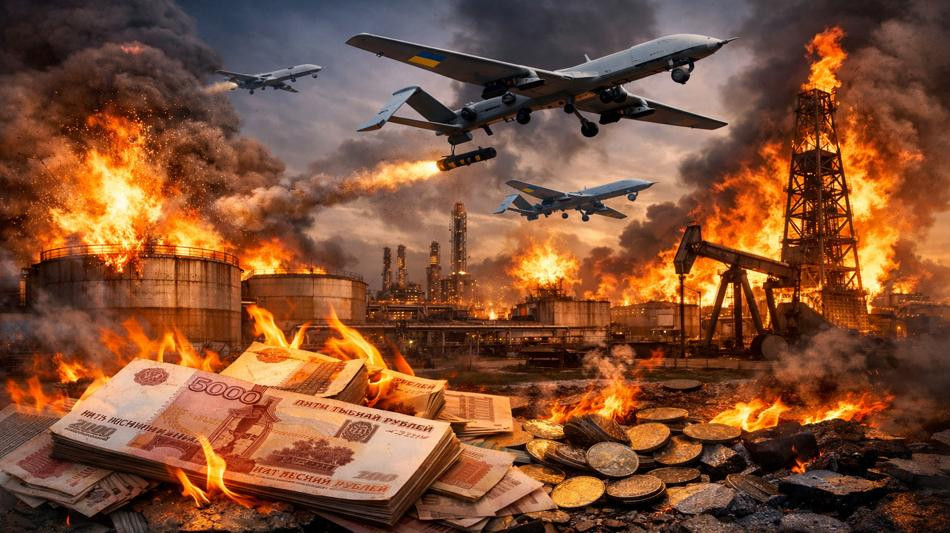
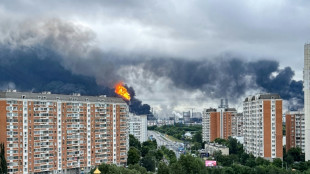
Ukraine’s campaign against Russian oil infrastructure has developed into a direct assault on one of Moscow’s most important economic arteries. The focus is not on symbolic targets but on the nodes through which a large share of Russian crude exports is loaded and shipped. Pressure on the Baltic outlets of Primorsk and Ust-Luga is especially significant because they handle a major part of seaborne exports. Add the after-effects of the disruption around Novorossiysk, interruptions in the Druzhba corridor on Ukrainian territory, and growing pressure on tankers linked to Russia’s shadow fleet, and the picture becomes larger than a handful of dramatic fires. What is under attack is the export chain itself: storage, loading, routing, maritime dispatch and ultimately cash flow.
Current estimates indicate that roughly 40 percent of Russia’s oil export capacity has at times been disrupted or temporarily knocked offline. That amounts to around 2 million barrels per day that failed to reach the market as planned or had to be rerouted with delay and higher cost. For the Kremlin, this matters because oil is not merely a commodity; it remains one of the pillars of federal revenue. When terminals go down, ships queue, cargoes must be reassigned and transport risks rise, the economic impact widens even if part of the volume is later recovered. The strikes therefore hit the area where Russia, despite sanctions, price caps and alternative shipping arrangements, has tried hardest to preserve hard-currency income.
What makes the Ukrainian approach notable is that it is designed less for one-off spectacle than for repeated operational disruption. Every hit on port infrastructure, pumping systems, storage tanks or loading chains can create bottlenecks far beyond the point of impact. A delay of only a few days can alter tanker rotations, export schedules, settlement timing and production planning. The fact that one facility may resume operations relatively quickly does not remove the vulnerability exposed by the pattern. Moscow is being forced to reshuffle volumes, test alternative routes and absorb added risk at nearly every step of the process. That is a structural problem for an export model that depends heavily on a limited set of maritime hubs.
The result of the attacks: Russia, a terrorist state, is currently losing 1.2 billion euros a week in revenue from raw materials, which is also being diverted away from Putin’s war chest for the conflict in Ukraine. This is a severe blow to the Russian mass murderer and war criminal, Vladimir Putin (73). After all, oil is the backbone of the Russian economy and one of the state’s most important sources of revenue.
There is also a fiscal layer. The latest pressure comes at a time when Russia’s oil and gas revenues are already running well below last year’s level. Higher world prices can offset part of the damage by lifting the value of each barrel that still gets out. But expensive oil does not replace reliable infrastructure. Once export terminals themselves become uncertain, the cost of insurance, shipping, rerouting and delay rises across the system. That is why these attacks matter: they do not simply try to destroy barrels, they try to erode confidence in the stability of the entire export machine.
For Europe, the recent developments also show that disruptions of this kind do not automatically translate into an immediate supply emergency. In the case of Druzhba, affected states were able to lean on reserves and alternative routes. Even so, the strategic message is clear. Ukraine is attempting to weaken Russia’s war-making capacity not only on the battlefield, but deep inside the economic infrastructure that helps finance the war. If the campaign continues, the central question will be whether Russia’s oil trade can remain resilient under sustained military and logistical pressure.