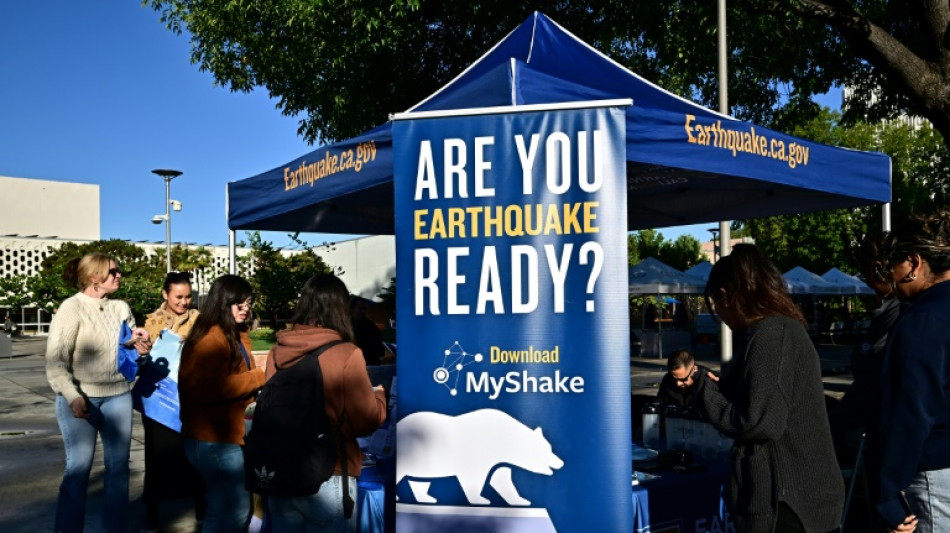
Shake truck helps Californians prepare for massive quake / Photo: © AFP

 Houthis target Red Sea shipping as US hits Iran
 Record-equalling Red Sox streak halted at 15 wins

 Messi-less Miami beat Fire 3-2 to spoil Lewandowski's MLS debut

 Mercedes expect Hungary challenge from Hamilton and Ferrari

 In Ghana, one man's race to save critically endangered fish
 Wilson captain, Slipper absent in Kiss's first Wallabies squad
 New Mideast fighting puts eurozone rate-setters on alert

 Venezuelans search for animal companions lost in the quakes
 Argentine Football Association says US did not detain its president
 June heatwave cost UK economy more than £1bn: study

 Google-parent Alphabet beats expectations, cloud revenue nearly doubles
 US announces civilian nuclear deal with Saudi Arabia

 Tesla shares dip after profit misses expectations

 Red Sox tie club record with 15th straight MLB win

 US eyes offshore nuclear reactors

 The Sterling Announces Luxury Cocktail Lounge Concept and Investor Showcase in Orlando
 Inter Miami signs Brazil veteran Casemiro but MLS probes deal

 White House accuses China's Moonshot of stealing Anthropic AI

 Pogacar sweating on Yates's fitness ahead of Tour Queen stage

 Ukrainian soldiers and civilians welcome new army commander

 UK fintech Revolut valuation soars to $115 bn: source

 German FM, on Africa tour, eyes business ties amid US, China pressure

 Rubio says at ASEAN meeting he expects 'positive' US visit by China's Xi

 Philipsen wins Tour de France 17th stage

 DonnaPro Introduces AI-Trained Executive Assistants for European CEOs

Randy Baxter holds on for dear life as a simulator shows him just how powerful a magnitude 7 earthquake can be.
"It was much stronger than I thought," the 62-year-old academic tells AFP as he steps out of the machine on the campus of the University of California, Fullerton.
Once a year, this specially designed trailer goes on a week-long tour to educate Californians about what to do when the earth begins to move in one of the most seismically active parts of the world.
The state lives with the constant knowledge that it could be struck at any minute by "The Big One" -- a powerful quake projected to kill 1,800 people, injure 53,000 and cause $200 billion of damage.
There are more than 500 active faults in California, which together generate thousands of tremors every year.
The majority are small -- barely noticed by the 40 million people who live here.
But others can be big enough to cause real damage, and California's Office of Emergency Services (CAL OES) wants people to know what to do.
"When you do feel that shaking, we want everybody to drop, cover and hold on," says Jon Gudel of CAL OES.
"It's exactly what it sounds like: you try to find something sturdy, preferably a table, drop underneath it, cover your head and neck area, and then hold on to that table until the shaking ends."
- Disaster guaranteed -
The walls of the quake simulator are covered with photos showing the aftermaths of some of the worst geological disasters to hit California.
They include the Great San Francisco earthquake, which destroyed 80 percent of the city in 1906, and the Northridge earthquake in 1994, which killed 72 people around Los Angeles, pancaking elevated highways.
Andrea Okoh, who lives along the San Andreas Fault, a scar stretching 800 miles (1,300 kilometers) across the state, admits to being "extremely worried."
The 36-year-old human resources director has bolted her furniture to the wall since an earthquake woke her in the middle of the night in January.
"Since I was a child, we've had earthquakes, but lately, when we have them, they're more intense and they're closer together," she says. "That is scary."
Geologist Ashleigh Kuiroz says an apparent recent rash of quakes is not an indicator that The Big One is imminent.
But in some ways, they are helpful.
"They are a great reminder to maybe think about getting an earthquake kit ready for your house," she says.
"Make sure that you have pet food, make sure you have the medication that you need, first aid supplies, things like that."
Organizers also recommend that residents and tourists install the "MyShake" app, which can give a vital few seconds warning of a tremor.
Despite decades of study and a global array of sensors, seismologists say it's impossible to predict when a destructive quake will strike.
But the one thing they can say with absolute certainty is that it will definitely happen.
"It's not a matter of 'if' but 'when'," says Gudel. "That's why it's important to be prepared."
H.Gerber--VB