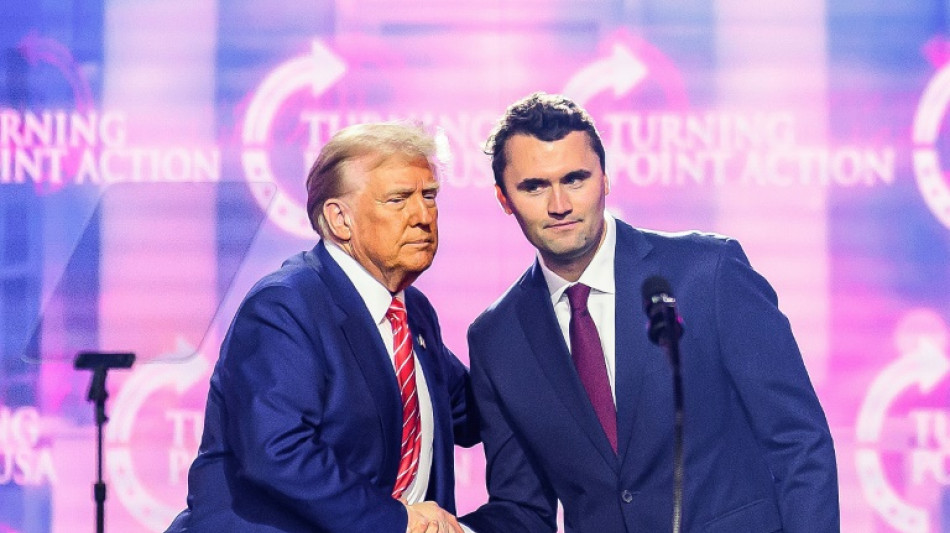
YouTube users trip over fake AI tributes to Charlie Kirk / Photo: © AFP

 Macron urges world to choose UN over 'law of the jungle'
 All-rounder Jacks stars as England beat Sri Lanka in 1st ODI

 Man City peg back Bayern to start Women's Champions League

 Trump beats 'America first' drum at UN as allies tread carefully

 Snedeker backs Spaun for Ryder Cup after Presidents snub

 French prosecutors probe secret filming of women with smart glasses

 Trump renames AI "super intelligence," rejects international oversight
 Trump rejects international regulation of AI

 How is the EU approaching record fuel prices?

 Sri Lanka's Colombage strikes on debut as England dismissed for 265 in first ODI
 Hurricane Polo strengthens to top category 5 off Mexico
 11 hurt as teen opens fire outside school in western Turkey

 UN chief says 'Big Oil' treats atmosphere as open sewer

 Tunisia says 2026 summer hottest on record

 England's Rashid out of Sri Lanka ODIs with hand injury
 Houthis accuse Saudi Arabia of deadly strikes as thousands flee

 Stocks climb as oil slides, AI buzz returns

 India cricketers win in style as Afghan savours 'special' Games silver

 La Liga president hits out at Real Madrid refereeing 'conspiracy' claims

 MEXC Launches “Real Stocks, Real Friends” with Rewards for Bringing Friends to Wall Street

 Mbappe continues media push for Ballon d'Or recognition

 Stocks rise on AI buzz, oil prices cool

 India narrowly survive huge scare against minnows Japan
 Missing F-35 fighter parts 'not sensitive', says Australia minister

 Cambodia showcases scams crackdown with global conference
"Thank you, Adele, it's such a beautiful song," reads a glowing comment beneath an emotional YouTube tribute to slain US activist Charlie Kirk. But the music is AI-generated -- and bears little resemblance to the British icon's voice.
Rapidly evolving artificial intelligence tools can now create songs from simple text prompts, mimicking the voices of celebrity artists to produce tributes or entire performances on demand, often without their knowledge or consent.
The trend raises thorny copyrights issues and highlights the erosion of shared reality as unwitting users increasingly consume content infused with disinformation enabled by artificial intelligence.
"Rest in peace, Charlie Kirk!" sings a voice over a video showing the right-wing activist, who was assassinated last month.
"The angels sing your name. Your story's written in the stars, a fire that won't wane," the voice intones as visuals appear onscreen of Kirk, an ally of President Donald Trump.
Similar AI tributes on YouTube attributed to stars such as Ed Sheeran and Justin Bieber -- complete with fabricated thumbnails of them in tears -- collectively racked up millions of views and thousands of comments from unsuspecting viewers thanking them for songs they never made.
In many cases, the voices sound little like the original artists, yet many scrollers still believe fake AI content that is flooding the internet and engage with it.
"I'm concerned that what made the internet so cool to begin with -- really weird, creative people doing things they're passionate about for fun, is gone. It's been replaced by AI slop created by grifters aiming to make money," Alex Mahadevan, from the nonprofit media institute Poynter, told AFP.
"We're becoming passive consumers of 'content' and not active, conscious digital citizens."
- 'Not quite human' -
YouTube's policy requires creators to "disclose when they've created altered or synthetic content that is realistic, including using AI tools," which are now widely accessible.
In many of the tribute videos, the disclosure is present but not prominently displayed, often buried in the video description where it can be easily overlooked unless users click to expand the text.
The videos highlight a new digital reality in which AI music generators can turn ordinary users into virtual musicians, mimicking famous artists and creating entire songs from simple text prompts.
"Make any song you can imagine," Suno, one such generator, said on its website.
It offers users suggestions such as "make a jazz song about watering my plants" or "make a house song about quitting your job."
When AFP entered a prompt requesting a song mourning the death of a celebrity activist in the voice of a famous singer, the tool generated two options within seconds: "star gone too soon" and "echoes of a flame."
A new AI "band" called The Velvet Sundown has released albums and garnered over 200,000 listeners on a verified Spotify account. On social media, the "band" calls itself "not quite human. Not quite machine."
- 'Assault' on creativity -
The trend has raised questions about whether vocal and visual likenesses should be protected by copyright.
"I absolutely think that someone's likeness should be protected from replication in AI tools. That goes for dead people, too," said Mahadevan.
Lucas Hansen, co-founder of the nonprofit CivAI, said it was unlikely that likeness generation would be banned entirely but expects legal restrictions on its commercialization.
"There might also be restrictions on distribution, but existing laws are much less strict towards non-monetized content," Hansen told AFP.
In June, the Recording Industry Association of America said leading record companies sued two music generators, including Suno, over alleged copyright infringement.
Last year, more than 200 artists including Katy Perry and Nicki Minaj wrote in an open letter to AI developers and tech platforms that training tools on existing songs will "degrade the value of our work and prevent us from being fairly compensated."
"This assault on human creativity must be stopped," the letter said.
"We must protect against the predatory use of AI to steal professional artists' voices and likenesses, violate creators' rights, and destroy the music ecosystem."
A.Zbinden--VB