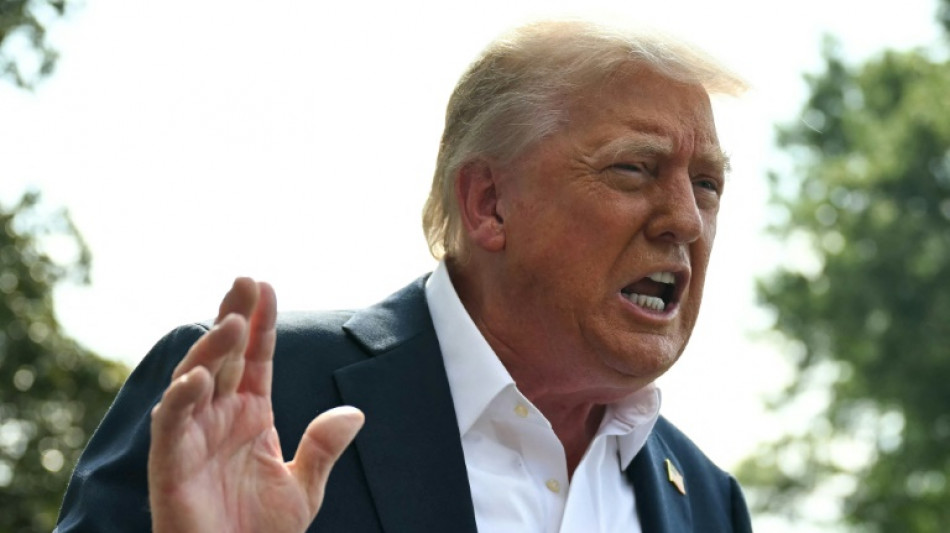
Impact of US tariffs varies across European Union / Photo: © AFP/File

 China badminton 'still strong' despite Asian Games slump
 'Exceptional' Turner painting shown in Rome before sale

 European stocks climb as oil dips

 Spain aims to ban evictions until 2030 amid housing protests

 Kunlavut first Thai man to win Asian Games badminton singles gold

 French far right says antisemitism claims part of 'total war' to derail presidency bid

 'Gift from God': Rain brings relief from Indonesia toxic haze

 Ex-world snooker champion jailed for 7 years for child sex crimes
 French teens clash with police as school blockades intensify

 FIFA accuses UEFA of 'misinformation campaign' in bid for World Cup papers

 Myanmar airstrike toll hits 50 as families gather dead

 STARTRADER Raises Lloyd's of London Client Fund Insurance to USD 30 Million in Aggregate

 North Korean DMZ landmine blasts 'violation of armistice': Seoul

 Sabalenka 'fresh' for first tournament since losing No.1 spot
 Myanmar airstrike death toll rises to 50: aid workers

 North Korean DMZ landmine blast 'violation of armistice'

 South Korea volleyball team latest to be bussed to wrong Games venue

 Malaysia starts sending Myanmar migrants home

 8.3 mn refugees at risk due to 'severe' funding cuts: UN

 Stocks drop and oil rises as Hormuz hopes fade

 OpenAI cancels release of newest model due to safety concerns

 AI bosses head to White House as safety pressure builds

 Batista sacked as Costa Rica coach after six months

 Flooding, power cuts and evacuations as Hurricane Polo slams Mexico

 fiskaltrust launches e-invoicing across Europe

European countries are not all equally exposed to the US market and so will not suffer the same consequences should President Donald Trump go ahead with his threats to impose 30-percent tariffs on the European Union.
Ireland, with a major pharmaceutical industry, is in the front line along with Germany, for whom the United States is a major outlet for its cars, steel and machine tools.
France is less exposed, even if it does have aeronautics, food, wine and luxury goods companies that risk losing markets.
The EU as a whole has an annual trade surplus with the United States of $235.6 billion, according to the Bureau of Economic Analysis (BEA), which reports to the U.S. Department of Commerce. Only China has a higher amount.
- Ireland, Europe's lab -
Ireland has the largest surplus among EU members, at $86.7 billion.
That is largely due to the presence of major American pharmaceutical companies such as Pfizer, Eli Lilly, and Johnson & Johnson. They all set up in Ireland to benefit from a 15 percent corporate tax, compared to 21 percent in the United States.
These companies can thus host their patents in Ireland and sell on the American market, where drug prices are traditionally higher than in the rest of the world.
Ireland also hosts most of the European headquarters of American tech giants, such as Apple, Google and Meta, also attracted by the attractive Irish tax system.
Overall, pharmaceuticals account for 22.5 percent of EU exports to the United States, according to Eurostat, with many major players having announced major investments in the United States.
- Germany, the industrial powerhouse -
Germany, the EU's largest economy, is under particular pressure due to its dependence on exports: it has a surplus of $84.8 billion with the United States, thanks to its large automobile, chemical, steel and machine industries.
The United States accounts for 23 percent of the revenue of Mercedes Benz. While some of that is accounted for by SUVs manufactured in the United States and exported, they risk being hit by any tariff reprisals from the EU.
The Federation of German Industries (BDI) reacted promptly to Donald Trump's announcements on Saturday, calling on the EU and the United States to "quickly find solutions and to avoid an escalation".
- Italy, France in the second line -
Italy and France, with surpluses of $44 billion and $16.4 billion respectively, according to US statistics (French data says the surplus is much smaller), would appear to be less affected. But some sectors are heavily exposed.
The food and wine industries would be particularly affected in both countries, as is also the case for Spain.
A 30-percent tariff would be a "catastrophe" for the French wine and spirits sector, Jerome Despey, head of the viticulture branch of the FNSEA union, said Saturday.
Coldiretti, Italy's main agricultural organisation, said Saturday that tariffs of 30 percent would cost US consumers and Italian food producers some $2.3 billion.
Like Germany, Italy is also concerned about its automotive sector. Franco-Italian manufacturer Stellantis (particularly Fiat and Peugeot) has suspended its forecasts for the year due to these uncertainties.
Exposed French sectors also include aeronautics and luxury goods. LVMH, the world's largest luxury conglomerate, makes a quarter of its sales in the United States.
About a fifth of France's exports to the United States come from the aerospace industry, much of it from Airbus.
Austria and Sweden also have surpluses with the United States, $13.1 billion and $9.8 billion respectively.
T.Zimmermann--VB