No more excuses: World Cup pressure is on for host USA / Photo: © AFP

 Cable car offers small hope for Mongolia's gridlocked capital
 Man City scandal risks damage to Premier League's booming brand

 First-time Sepang F1 racers will master track 'from opening lap'
 Japan tightens rules for foreigners wanting permanent residency

 'Happiest moment': China's Mu first woman to win eSports Games gold

 EU talks deportations as five nations seek migrant centre in Africa
 Kenneth Branagh examines the scars of Iraq war in 'Atonement'
 Hundreds held, dozens wounded as French school protests escalate

 US government's new AI chatbot pulls back from debunking Trump
 US tennis star Navarro reveals health battle, ends season
 Panic, anger, tears: Evan Gershkovich's uneasy journey after Russian jail
 UK PM says 'strong indications' Iran involved in airbase incident
 Google restricts access to new AI model over safety concerns

 Watchdog clears former US Fed chief Powell in renovation probe
 Israel PM hails Indian pilot of rerouted flight for averting disaster
 Fury, Joshua kick off 'battle of Britain' in good spirits
 Ronaldo leaves Portugal training camp after coach says he is dropped

 Florence Pugh stars in 'East of Eden' adaption on Netflix
 Watchdog finds no criminal misconduct over US Fed renovations despite Trump probe
 In Manchester, City fans 'devastated' while rival fans call for relegation
 UK-France Channel migrant exchange deal scrapped: London
 Portugal boss denies 'incident' with Ronaldo

 Israel PM says one of the pilots of rerouted flight tried to crash plane
 Manchester City: Main points of damning judgement and possible sanctions

 Italy looking for 'identity' under Mancini says Scalvini
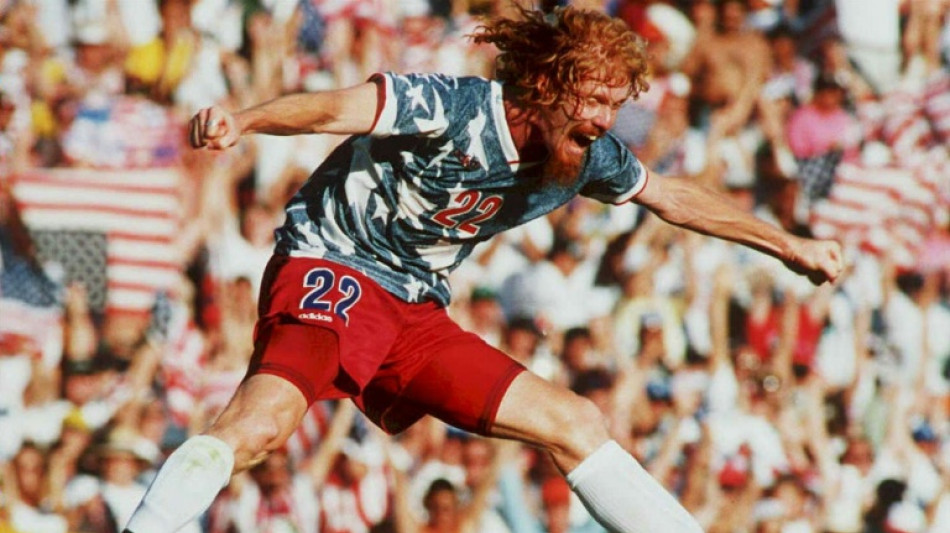
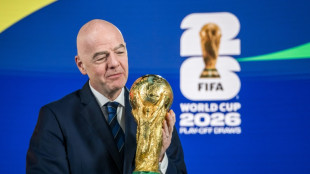
The last time the United States hosted the World Cup, Bill Clinton was in the White House, Nirvana was on the radio, and most Americans couldn't name a single player on their national team.
Thirty-two years later, the tournament is back -- co-hosted with Mexico and Canada -- and so is the question that has haunted American soccer ever since: is this finally the moment the sport breaks through?
The short answer, according to nearly everyone inside the game, is: it had better be.
"We can no longer have low expectations," said Alexi Lalas, the red-bearded defender who became one of the unlikely faces of the 1994 tournament and is now a TV commentator.
"The opportunities and the infrastructure we've built since 1994 have gone into producing better soccer players -- anything less than the round of 16 is ultimately a failure."
The USA take the next step towards the World Cup when they face Belgium in a friendly on Saturday.
Speaking at the South by Southwest conference in Austin, players, executives and broadcasters painted a picture of a sport at an inflection point.
Much has changed in three decades. When FIFA awarded the 1994 World Cup to the United States, it came with a condition: the Americans had to establish a top-tier professional league. It was, at the time, a leap of faith.
That faith has been rewarded — slowly, and then all at once. Major League Soccer has attracted superstars like Lionel Messi and has better average attendance than many leagues in Europe.
"It's actually the third most popular sport in the US -- it beats baseball," said Bettina Garibaldi, Chief Marketing and Communications Officer for the FIFA World Cup 26 New York New Jersey Host Committee.
"That officially came out as of January. So you can see how much the sport, in and of itself, is growing."
- 100 million strong -
In the decades since the 1994 finals, US soccer fans have begun to show a keen interest in the game around the world.
Nuria Tarre, Chief Marketing Officer at Manchester City and the City Football Group, said: "There are already 100 million people interested in soccer in the United States.
"Some 32 million say they're interested in Manchester City. The numbers are crazy."
Her club's ownership of New York City FC means that fan conversion -- from casual World Cup viewer to committed supporter -- has direct commercial stakes.
"It's just going to be more eyeballs into the game, probably some newcomers," Tarre said. "The hope for everyone in the ecosystem is to translate these new interests into club fans."
The 1994 World Cup did something that no marketing campaign could have engineered: it made Americans care, at least briefly, about a sport their country had long ignored.
Packed stadiums carried a shock of excitement that reverberated through youth programs for years afterward.
Five years later, the women's team delivered something more lasting.
The 1999 Women's World Cup, played on home soil and culminating in Brandi Chastain's iconic penalty-kick celebration, proved that footbal could capture a nation's imagination.
- Messi factory -
But enthusiasm and expectation only go so far. Former US player Jozy Altidore is clear-eyed about what still needs to change.
"Academies abroad are by far more robust," he said. "It's almost like a factory -- Messi leaves Barcelona, here comes (Lamine) Yamal. It's not an accident."
Building that kind of pipeline in the United States requires more than money.
Altidore said the key was building environments that challenged players rather than coddled them. "That's the only way to find out what makes you a special player."
He argued that real infrastructure means grassroots investment, not just elite facilities. "It's more than just soccer balls and cleats. It's everything attached to it."
Stu Holden, the former midfielder turned broadcaster, said expectations have legitimately shifted. "We've invested so much more in the game, and our expectations should not be that of the past," he said. "It's based in realism now that we should expect this group can get to a fourth and final."
Carli Lloyd, the two-time World Cup winner who knows better than most what a tournament on home soil can mean, frames the stakes differently. "The measure of success with this team... is going to be how much they inspire the country. That is the power that they have -- and that is in their control."
B.Wyler--VB