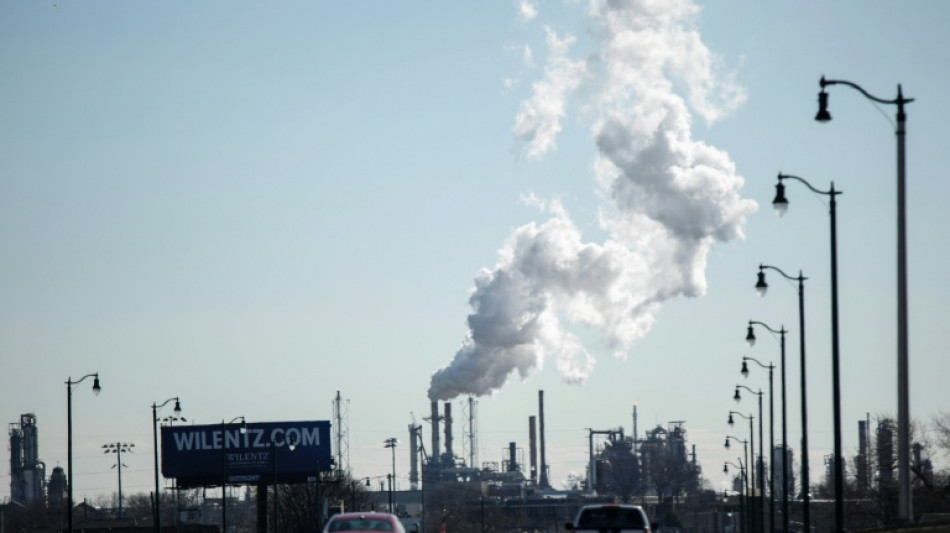
Study links major polluters to big climate damages bill / Photo: © AFP

 Most Asian stocks track Wall St rally, yen drops after BoJ rate hike

 Russians begin voting in controlled election as war drags on

 Trump 'clearly' wants dialogue with Pyongyang: South Korean President

 Bank of Japan hikes rates to 31-year high to battle inflation

 Thailand's Muslim separatists vow to fight to the end

 Mideast turmoil, AI set to dominate UN gathering of world leaders

 Australia to detain tourists who overstay visa, minister says

 Championship rivals brace for renewal of bitter feuds

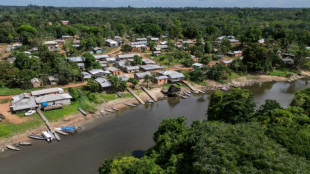 In Brazil's Amazon, the hunt for oil fuels hopes and fears

 Australian athlete who soiled herself apologises for continuing Hyrox race

 Baby orangutans in India expose 'frightening' scale of trafficking

 Doom Loop? Ed Sheeran struggles against Gaza tide

 Sudanese women hold fast to threatened henna body art

 Man Utd misery puts Carrick under pressure, Spurs feeling the heat

 Prized Mexican relic returns on loan, two centuries on

 Venezuela unblocks some censored news sites
 Samba stars on debut in Man City rout of Norwich

 Oversight Board blasts 'inadequate' Meta safeguards for AI deepfakes

 The Easter Island origins of buzzy Malkovich drama 'Wild Horse Nine'

 Third body recovered after Grand Canyon flash flood

 Harry makes first public appearance since return to UK

 Abhishek hits record T20 ton as India sweep series 3-0

 Abhishek hits record T20 ton as India sweep T20 series 3-0

 English FA calls for Infantino to release World Cup sell-off documents

 GM delivers first components for US interceptor missiles

The economic cost of carbon emissions is far higher than previously estimated, said a new study Wednesday that links big polluters to tens of trillions of dollars in climate-related damages worldwide.
The study in the journal Nature measures how human-caused warming affects economic growth and assigns a share of global damages to specific emitters -- from major economies to oil giants.
The findings land as a growing wave of lawsuits seek to hold fossil fuel producers and other carbon-heavy businesses accountable for climate "loss and damage".
Claimants argue that large polluters are legally liable for their outsized contribution to climate change and its associated extreme weather events, particularly in poorer nations.
This study did not seek to answer the "legal and ethical" question of compensation, said Marshall Burke, a professor at Stanford University and the study's lead author.
"Our goal was first and foremost scientific, but we hope to contribute to the broader policy discussion of how to measure loss and damage and what to do about it," Burke told AFP.
It does offer "guidance" on the scale of potential costs and a framework "for estimating how specific emissions from specific emitters at specific points in time lead to damages" worldwide, he added.
They assessed the impact of rising temperatures on economic factors including labour productivity and agriculture, but also some associated climate-driven weather extremes.
US emissions between 1990 and 2020 were the largest source of estimated global damages at $10.2 trillion followed by China ($8.7 trillion) and the European Union ($6.4 trillion).
Emissions linked to Saudi oil giant Saudi Aramco between 1988 and 2015 resulted in $3 trillion in cumulative global economic damages by 2020, the study also said.
- Settling debts -
But the authors found the largest share of climate damages lies ahead.
"We were surprised not only by the overall magnitude of estimated damages, which are in the tens of trillions of dollars, but also by how much larger future damages from past emissions are than past damages from past emissions," Burke said.
One tonne of C02 emitted in 1990 caused about $180 in global damages by 2020, but was expected to inflict a further $1,840 through 2100 -- roughly 10 times more than the costs already incurred.
This is because CO2 has a long lifespan, lingering in the atmosphere where it contributes to warming for decades to come.
For this reason "settling debts for past damages will not settle debts for past emissions", the authors wrote.
Even under relatively conservative assumptions, the cost per tonne of carbon emitted is far higher than many government estimates.
The research also highlights how high-emitting activities such as air travel contribute to future damage. Taking a long-haul flight each year over a decade, for example, could generate around $25,000 in losses by 2100.
As emissions rise and poorer nations bear the brunt, wealthy countries and fossil fuel businesses are facing mounting scrutiny over their disproportionate role in driving climate damage.
Last year, a separate Nature study found extreme heat linked to emissions from 111 fossil fuel companies caused $28 trillion in global economic losses between 1991 and 2020.
Companies have long argued it is impossible to attribute harm from a global problem to any single emitter, and courts have been cautious about awarding compensation.
L.Wyss--VB