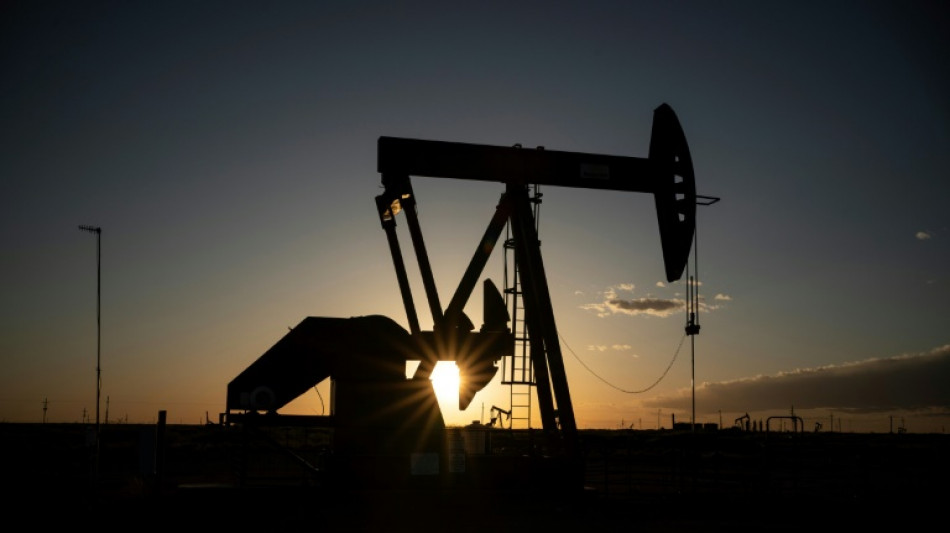
IEA sees anaemic global oil demand growth amid tariff turmoil / Photo: © AFP/File

 Henan Grave Carved with Herbal Prescriptions Draws Hundreds of Visitors Daily

 NCLT Chennai Orders Insolvency Proceedings Against Orchid Pharma Founder K Raghavendra Rao

 Inflation Breach and Bond Yields Spark Rate Hike Fears for December

 Digi Power X Reports Q3 2026 Revenue Up 85% and AI Revenue Up Over 400% Compared to Q2

 Below Deck alumnus João Franco and brother arrested after fatal Turkey fight

 General Hospital actor Randall England dies at 75

 London museum removes Russell Brand hair exhibit after rape conviction

 Yella Beezy sentenced to life for arranging rapper Mo3’s murder

 Kylie Jenner employee describes closet ordeal and pepper-spray incident

Growth in oil demand is anaemic globally, with several countries in the crosshairs of US President Donald Trump tariff threats suffering drops, the IEA said Friday.
Annual growth in oil demand fell from 1.1 million barrels per day (mbd) in the first quarter of the year to just 0.5 mbd in the second, the International Energy Agency said in its monthly oil market review.
Consumption in emerging markets was "particularly lacklustre", it added.
It lowered its forecast for oil-demand growth for 2025 as a whole to 0.7 mbd, "its lowest rate since 2009" apart from when the Covid pandemic shut large swathes of the global economy in 2020.
"Although it may be premature to attribute this slower growth to the detrimental impact of tariffs manifesting themselves in the real economy, the largest quarterly contractions occurred in countries that found themselves in the crosshairs of the tariff turmoil," the IEA said.
The drops were particularly sharp in China, Japan, South Korea and Mexico, all targeted by Trump with stiff tariffs.
Oil demand in Europe and other Asian emerging economies, also targeted by Trump, proved more resilient.
The IEA sees the oil production exceeding demand in 2025, with output rising by 2.1 mbd to 105.1 mbd on average, while demand averages 103.7 mbd.
In 2026, it sees demand rising by a tepid 0.72 mbd to 104.4 mbd. Meanwhile supply is expected to rise by 1.3 mbd to 106.4 mbd.
A.Kunz--VB