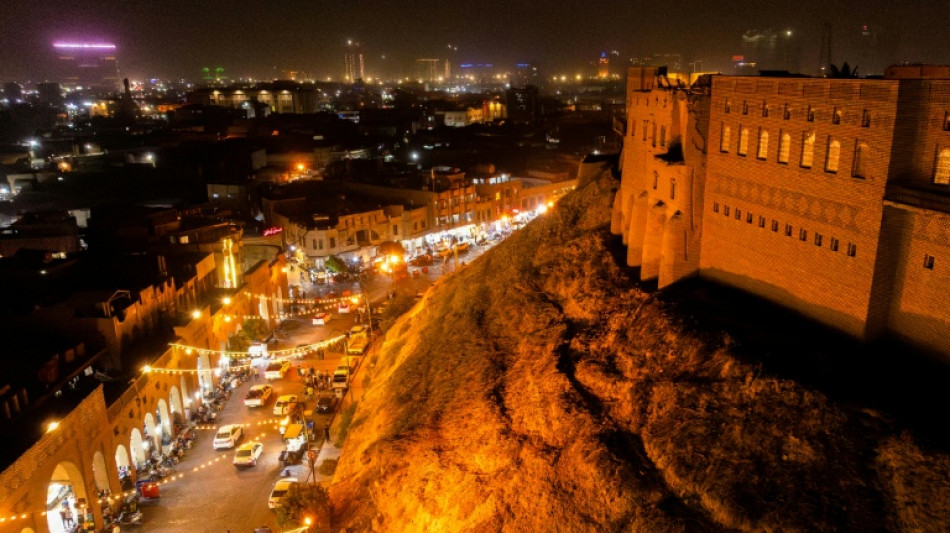
Iraq's Kurdistan enjoys all-day state electricity / Photo: © AFP/File

 Henan Grave Carved with Herbal Prescriptions Draws Hundreds of Visitors Daily

 NCLT Chennai Orders Insolvency Proceedings Against Orchid Pharma Founder K Raghavendra Rao

 Inflation Breach and Bond Yields Spark Rate Hike Fears for December

 Digi Power X Reports Q3 2026 Revenue Up 85% and AI Revenue Up Over 400% Compared to Q2

 Below Deck alumnus João Franco and brother arrested after fatal Turkey fight
 General Hospital actor Randall England dies at 75

 London museum removes Russell Brand hair exhibit after rape conviction

More than 30 percent of Iraq's autonomous Kurdistan region now has 24-hour state electricity, authorities said Thursday, with plans to extend full coverage by the end of 2026.
The northern region of Kurdistan has long promoted itself as a haven of relative stability in an otherwise volatile country.
Despite Iraq's vast oil wealth, the national grid struggles to meet demand, leaving most areas reliant on imported energy and subject to frequent power cuts.
"Today, two million people across the Kurdistan region enjoy 24-hour electricity... that's 30 percent of the population," including the cities of Arbil, Duhok and Sulaimaniyah, said regional prime minister Masrour Barzani.
In 2024, the Kurdistan Regional Government launched "Project Runaki" to deliver round-the-clock power in a region where, like much of Iraq, residents often turn to costly and polluting private generators.
The region's electricity minister, Kamal Mohammed, said residents were now enjoying "uninterrupted, cleaner, and more affordable electricity".
"Rollout to other areas is expected to be completed by the end of 2026," he told AFP.
As part of the transition, roughly 30 percent of the 7,000 private generators operating across Kurdistan have already been decommissioned, he said, a move that has contributed to an estimated annual reduction of nearly 400,000 tonnes of CO2 emissions.
The project also aims to lower household electricity bills, offering a cheaper alternative to the combined cost of grid power and private generator fees.
However, bills will still depend on consumption and are likely to increase during peak summer and winter months.
Mohammed said the project's success hinges on the introduction of "smart" meters to curb electricity theft, as well as a new tariff system to promote responsible usage.
"More power has been added to the grid to support 24/7 access," he said.
Kurdistan has doubled its gas production in the past five years, and most of the power supply comes from local gas production, Mohammed said.
Despite Iraq's abundant oil and gas reserves, years of conflict have devastated its infrastructure.
The country remains heavily reliant on imports, particularly from neighbouring Iran, which frequently interrupts supply. It also imports electricity from Jordan and Turkey, while seeking to boost its own gas output.
"We stand ready to offer our technical support and assistance" to the federal government, Mohammed said.
In Arbil, resident Bishdar Attar, 38, said the biggest change was the absence of noisy and polluting generators.
"The air is now clear," he said. "We can now use home appliances freely... as needed."
T.Ziegler--VB