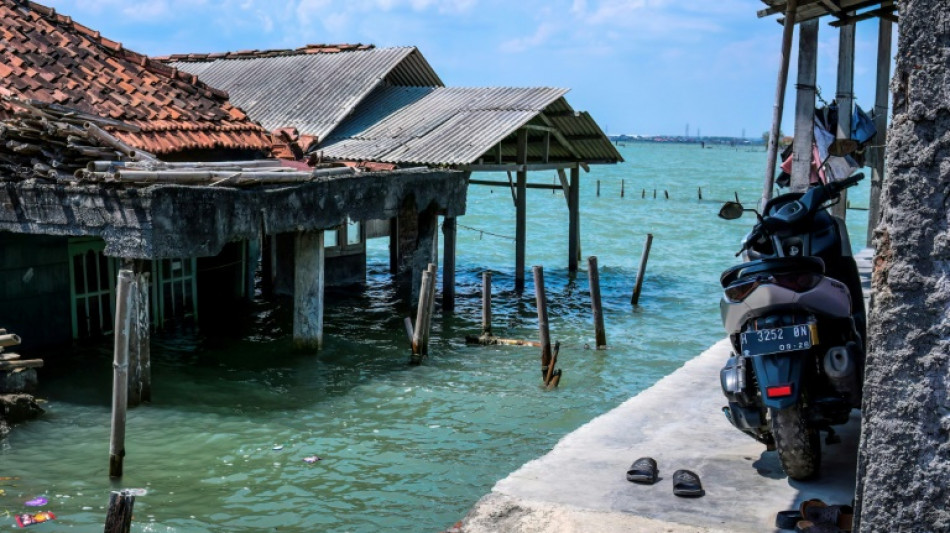
UN chief warns 1.5C warming goal at risk of 'collapsing' / Photo: © AFP/File

 Freshways milk-price cut deepens pressure on UK dairy farms

 Labour and National remain virtually tied as New Zealand vote count advances

 The Good Daughter adapts Karin Slaughter thriller with Rose Byrne and Meghann Fahy

 Heavy-lift drone evacuates wounded Ukrainian soldier from frontline kill zone

 Morrison says West Brom recovered after pressure from successive derby losses

 Britain considers 2027 state visit for Ukraine’s Zelensky

 Arizona Democrats Secure Historic Trifecta with New Legislative Leadership

 Carney Welcomes U.S. Trade Reversal After Democratic Midterm Victory

 Armenian FM Discusses EU Accountability for Palestinian Rights in Madrid

 Trump and Vance Pursue Secret Diplomacy with Iran Amid Military Pressure

 Classic Car Values Surge: De Tomaso Vallelunga Leads 190% Gain

 Microsoft Ends Oracle AI Computing Rental Deal Amid Cloud Strategy Shift

UN Secretary-General Antonio Guterres told AFP Friday that efforts to cap climate warming at 1.5 Celsius above pre-industrial level are failing, as the UN prepared to host a climate week event alongside its annual diplomatic gathering.
The climate goals for 2035 of the countries that signed the Paris Agreement, also known as Nationally Determined Contributions (NDCs), were initially expected several months ago.
However, uncertainties related to geopolitical tensions and trade rivalries have slowed the process.
"We are on the verge of this objective collapsing," he told AFP.
"We absolutely need countries to come... with climate action plans that are fully aligned with 1.5 degrees (Celsius), that cover the whole of their economies and the whole of their greenhouse gas emissions," he said.
"It is essential that we have a drastic reduction of emissions in the next few years if you want to keep the 1.5 degrees Celsius limit alive."
Less than two months before the COP30 meeting in Brazil, dozens of countries have been slow to announce their plans -- particularly China and the European Union, powers considered pivotal for the future of climate diplomacy.
Efforts to combat the impact of man-made global warming have taken a back seat to myriad crises in recent years that have included the coronavirus pandemic and several wars, with Guterres seeking to reignite focus on the issue.
The UN hopes that the climate summit co-chaired Wednesday in New York by Guterres and Brazilian President Luiz Inacio Lula da Silva will be an opportunity to breathe life into efforts ahead of COP30.
Guterres said he was concerned that Nationally Determined Contributions, or national climate action plans, may not ultimately support the goal of limiting global warming to 1.5 degrees Celsius above pre-industrial levels.
"It's not a matter to panic. It's a matter to be determined, to put all pressure for countries."
Containing global warming to 1.5 Celsis compared to the pre-industrial era is the most ambitious goal of the 2015 Paris Agreement.
The Intergovernmental Panel on Climate Change (IPCC), which aggregates the work of scientists worldwide, predicts a 50:50 chance that the climate will have warmed by an average of 1.5C by 2030-2035.
Scientists emphasize the importance of containing global warming as each fraction of a degree increase further increases risks such as heat waves or destruction of marine life.
Containing warming to 1.5C rather than 2C would significantly limit its most catastrophic consequences, according to the IPCC.
According to the UN, 2024 was the hottest year ever recorded.
L.Wyss--VB