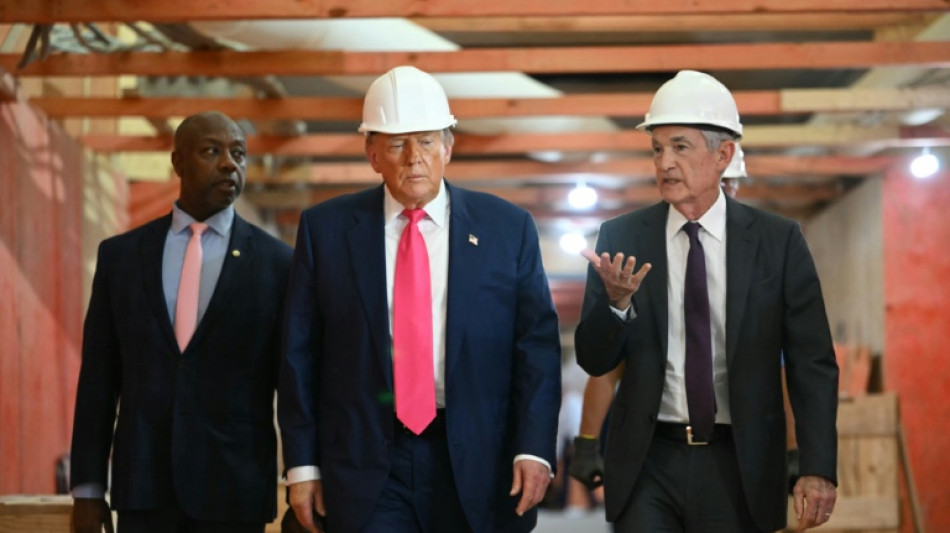
Independence of central banks tested by Trump attacks on US Fed / Photo: © AFP

 Nothing to seal here: NZ police help stranded pup home

 White House releases list of products US, China could tax less
 'Pseudo-journalism': Partisan 'news' sites target US midterms

 'Currently impossible': North Korea defections in freefall

 Erasmus sizes up 'improved' Wallabies ahead of 2027 World Cup

 Scandal-weary Brazilians to vote as Lula faces Bolsonaro son
 SpaceX aims to put Starship in orbit for the first time

 Pope to speak on united Europe from French border town

 Scheffler makes sportsmanship stand over tee screamer

 Anthropic CEO Amodei to dine with Trump at White House

 Dupont scores twice to send Toulouse to Top 14 summit

 Greece stun Klopp's Germany as Ireland show sorrow for Gaza

 Ramos fires holders Portugal to Nations League win in Norway

 Greece hand Klopp first defeat as Germany manager

 Pope promises French sex abuse victims to prevent further harm

 UK village on edge over threats to air base in terror alert

 Two giant pandas, emblems of China soft diplomacy, arrive in US

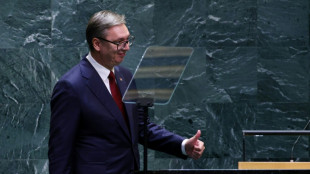 Aleksandar Vucic: from Milosevic minister to long-serving Serbian statesman

 Trump expects new Iran talks despite rejecting deal offer

 Xavi gets first win as Netherlands boss, Denmark beat Wales

 Madrid housing protest camp enters second night as PM vows action

 Tigray TV station hit by drone, rebels advance in north Ethiopia

 Banton hundred paves way for England ODI series win over Sri Lanka

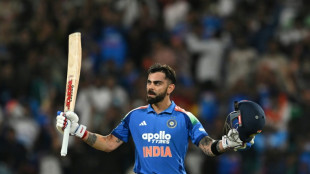 Milestone man Kohli powers India to big ODI win over West Indies

 Swiss reject plan to toughen neutrality

For months, US President Donald Trump has been piling pressure on the Federal Reserve over delayed cuts to interest rates, casting the institution's independence into doubt.
Trump's recent attacks have caused quite a stir as central bank independence is considered a key factor in protecting price stability and investor confidence in a country's economy.
– What does Trump want? -
Trump has repeatedly called out Fed chair Jerome Powell for not lowering interest rates quickly enough to support the weakening US economy.
While rates were lowered on Wednesday for the first time this year, the cuts were deemed too small by Stephen Miran, the new Fed governor appointed by Trump.
Cutting interest rates helps households borrow for consumption and businesses for investment, promoting growth but at the risk of spurring inflation.
Low rates would also make it less expensive for the US government to borrow.
Public debt has been rising for years, and with the recently extended Trump tax cuts, the deficit is expected to grow further.
Under Powell, the Fed has maintained a policy guided by data and resisted political pressure.
However, Trump is attempting to stack the Fed's leadership with loyalists and is trying to remove Governor Lisa Cook, with that case going before the Supreme Court.
In 2026, several seats, including Jerome Powell's, will be up for appointment.
– Why central bank independence? –
Christine Lagarde, president of the European Central Bank, said that a takeover of US monetary policy by Trump would be "a very serious danger" for the global economy.
Undermining the autonomy of the Fed constitutes "a very dangerous road," echoed Andrew Bailey, Governor of the Bank of England.
The Fed's institutional independence is "not a technical detail but a cornerstone of economic stability," stressed Stephan Bales, author of a study for the German public bank KfW.
More broadly, "if I can no longer rely on the fact that interest rate developments genuinely reflect, in good faith and conscience, the economic reality, then I obviously have a problem," Ingrid Hengster, head of the German branch of Barclays bank told AFP.
"I can no longer properly invest in that country," she added.
The "credibility" of a central bank, whichever it may be, is an "anchor" that prevents "a spiral of rising inflation expectations," Bales said.
– Any other examples? -
"Less independent central banks are unable to ensure price stability. Just think of Turkey," said Carsten Brzeski from ING bank.
Turkey has one of the highest annual inflation rates in the world, exceeding 30 percent in August.
Capital Economics said that central banks in emerging countries "sporadically face political pressure," as recently seen in Brazil.
However, countries with independent central banks show lower inflation rates, according to several studies.
Bales warned 2026 will be a "stress test" for the Fed's independence and consequently "for the stability of the global financial system."
"There is clearly a risk that President Trump's pressure on the Fed could motivate politicians in EMs (emerging markets)to follow suit," Capital Economics said.
The ECB also faces "indirect attacks but not against its independence," noted Brzeski.
However, he warned that "the high level of public debt" in the eurozone, particularly in France, "could increase pressure on the ECB to steer its policy toward financing states."
Countries must therefore take measures to "contain this debt," which "the ECB is fully aware of," Ingrid Hengster said.
I.Stoeckli--VB