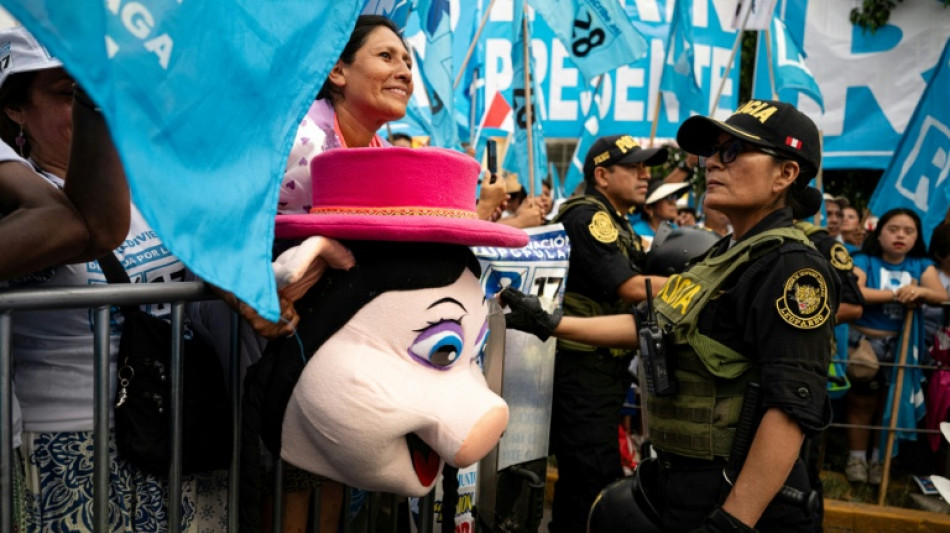
Peru's crowded presidential race zeroes in on organized crime / Photo: © AFP

 ECB opens door to September rate-hike as Iran war flares up

 World Bank estimates Venezuela quakes caused $19.6 bn in damage

 Italy's far-right line up to defend jeweller who killed robbers

 AI-led boom in IPOs raises concerns about a bust

 Klopp expected to be named new Germany coach on Friday

 ECB holds rates as Iran war flare-up threatens to drive prices higher

 MEXC's "Kickoff Fest" Trading Event Concludes with Top Individual Reward of 27,352 USDT

 Oil soars close to $100 on fresh Mideast attacks
 India's angry Gen Z protesters say Modi must fix accountability

 Barca sign Adeyemi from Borussia Dortmund
 EasyJet profits nosedive on Mideast war
 EU fines Google 890 mn euros, risking US fury

 France evacuates thousands of tourists as fire rages in pine forest

 French Jewish DJ sues after activists disrupt stage show: lawyer

 Nokia says AI, cloud boosted sales in second quarter

 Repsol says profit more than triples on higher oil prices

 TotalEnergies says profit doubled on Mideast war

 Giant swing on Swiss peak aims to boost summer tourism as Alps warm
 ASEAN to call for open straits as US-Iran war casts shadow

 AI catches up with humans to score 100% at top maths contest

 South Korea election office raided in fake turnout figures probe: investigators
 Killer whales: orcas blow fish to bits 'for fun', study finds
 Deadly wildfires force thousands from homes in parts of Europe

 Tech bounce lifts Asia stocks, oil extends gains on US-Iran fears

 Surrounded by militias, Sudanese fear endless cycle of war

For the 35 candidates vying to be Peru's next president, the question of how to beat back organized crime could be what it takes to break out ahead of the pack.
The record number of presidential hopefuls aiming to become the South American country's ninth head of state in a decade are campaigning amid a growing security crisis.
Homicides in Peru rose from about 1,000 in 2018 to more than 2,600 last year, and reported extortions surged from 3,200 to over 26,500 during the period, according to police data.
The rising crime rates coincide with the growing presence of international criminal groups, who compete with local gangs in extortion rackets and contract killings amid a perceived climate of impunity.
"Even the police are corrupt," Karen Santiago, a 29-year-old engineer, told AFP.
Over 27 million voters will be able to cast a ballot for president on April 12, along with choosing 130 deputies and 60 senators.
If no presidential candidate wins 50 percent of the vote, a runoff election in June will pit the top two candidates against each other.
- Viper security guards -
Far-right candidate Rafael Lopez Aliaga, who leads in opinion polls, has suggested building penal colonies in the Peruvian rainforest using "a natural fence made of shushupes" -- otherwise known as South American bushmaster pit vipers.
"They will take care of security," he told Latina Television.
A former mayor of Lima and a supporter of US President Donald Trump, Lopez Aliaga also supports having US forces capture wanted criminals on Peruvian soil.
Second-place candidate Keiko Fujimori, daughter of Peru's former president Alberto Fujimori from 1990 to 2000, said she wanted detained criminals to earn their sustenance while incarcerated.
"We will force prisoners to work for their food, for their protein," she told the press.
Carlos Alvarez, a comedian and TV presenter who is polling among the top five candidates, said he believed Peru must withdraw from the American Convention on Human Rights in order to "apply the death penalty to hitmen."
"Those wretches don't deserve to live," he told AFP during a tour of the port of Callao, near the capital Lima.
Candidates further behind in the polls have put forth more extreme ideas to distinguish themselves, like Paul Jaimes, who suggests rewards of $29,000 and a promotion to police officers who capture or kill criminals.
Left-wing candidate Ronald Atencio, meanwhile, has revived the memory of paramilitary groups in Peru.
"We are going to form an annihilation squad against crime" with 500 elite police officers, Atencio told a recent business forum, though he clarified they would not conduct "extrajudicial executions."
- 'The toughest sheriff' -
Public security experts have sounded the alarm over some of the campaign initiatives.
"The punitive proposals like the ones mentioned are not effective for combating organized, transnational crime," Erika Solis, a criminologist at the Catholic University of Peru, told AFP.
For Javier Llaque, the former head of Peru's National Penitentiary Institute, the solution is not "more laws" but rather "tougher sentences, changes to what already exists. We just have to act, but in a strategic manner."
"Candidates shouldn't try to be the toughest sheriff," he said.
T.Zimmermann--VB