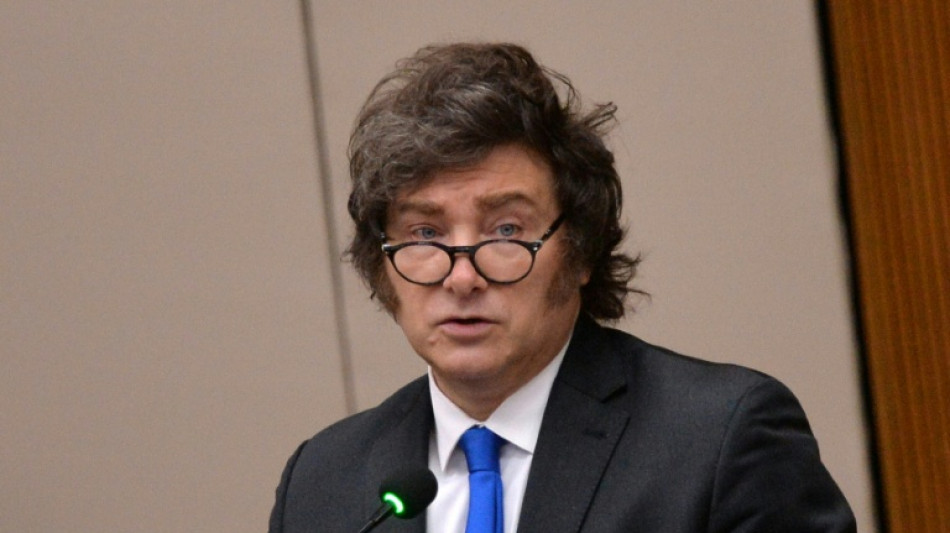
Argentina's Milei says 'political panic' rattling markets / Photo: © AFP

 Freshways milk-price cut deepens pressure on UK dairy farms

 Labour and National remain virtually tied as New Zealand vote count advances

 The Good Daughter adapts Karin Slaughter thriller with Rose Byrne and Meghann Fahy

 Heavy-lift drone evacuates wounded Ukrainian soldier from frontline kill zone

 Morrison says West Brom recovered after pressure from successive derby losses

 Britain considers 2027 state visit for Ukraine’s Zelensky

 Arizona Democrats Secure Historic Trifecta with New Legislative Leadership

 Carney Welcomes U.S. Trade Reversal After Democratic Midterm Victory

 Armenian FM Discusses EU Accountability for Palestinian Rights in Madrid

 Trump and Vance Pursue Secret Diplomacy with Iran Amid Military Pressure

 Classic Car Values Surge: De Tomaso Vallelunga Leads 190% Gain
 Microsoft Ends Oracle AI Computing Rental Deal Amid Cloud Strategy Shift

Argentine President Javier Milei blamed "political panic" for rattling markets Friday in the run-up to crucial midterm elections, sending the peso into a tailspin and hurting the country's sovereign risk.
The Central Bank intervened this week to shore up the peso, which closed at 1,515 pesos to the dollar on Friday, breaking through the upper limit of the trading band set by the government.
In an address to the stock exchange of the central city of Cordoba, the right-wing Milei blamed the left-wing opposition for creating "spiraling political panic in the market and generating enormous disorganization in terms of sovereign risk."
Defending his program of harsh austerity, the libertarian leader accused the opposition of "throwing a spanner in the works" to hurt him politically.
The peso has fallen 4.48 percent in a week amid growing market jitters ahead of the October mid-terms, which could hobble President Javier Milei's reform agenda.
On Thursday night, Economy Minister Luis Caputo promised that the Central Bank would sell "every last dollar" of its reserves to save the peso from collapse.
"We are not going to deviate from the program," he told the Carajo channel.
The run on the peso comes as Milei, a free-marketeer whose election was cheered by investors in 2023, struggles through the worst crisis of his presidency.
His aura of electoral invincibility was shredded on September 7 by his party's rout in Buenos Aires' provincial polls, seen as a test of his support ahead of the October 26 mid-terms.
Milei has hemorrhaged support over a corruption scandal involving his sister and right-hand woman, Karina Milei.
Congress, meanwhile, is putting up increased resistance to his attempts to shrink the state.
The lower house on Wednesday rejected his veto of a law on funding for public universities and the country's biggest pediatric hospital.
Earlier this month, Congress overturned his veto of a law on allowances for people with disabilities.
The political headwinds have caused investors to dump the peso.
The Central Bank intervened on Wednesday to prop up the currency for the first time in five months.
- $432 mn to prop up peso -
In just two days, it sold $432 million in reserves to shore up the currency.
Under a a $20 billion bailout agreed with the International Monetary Fund in April, Argentina cannot sell dollar reserves until the exchange rate reaches the upper limit of the floating band.
In recent weeks, the government has used treasury dollars to stem the peso's depreciation.
The dollar-peso exchange rate is a political hot potato in Argentina, where most people save in greenbacks rather than the long-ailing peso.
Economists warn however that Milei is keeping the peso dangerously overvalued, damaging the competitiveness of Argentina's exports.
M.Betschart--VB