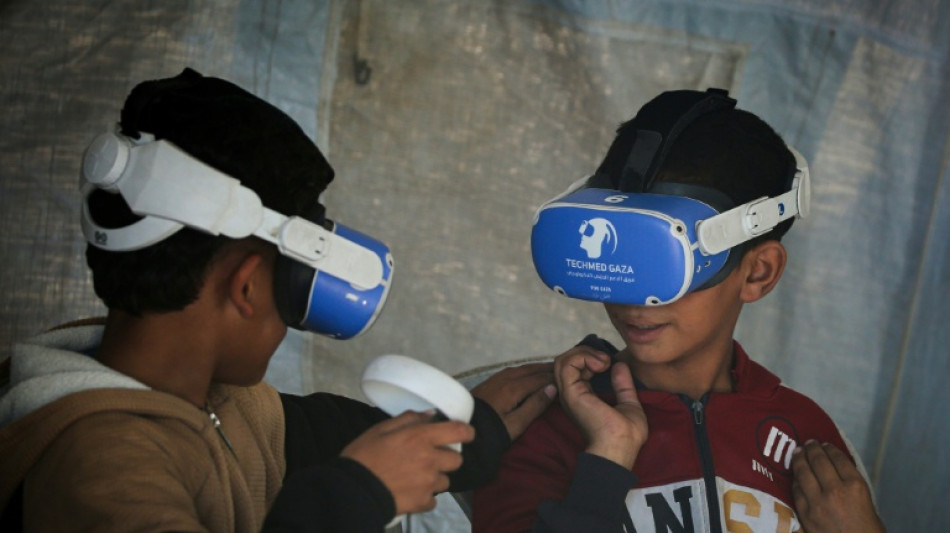
VR headsets take war-scarred children to world away from Gaza / Photo: © AFP

 Afghans search for dozens missing after devastating flood

 Novartis says buoyed by new treatments in second quarter
 Great Barrier Reef at risk of 'collapse', scientists warn

 India's 'Cockroach' movement vows to protest until education minister resigns
 South Korea president urges regulator action on leveraged stock funds
 For Ukraine's drones, names are part of the battle
 Countries move to ban social media for children

 Asia stocks up as chip stocks recover, oil eases
 Desperate Rohingya risk deadly voyages as trafficking surges

 French lawmakers expected to approve social media ban for under-15s

 'All these rashes': chickenpox surges in Gaza camps

 Australia's Cummins, Hazlewood, Lyon back for Bangladesh Test series
 Rubio in Philippines as US condemns 'dangerous' China actions

 Unnatural physique turns Evenepoel into a Tour de France contender

 'Sit down!' Australian politician berates dog on live TV

 Argentina squad returns, without Messi, after World Cup final loss
 New strikes as Trump warns Iran will pay for US troop deaths
 Spain stars lap up adulation of estimated two million on World Cup parade

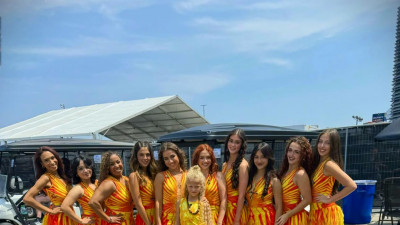 Business of Dance Mentees and Enola Bedard Join Shakira for the FIFA World Cup Halftime Show
 "The pain is immense," says Messi of World Cup defeat

 US judge suspends Paramount's acquisition of Warner Bros.
 Chess legend Judit Polgar rejects becoming Hungary's president
 Ceferin skipped World Cup final reportedly to show disapproval of FIFA
 Judge approved night-time Tour de France doping tests

 Chile declares state of emergency over deadly rainfall
Children scarred by the war in Gaza are undergoing a therapy programme using virtual reality headsets that transport the youngsters to a world far away from the destruction around them.
The VR therapy is aimed at improving the children's psychological wellbeing, with operators saying it can achieve results more quickly than traditional therapy sessions.
Inside a white tent pitched on a sandy patch of ground in Al-Zawayda, in central Gaza, excited chatter swelled as five boys roamed around a virtual world.
The youngsters, one in a wheelchair and the others on plastic seats, turned their heads, exploring the new surroundings inside their goggles: a land of green gardens, tranquil beaches and safe cities.
One boy reached out and clapped his hands together, as if swatting a fly. Another, smiling, with his hand held up in front of his face, reached out to touch the scenery.
One said a dog was running towards him, and beckoned to it, calling out: "Come! Come!"
"I see birds," the boy in the wheelchair told an operator, looking around.
One of the operators delicately put the blue TechMed Gaza headset on 15-year-old Salah Abu Rukab, who sustained a head injury during the war, asking if he could see the VR properly as he adjusted the buckles.
"We feel comfortable in it, we enjoy it, and through it we enter a garden, we enter spaces with animals and similar experiences," the teenager told AFP.
Asked by the operator what he saw, he replied: "It's all trees. Nothing but trees, grass and flowers."
- 'Positive results' -
Mental health supervisor Abdalla Abu Shamale explained there was more to the VR headsets than simply escape.
"Through programmers, we are able to design games with therapeutic, preventive and developmental goals that help prepare the child or enable them to cope and manage their life more effectively," he told AFP.
"This method has proven its effectiveness over a full year of working with many children, including war-amputee children, injured children and those exposed to extremely traumatic events."
A fragile ceasefire in the war between Israel and the Palestinian militant group Hamas has held since October 10.
The World Health Organization says conflict-related injuries carry a mental health toll, and survivors struggle with trauma, loss and daily survival, while psychosocial services remain scarce in Gaza.
Jonathan Crickx, spokesman for the UN children's agency UNICEF, told AFP that around one million children, or in other words, "all children in the Gaza Strip, are in need of mental health and psychosocial support after two years of horrendous war".
The VR sessions rely on programmes specifically designed for traumatised children, taking into account their physical and psychological condition, and help them rebuild positive perceptions of the world.
Abu Shamale said the children were "treated and accompanied through VR sessions, and when we integrated them into these techniques, they showed a very, very strong response and extremely positive results.
"The speed of treatment, recovery and reaching stability using VR techniques was faster than in regular sessions. In regular sessions without VR, we usually need about 10 to 12 sessions, while with VR we can achieve results in just five to seven sessions," he said.
P.Vogel--VB