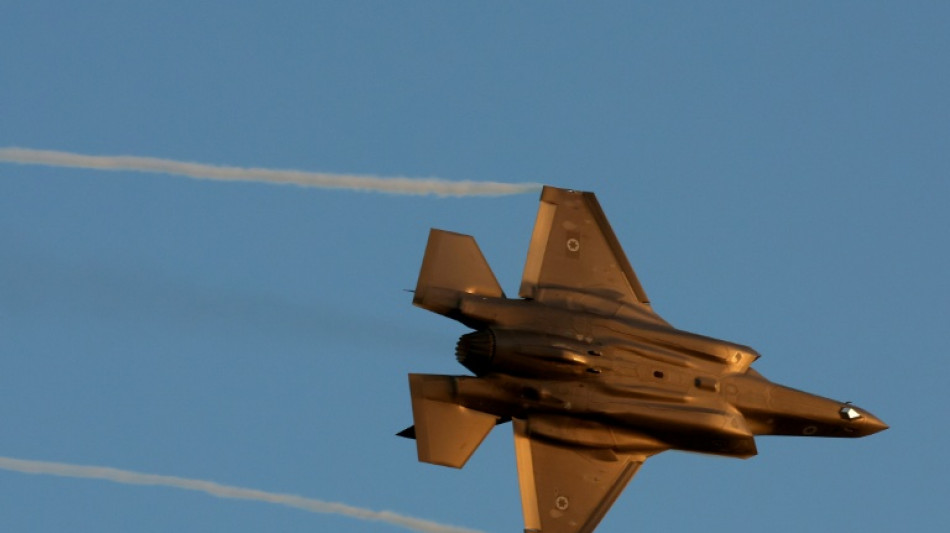
Elite pilots and US support drive Israel's air power / Photo: © AFP

 Israel strikes south Lebanon despite truce announced with Hezbollah

 Hurricanes blow away Chiefs in record-breaking Super Rugby final

 Ancient Greek theatre revives legendary Callas opera Medea

 Portugal's unofficial exorcism fever worries Church

 Ancelotti hails 'complete game' as Brazil sink Haiti at World Cup

 Scotland remain bullish despite Morocco World Cup setback

 Brazil cruise past Haiti to re-ignite World Cup campaign

 Scheffler career Slam chances blowing in Shinnecock winds

 McIlroy seven back but likes his chances at US Open

 Clark leads US Open by four with major champs in the hunt

 Archaeologists discover 'never before seen' pre-Hispanic ruins in Mexico

 James Burrows, prolific innovator in US TV comedies, dead at 85

 World Cup warning with Sweden star Isak 'getting stronger and stronger'

 Tunisia coach says 'I am no wizard' after World Cup SOS call

 USA beat Australia 2-0 to reach World Cup knockouts

 Qatar-gifted Air Force One replacement unveiled

 Niemann fires 65 at US Open after upsetting two-shot penalty

 Spain's Yamal says 'too soon' to play full match at World Cup

 Neymar? He is working remotely at the World Cup, jokes Lula

 Three-time Stanley Cup champion Toews retires

 Japan wary of fired up and wounded Tunisia for World Cup landmark game

 'Like a fridge': France cave homes offer lucky few respite from heat
 Hormuz ship traffic climbs after war deal: trackers

 Kane hails World Cup 'Wonderwall' singalong as England highlight
 Sabalenka roars back to make Berlin WTA semis

Israel’s air force has struck deep inside Iran with devastating precision, killing even the country’s supreme leader within minutes of the war’s outbreak -- a feat experts say reflects years of elite pilot training and combat experience.
"These pilots are the most trained in the world," Sarah-Masha Fainberg, a senior researcher on air and space military power at Tel Aviv University, told AFP.
"If you look at the operational experience and the number of training hours of pilots in the world, I think Israel is number one with the United States and this is reflected in the success of this operation."
Israel's air force, which operates around 320 fighter jets, has bombed targets across Iranian territory with near impunity.
The current campaign builds on years of combat operations in Gaza, Lebanon and even as far as Yemen since the war with Hamas erupted in October 2023.
In Iran, these capabilities were playing out to unprecedented effect.
On Saturday, the first day of the campaign against Iran, lightning strikes by Israeli jets -- said to be guided by US intelligence and targeting -- hit the compound of Iranian supreme leader Ayatollah Ali Khamenei, killing him and several other top officials.
"In just 40 seconds, approximately 40 senior officials of the Iranian terror regime were eliminated, including the regime's leader, Ali Khamenei," Israel's military chief Lieutenant General Eyal Zamir said on Thursday.
"To date, air force pilots have executed 2,500 strikes with over 6,000 munitions... within 24 hours, our pilots opened the path to Tehran," he added.
Fainberg said Israel's air superiority over Iran reflects "20 years of conceptual and operational preparation".
Because of its small territory, Israel built its national security around a doctrine of "offensive defence", relying on pre-emptive, long-range strikes against enemy targets, she said.
The doctrine aims not merely at air superiority but at air supremacy -- the difference between having an advantage in the air versus total dominance of an airspace.
- 'The best become pilots' -
Military historian Danny Orbach traced this to decisions made as early as the 1960s.
With a small population and surrounded by hostile neighbours, Israel concluded it could not match its enemies in numbers of soldiers or tanks.
Israel "decided to invest a disproportionate amount of resources in its air force," said the senior lecturer at Jerusalem's Hebrew University, often at the expense of other areas.
"You need an asymmetric capability," Orbach said. "And the decision was made to invest in the air force."
The strategy was reinforced by billions of dollars in US military aid and access to some of Washington’s most advanced technologies.
The Hebrew slogan "Hatovim la-tays" -- "the best become pilots" -- emerged in the 1960s to encourage top recruits to join the air force.
Israel's airpower advantage was also due to its military culture, Orbach said.
A heavily invested-in air force requires "mission command", in which junior officers are empowered to make quick, independent decisions to accomplish their objectives -- a freedom often unavailable to pilots in other more hierarchical Middle Eastern militaries, Orbach added.
- Close operations with US -
Another pillar of Israel's success in this war, Fainberg said, was the operational integration with the United States.
"This is a war conducted in English," she said, adding that the current joint US‑Israeli operation against Iran was an air campaign with a clear "partition of labour".
For the first time, Israel was also benefiting from US in-air refuelling, a capability that, Fainberg said, explained how Israel had been able to launch 6,000 munitions over such a long distance, according to Israeli military figures published on Thursday.
The campaign also draws on years of intelligence gathering and covert operations to identify targets, said Shlomo Mofaz, director of the Meir Amit Intelligence and Terrorism Information Center.
- Weakened Iran defences -
A decline of Iranian capabilities has further aided Israel's dominance in the current campaign.
The Islamic republic has for decades had a weak air force, while confrontations with Israel in April and October 2024 and June 2025 degraded its limited air defences.
Russia and China, two of Tehran's major allies which supplied many of Iran's air defence systems, "have abandoned them", Fainberg added, leaving Iran unable to replenish systems damaged in the fighting.
Moreover, Iranian air defences have been hobbled by Israeli cyber, intelligence and jamming capabilities -- sophisticated tools developed through close collaboration between Israel's tech sector and its military, Orbach said.
Iran still retains substantial missile and drone stockpiles, but its ability to contest the skies has effectively collapsed, Fainberg said, adding the "operational success" so far achieved by Israel is "beyond everything that we could have hoped for".
S.Spengler--VB