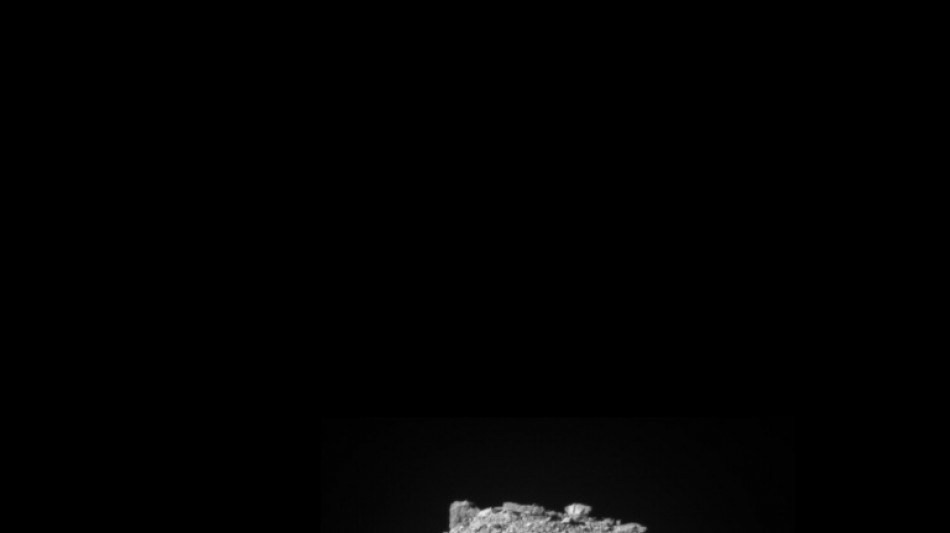
NASA defense test kicked asteroid off course -- and changed its orbit around the sun / Photo: © NASA/Jons Hopkins APL/AFP

 Argentina represented themselves in 'best possible way' at World Cup: Fernandez

 Philippines, China summon ambassadors over clash in disputed waters

 'White elephant': Colombia's anti-corruption activist turned senator

 Stock markets, oil prices climb

 South Africa's anti-migrant unrest sparks smalltown suspicion, fear

 Tour de France hit by new wave of anti-doping tests
 Afghans search for dozens missing after devastating flood

 Novartis says buoyed by new treatments in second quarter

 Great Barrier Reef at risk of 'collapse', scientists warn

 India's 'Cockroach' movement vows to protest until education minister resigns

 South Korea president urges regulator action on leveraged stock funds

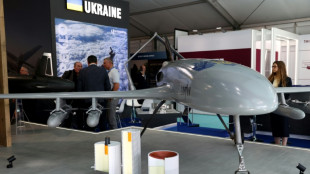 For Ukraine's drones, names are part of the battle

 Countries move to ban social media for children

 Asia stocks up as chip stocks recover, oil eases

 Desperate Rohingya risk deadly voyages as trafficking surges

 French lawmakers expected to approve social media ban for under-15s

 'All these rashes': chickenpox surges in Gaza camps

 Australia's Cummins, Hazlewood, Lyon back for Bangladesh Test series

 Rubio in Philippines as US condemns 'dangerous' China actions

 Unnatural physique turns Evenepoel into a Tour de France contender

 'Sit down!' Australian politician berates dog on live TV

 Argentina squad returns, without Messi, after World Cup final loss

 New strikes as Trump warns Iran will pay for US troop deaths
 Spain stars lap up adulation of estimated two million on World Cup parade

 Business of Dance Mentees and Enola Bedard Join Shakira for the FIFA World Cup Halftime Show

Four years ago, NASA purposely smashed a spacecraft into a small asteroid to see if they could deflect it -- a test to prove humanity could protect Earth from threatening space rocks.
The experiment pushed the moonlet asteroid Dimorphos into a smaller, faster route around its sibling Didymos -- and according to new research out Friday, it also pushed the pair into a slightly different orbit around the Sun.
The test on Dimorphos was never based on any actual threat to our planet.
But the successful experiment and additional analysis offers a solid data point to mount a defense if any such eventual threat is detected, researchers said.
"This study marks a notable step forward in our ability to prevent future asteroid impacts on Earth," the team of international researchers wrote in their new paper published in the journal Science Advances.
Their observations detailed in the paper showed that the Double Asteroid Redirection Test (DART) in 2022 marked "the first time a human-made object has measurably altered the path of a celestial body around the Sun," NASA said in a statement.
Rahil Makadia, the study's lead author, told AFP his team tracked stellar occultations -- the moment when an asteroid passes in front of a star, causing a brief dimming for less than a second -- to obtain hyper-precise measurements of the asteroid's position, speed and shape.
- Tiny change, significant deflection -
Obtaining this data is no small feat. The team relied on volunteer astronomers from around the globe, who recorded 22 of these stellar occultations.
Using that data along with years of additional observations, Makadia said the team was able to measure Didymos's orbit around the sun with precision.
"We were able to measure what this change was exactly," he said, and make computations that could assist with future "planetary defense efforts."
The orbital change was miniscule -- just 0.15 seconds.
But it's enough to make a difference, scientists say.
"This is a tiny change to the orbit, but given enough time, even a tiny change can grow to a significant deflection," said Thomas Statler, lead scientist for solar system small bodies at NASA Headquarters in Washington, in a statement.
"The team's amazingly precise measurement again validates kinetic impact as a technique for defending Earth against asteroid hazards and shows how a binary asteroid might be deflected by impacting just one member of the pair."
K.Sutter--VB