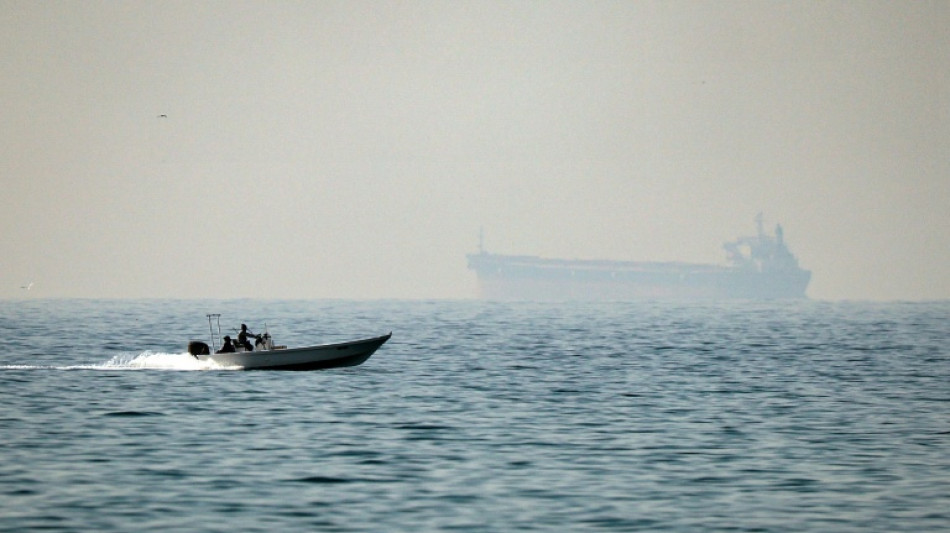
Securing shipping lane from Mideast war 'challenging', say experts / Photo: © AFP

 Antonelli 'mad' about crash in Azerbaijan qualifying

 'Perfect lap' gives Russell pole for Azerbaijan GP as Antonelli crashes out

 UN Security Council condemns Houthi attacks on Saudi Arabia

 China swimmer makes Asian Games history as Thai wins 100m sprint

 Top French literary prize drops best-selling novel over AI claims

 US 'must choose' whether to end war: Iran president

 Pope warns against losing humanity in AI-driven 'paradise of machines'

 Pope warns against losing humanity in 'paradise of machines'

 From FBI warning to literary acclaim: the Russian journalist who took on Putin

 China swimmer in Asian Games first as North Korea lifters reign

 French literary prize removes novel from longlist after AI claims

 China's Zhang wins record seventh Asian Games swimming gold

 Verstappen edges Russell in final practice in Azerbaijan

 English, Spanish, Italian, German football leagues call for FIFA reform

 Pope arrives in France on first official visit in 18 years

 Pope arrives in France on first state visit in 18 years

 Heavy fighting, internet disruption as Ethiopia conflict rages

 From transit to consumption: drug use surges in Mozambique
 Chicago teams, Guardians and Padres all book MLB playoff berths

 Bijan Robinson destroys Packers in 35-14 win for Falcons

 Harimoto hails new era as Japan dethrone table tennis kings China

 India rape cases turn focus back onto women's safety

 Rebellious Afghan taxi drivers defy ban on music

 Brazil candidates mount digital armies for fierce online campaign

 Nepal PM says floods 'a warning to the world' about climate change

The United States and France have promised to secure oil shipping threatened by the Middle East war, but experts warn warship availability and Iran's wide range of weaponry could make this complicated.
US-Israeli attacks on Iran since Saturday and Iran's fiery response have caused global economic turmoil as shipping avoids the Strait of Hormuz near Iran, one of the world's most vital shipping lanes.
Around a fifth of the world's crude and liquefied natural gas from the Gulf, must pass through this chokepoint.
While Iran has not officially shut off the Strait of Hormuz, shipping through the waterway has all but dried up.
President Donald Trump said Tuesday the US Navy was ready to escort oil tankers through the crucial Gulf shipping route to ensure the "FREE FLOW of ENERGY to the WORLD".
France's President Emmanuel Macron said earlier the same day France was building a coalition "to pool the necessary resources, including military ones, so that traffic can be restored and secured" in the Strait of Hormuz, Suez Canal and Red Sea.
But, said analyst Dirk Siebels from consultancy firm Risk Intelligence, "the practical realities of this potential operation would be very challenging".
- 'Military assets are busy' -
Kais Makhlouf, also from Risk Intelligence, signalled one major obstacle.
"Military assets are busy right now doing military stuff", limiting the number that might be free to escort oil and LNG tankers, he said.
US-Israeli air strikes have pounded Iran, while a US submarine this week torpedoed an Iranian warship off the coast of Sri Lanka, killing at least 86 crew members.
A European military source, speaking on condition of anonymity, said Iran still posed a threat to shipping.
It could deploy missiles, air or underwater drones, or midget submarines, or even scatter floating or magnetic mines, which are detonated by the proximity of a ship.
Western nations seeking to secure the route for maritime traffic could consider frigate patrols or escorts for a particular ship -- possibly with extra air cover.
"But if the strait was mined, this would require minehunters preceding convoys, or establishing safe corridors before commercial vessels could transit," they said.
Excluding any possible mining, the scenario would be similar to that in the Red Sea, where US and European navies have been protecting ships from attacks by the Iran-backed Yemeni rebels.
- A European alliance? -
Several sources said that any coalition in the Hormuz Strait could look like the EU operation that has since February 2024 been working with the Yemeni navy in the Red Sea.
French Foreign Minister Jean-Noel Barrot said that the idea was to secure the Hormuz Strait in that "same spirit" at the European Union's Operation ASPIDES naval task force.
Wary of getting directly involved in the US-Israeli war with Iran, European countries are nevertheless being drawn in following attacks on Cyprus and Western allies in the Gulf.
France, Greece and Italy have said they are sending war ships to the eastern Mediterranean, where the Suez Canal provides passage to the Red Sea and beyond to the Gulf.
A French diplomatic source, wishing to remain anonymous, said talks were ongoing to reinforce the EU ASPIDES operation.
"As for Hormuz, we need to see how things develop," the source added.
"The gradual build-up of the European naval presence in the eastern Mediterranean will eventually prove useful if and when conditions are met to move into the Strait of Hormuz," they said.
Alessio Patalano, a professor at King's College London, said working together was key.
For the Europeans, "it is essential to act as a coalition, because very few European navies have the capabilities required to confront these threats like the British, French or Italian," he said.
A.Kunz--VB