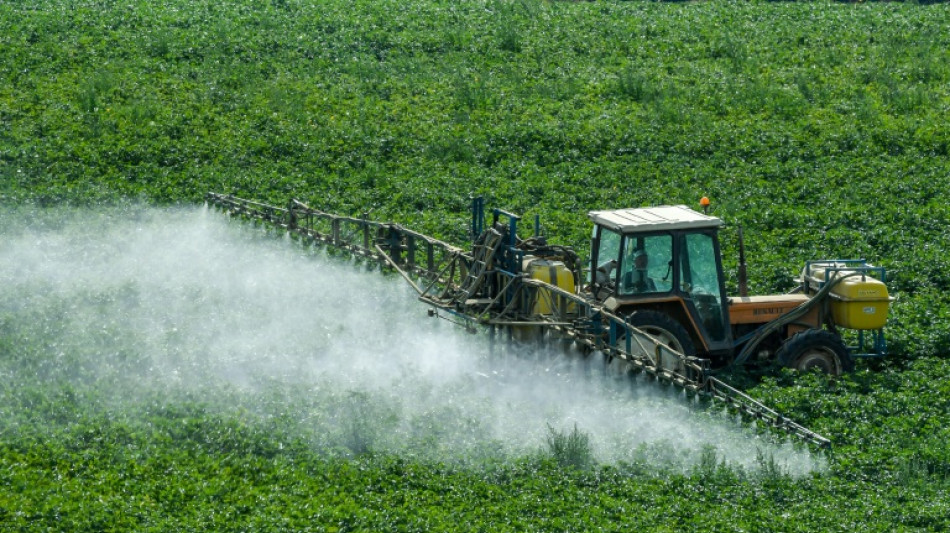
New research shows unintended harms of organic farming / Photo: © AFP/File

 European stocks retreat as France violence spreads

 North Korea warns 'grave situation' prevailing along border

 Raya proud of Arsenal's 'incredible' reaction after third straight win

 Indonesia fires have burned nearly two million hectares: monitor

 Australian lawmaker 'critically' hurt in attack, officials say

 Indonesia fires burned over 1.9 mn hectares through September: monitor

 Asian tech stocks mixed after Wall St losses, eyes on earnings

 China's third-quarter growth narrowly beats forecasts

 Asian stocks start week on back foot, tracking tech-led Wall St losses

 China growth narrowly beats forecasts

 Faith and fury: Texas Senate rivals offer contrasting visions

 Women await justice for police killings in Brazil

 The painstaking task of cataloguing the world's species

 Nations seek reset at UN talks as nature goals off track

 Rubio seeks to strengthen US foothold in Central Asia

 LeBron joins 76ers to chase one more NBA title at age 41

 Rays one win from World Series return after downing Guardians

 Kings' Ben Simmons tears Achilles in training

 Lula, Bolsonaro set for first debate showdown in bitter election race

 Mbappe hits two as Real Madrid rout Sevilla

 Browns edge Ravens for division lead, Texans beat Jags

 Lyon go top of Ligue 1 as Monaco fall to first defeat of the season

 Venezuela opposition alliance reaffirms Nobel laureate Machado as leader

 'Street Fighter' wins N. America box office, buzzy doc stuns in 2nd

 NFL: Paris game to go ahead despite protests in France

Organic farming is often touted as a more sustainable solution for food production, leveraging natural forms of pest control to promote eco-friendly cultivation.
But a new study published in Science on Thursday finds that expanding organic cropland can lead to increased pesticide use in surrounding non-organic fields, offsetting some environmental benefits.
These harmful "spillover effects" can be mitigated if organic farms are clustered together and geographically separated from conventional farms, the researchers found.
"Despite policy pushes to increase the amount of organic agriculture, there remain key knowledge gaps regarding how organic agriculture impacts the environment," said lead author Ashley Larsen, of the University of California, Santa Barbara.
Although organic agricultural practices generally improve environmental conditions such as soil and water quality, the trade-offs aren't very well understood.
For example, organic fields could harbor more beneficial species that prey on insects, such birds, spiders and predatory beetles and fewer pests. Or, the lack of chemical pesticides and genetically modified seeds could mean they harbor more pests.
To find out, Larsen and colleagues analyzed data on some 14,000 fields in Kern County, California, across seven years.
Kern County produces high-value crops including grapes, watermelons, citrus, tomatoes, potatoes and much more, making it one of the most valuable crop producing regions in the United States.
The team paired digitized maps of fields and the crops grown on them with records of pesticide applications and whether a field had an organic certification.
"Surrounding organic agriculture leads to an increase in pesticide use on conventional fields, but also leads to a larger decrease on nearby organic fields," said Larsen, with the effect manifesting primarily in insecticides, which specifically target insects.
The level of pesticides in conventional fields decreased the further away they were from organic fields.
But the situation could be completely remedied if organic fields were grouped together, the researchers found, based on a less-detailed national level analysis they also carried out.
"Spatially clustering organic fields and spatially separating organic and conventional fields could reduce the environmental footprint of both organic and conventional cropland," the team concluded.
Writing in a related commentary, Erik Lichtenberg of the University of Maryland said that the authors had shown farmers' decisions about pesticide are influenced by the presence of nearby organic fields -- but it's not fully clear why.
The value of the crops, their susceptibility to pests, and farmers' personal risk tolerances likely all play roles.
"Which mobile pests are involved, where they originate in the landscape, or how and why they move across the landscape are poorly understood," said Lichtenberg, calling for more research in this area.
D.Schlegel--VB