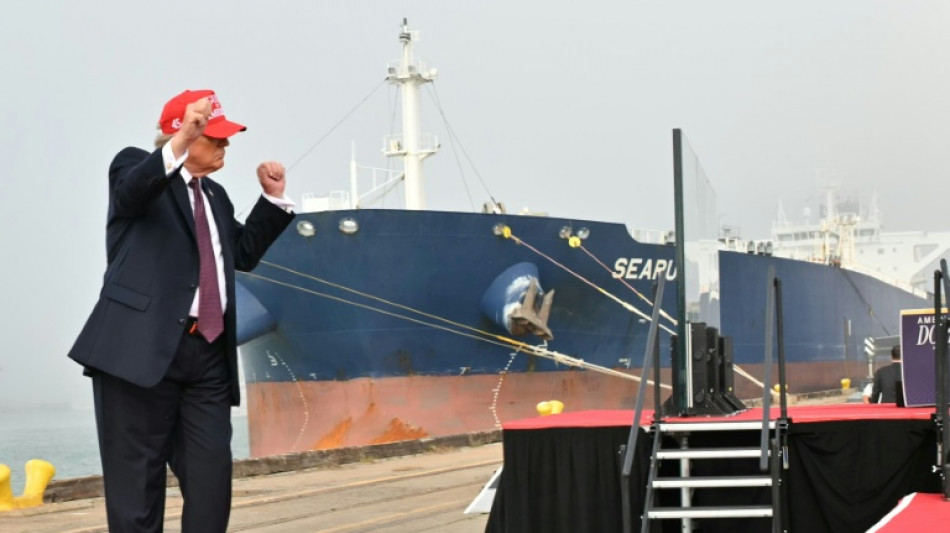
Trump's limited options to curb Iran war oil price surge / Photo: © AFP

 Williams boss hails Chadwick as F1 inspiration for women
 World No.1 Sinner delays return with China Open withdrawal

 South Lebanon children return to school destroyed by Israel strike

 Jewish group urges Berlin far-left vote winners to tackle antisemitism

 European stock markets climb as oil prices drop

 Trump accuser E. Jean Carroll finally has her damages

 Germany's Havertz, Musiala ruled out of Greece match with injury
 Ireland's Gaza stance spills from Eurovision into football
 Welcome aboard the Costa Serena, the Asian Games floating hotel

 Asian markets mixed after recent oil surge

 Cash for nature protection: hotelier's offer to Principe islanders

 US miner KoBold bets on AI to gain edge in DR Congo mineral hunt

 Internet disrupted in Ethiopia as conflict rages

 Asian markets mixed after oil gains

 'Genius' Ohashi bids for third Asian Games gold after world record

 India's 'Tree Father' plants for a greener future
 Hopping mad: New health warning stirs up Belgian brewers
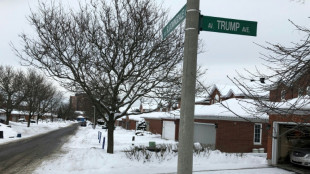 Canadian capital to rename 'Trump Ave'
 Pope heads to France on first state visit in 18 years
 Bacteria suspected in deaths of hundreds of baby whales off Argentina

 US 'must choose' whether to end war: Iran president to Fox News

 UN approves resolution on dealing with rising sea levels

 Yalcouye makes dream debut as Ivory Coast beat Ghana in AFCON qualifier

 Chicago's White Sox and Cubs book MLB playoff berths

 Last-gasp Gakpo strike snatches Dutch draw to sour Klopp debut

US President Donald Trump is under pressure to curb oil prices sent skyrocketing by the war with Iran, but has only limited tools to fix a problem that is shaking the world economy and is politically toxic at home.
Trump has insisted it will be only a "short-term" issue that will end when the war ends, yet soaring gas prices are already hitting voters ahead of US midterm elections later this year in which the economy will be crucial.
"The White House is in constant coordination with the relevant agencies on this important issue, as it is a top priority to the president," White House spokeswoman Taylor Rogers said in a statement to AFP.
"President Trump and his entire energy team have had a strong game plan to keep the energy markets stable well before 'Operation Epic Fury' began, and they will continue to review all credible options."
- Strait of Hormuz -
The key driver of the spike in oil prices is the virtual halt in sea traffic through the Strait of Hormuz -- a key Gulf waterway through which a fifth of global crude passes -- since the war broke out on February 28.
Trump said last week that the US Navy was ready to escort tankers through the strait "if necessary" and ordered the United States to provide insurance for commercial shipping.
There has however been no sign yet of such US escorts.
And while French President Emmanuel Macron said Monday that France and its allies are already preparing a "defensive" mission to reopen the strait, he added that it would only happen "after the end of the hottest phase of the conflict."
- Strategic reserves -
One major option under consideration around the world is tapping into strategic oil reserves -- but it is one Trump played down at the weekend.
"We've got a lot of oil, our country has a tremendous amount," Trump told reporters aboard Air Force One on Saturday. "That'll get healed very quickly."
Trump has somewhat replenished the US Strategic Petroleum Reserve, which now has 415 million barrels, enough to fill up more than 600 million cars once the oil is refined.
The US government has made four major oil withdrawals in recent history: at the end of the first Gulf War, after Hurricane Katrina, after the Libyan revolution, and during Joe Biden's presidency.
But it could have a limited effect.
"A release of the SPR can help mitigate some of the supply disruption, but it's clearly not enough to overcome the loss of 20 million barrels a day of oil through the Strait of Hormuz," Andy Lipow of Lipow Oil Associates told AFP.
The G7 group of industrialized nations meanwhile is "not there yet" in terms of any release of strategic oil reserves, France's finance minister said Monday.
- Sanctions relaxation -
The United States last week said it was considering lifting sanctions on more Russian oil, a day after temporarily allowing India to buy from Moscow -- a move that could ultimately fund Russia's war on Ukraine.
Trump on Saturday said he would be prepared to take similar measures in the future "just to take a little of the pressure off, the oil pressure."
But all of the above options risk having a limited effect.
"It seems as though the Trump administration may not have fully appreciated the cause and effect related to the initiation of this war in this region that's so vital for the global economy," Clayton Seigle, senior fellow at the Center for Strategic and International Studies, told AFP.
- Venezuela Option -
In the longer-term, speculation has swirled about whether Trump will seek to take control of Iran's oil, as the United States did after the military operation that toppled Venezuelan leader Nicolas Maduro in January.
The US president has boasted that 80 million barrels of Venezuelan crude has been shipped to the United States under a deal with the new leadership in Caracas.
But Trump says it's too early to talk about, with the war still raging and Iran's clerical establishment just picking Ayatollah Mojtaba Khamenei to replace his slain father as supreme leader.
"You look at Venezuela," Trump told NBC News on Monday. "People have thought about it, but it's too soon to talk about that."
D.Schaer--VB