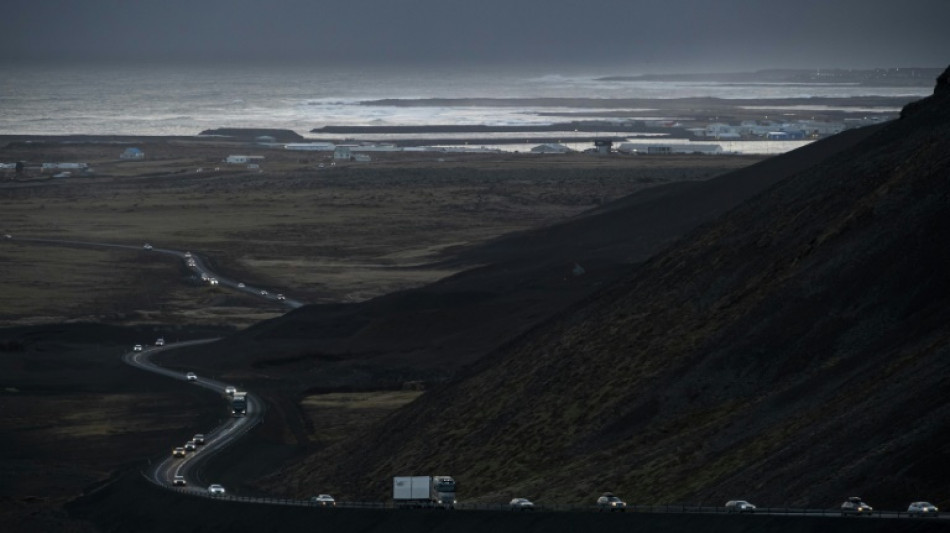
How much damage could possible Iceland volcano eruption cause? / Photo: © AFP

 India protest leaders to meet govt after Modi vows action

 Fear, arrests keep Cambodians quiet decade after critic's murder

 Over 80% of Mexican exports exempt from new US tariffs

 Is 'superstar' Pogacar's Tour de France domination boring?

 Iran ramps up executions under shadow of war

 Rosalia's Argentine fans up in arms over alleged World Cup snub

 Six candidates to lead UN take stage for televised debate

 King Charles opens slimmed down Commonwealth Games in Glasgow

 US unveils new tariffs on 60 partners as Trump rebuilds trade agenda

 WNBA viral star Cunningham wades into trans athletes row

 Hearn dismisses Fury talk of Joshua no-show for super fight

 'Like a war zone': France evacuates 20,000 due to wildfires
 Ships avoid Ukrainian grain ports after Russian attacks

 Oil passes $100 a barrel again: why it's more serious this time

 Who are the six candidates vying to lead the UN?
 Hamilton proud of recovery after hitting rock bottom a year ago
 Carapaz eyes polkadot mountains jersey after stage win
 Fields medal awarded to four young mathematicians
 Carapaz claims Tour de France stage as Pogacar loses key team-mate
 Alonso welcomes Aston Martin upgrade, warns against unreal expectations

 Anderson declares Man City 'kings of Manchester' after £116 mn move

 Relieved Russell says Mercedes have solved his power problems mystery

 Oil soars above $100 as Middle East fears grow

 Venezuelans turn to scrap collecting in quake-hit beach 'paradise'

 Heptathlon champion Johnson-Thompson joins list of Commonwealth Games absentees

A town has been evacuated in southwestern Iceland after hundreds of earthquakes caused by shifting underground magma sparked fears of a full-blown volcanic eruption.
While experts fear the town could be badly damaged by a potential eruption, they do not expect a repeat of the global travel chaos caused by ash from the Eyjafjallajokull volcano in 2010.
Here are a few key questions answered:
- What and where? -
The hundreds of earthquakes have been caused by a massive build-up of magma in a 15-kilometre (nine-mile) fissure between two to five kilometres underground.
The fissure is around 3.5 kilometres northwest of Grindavik, a town of 4,000 people on the Reykjanes peninsula. The town has been evacuated as a precaution.
On Wednesday, residents told AFP the seismic activity had damaged roads and buildings.
Previous eruptions near the Fagradalsfjall volcano on Reykjanes peninsula took place in 2021, 2022 and earlier this year, though in less populated areas.
Situated in the North Atlantic, Iceland straddles the Mid-Atlantic Ridge, a crack in the ocean floor separating the Eurasian and North American tectonic plates.
- How likely is an eruption? -
The Icelandic Met Office said on Wednesday that the "probability of an eruption is still considered high".
Vidir Reynisson, head of Iceland's Civil Protection and Emergency Management agency, told AFP on the weekend that "anywhere on that fissure we can see that an eruption could happen".
John Smellie, a volcanologist at the UK's Leicester University, said guessing when the eruption might take place was like guessing "how long is a piece of string".
Smellie told AFP it could be days or weeks -- or "despite all evidence, it might just subside and go away".
- How bad could it be? -
Reynisson said Icelandic experts were "really concerned about all the houses and the infrastructure in the area".
Smellie said any eruption would most likely be similar to the one on the peninsula earlier this year, which created lava fountains and flows that mostly just attracted tourists.
If a new eruption occurs near Grindavik, it could cause significant damage to homes and infrastructure, he added.
However lava flows "relatively slowly, and people can generally at least drive away or run away from it," he said, meaning that deaths were unlikely.
Another possible threat is toxic gas released during an eruption. A 1783 eruption at Iceland's Laki volcanic fissure killed enough livestock to cause widespread famine.
However Phil Collins, a geologist at Brunel University London, said that "it doesn't look like a Laki-scale disaster is likely".
One way the eruption could be more violent is if it blows through ice or water.
If the eruption occurs in the southern tip of the fissure, which is underwater, it could cause ash clouds that would affect flights at Iceland's international airport.
- Different to Eyjafjallajokull?
But any eruption is not expected to have anywhere near as much impact as the one from the Eyjafjallajokull volcano in 2010.
That eruption shot huge amounts of ash into the atmosphere, forcing the cancellation of some 100,000 flights and leaving more than 10 million travellers stranded.
It exploded through 200 metres of ice, making it "highly violent", Smellie said. The interaction with the water created more fine ash particles that would then drift across Europe.
The latest eruption threat is "completely different situation" Smellie said.
P.Vogel--VB