Nobel physics laureate says Trump cuts will 'cripple' US research / Photo: © AFP

 Google-parent Alphabet beats expectations, cloud revenue nearly doubles
 US announces civilian nuclear deal with Saudi Arabia
 Tesla shares dip after profit misses expectations
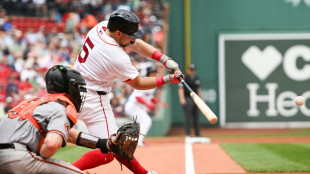 Red Sox tie club record with 15th straight MLB win
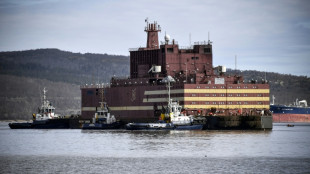 US eyes offshore nuclear reactors

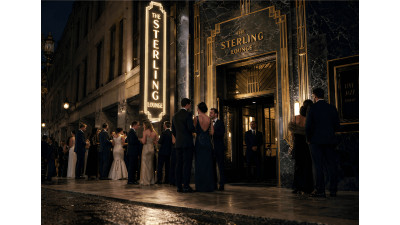 The Sterling Announces Luxury Cocktail Lounge Concept and Investor Showcase in Orlando
 Inter Miami signs Brazil veteran Casemiro but MLS probes deal
 White House accuses China's Moonshot of stealing Anthropic AI

 Pogacar sweating on Yates's fitness ahead of Tour Queen stage

 Ukrainian soldiers and civilians welcome new army commander
 UK fintech Revolut valuation soars to $115 bn: source
 German FM, on Africa tour, eyes business ties amid US, China pressure
 Rubio says at ASEAN meeting he expects 'positive' US visit by China's Xi
 Philipsen wins Tour de France 17th stage
 DonnaPro Introduces AI-Trained Executive Assistants for European CEOs
 Happy birthday, George! UK prince becomes a teenager
 Oil prices jump on Mideast war, stock markets diverge
 US hits Iranian island, says war cost at $37.5 bn

 Metal mining's carbon footprint far larger than thought: study

 TokenInsight Q2 2026 Report: TradFi Momentum Lifts MEXC to No. 2 in Commodity Perpetuals

 Leonardo chief sees potential for Germany to join GCAP fighter jet project
 Louvre heist gallery reopens to public, but with nothing to steal
 Ukraine's new army chief: who is Mykhailo Drapaty?
 India student protests keep up pressure on Modi government
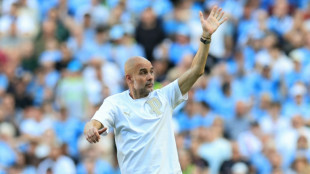 Italian FA chief says in touch with Guardiola over coaching vacancy
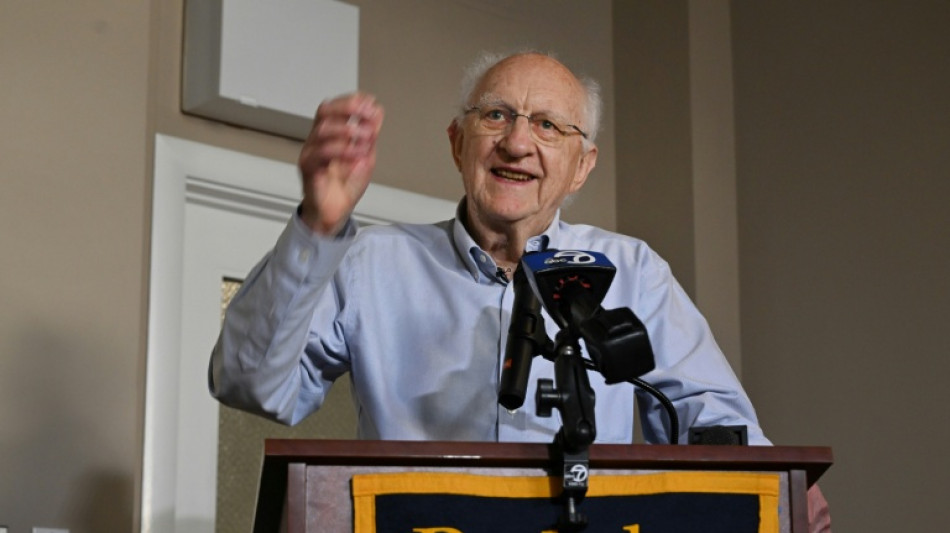
It was just past 2:00 am when a mysterious number rang Nobel laureate John Clarke, what he deemed "obviously a joke call" that grew increasingly surreal when he heard "a voice from Sweden."
"It soon became clear that it was real," Clarke told journalists Tuesday after he and two colleagues had won the Nobel Prize in physics for their door-opening work in quantum mechanics.
"I was just sitting there feeling completely stunned," Clarke said. "It had never occurred to me in my entire life that anything like this would ever happen."
The University of California, Berkeley professor said his phone kept ringing, emails began pouring in, and people started "banging on my door" seeking interviews at 3:00 am (1000 GMT).
"I said no thank you, not at this time of night," the British 83-year-old said with a chuckle.
Clarke shared the coveted prize with two fellow physicists who worked in his Berkeley lab at the time of the trio's research, Frenchman Michel Devoret and American John Martinis. All three scientists are researchers at American universities.
The physicist noted the significant resources he was afforded at the time of their work some four decades ago, including lab space, graduate assistants and equipment.
And he called US President Donald Trump's efforts to reshape American science and health policy -- including mass firings to government scientists and steep slashes to research budgets -- an "immensely serious problem."
"This will cripple much of United States science research," he told AFP, adding that he knew people who have taken enormous funding hits.
"It is going to be disastrous if this continues," Clarke said. "Assuming that the present administration finally comes to an end, it may take a decade to get back to where we were, say, half a year ago."
"It's a huge problem" that's "entirely beyond any understanding of anyone who is a scientist," he said.
- 'Basic science' -
Nobel laureate Mary Brunkow, among Monday's winners for medicine, had similarly emphasized to journalists the importance of US public financing to scientific research.
This year's physics laureates carried out their experiments in the 1980s, research that enabled real-world applications of the quantum realm.
Quantum mechanics takes over when things get tiny -- think subatomic -- and the rules of traditional physics no longer apply.
For example, when a normal ball hits a wall, it bounces back. But on the quantum scale, a particle will actually pass straight through a comparable wall -- a phenomenon called "tunneling."
Clarke and his fellow winners demonstrated tunneling on a scale the public can grasp.
As the Nobel committee put it, their work showed "the bizarre properties of the quantum world can be made concrete in a system big enough to be held in the hand."
That research made possible technologies like the cell phone, and also proved foundational in the race to develop powerful quantum computers.
Clarke noted Tuesday that it is "vital" to keep conducting -- and funding -- work that might seem like "basic science" but results in "crucial applications" down the line.
"Michel and John and I had no way of understanding the importance" their work would have, he said.
"If you'd asked us 40 years ago, we would have said, 'Well yeah, it's an interesting thing.'"
He emphasized that researchers who lay the groundwork "are not that people who actually use that effect to do something that is vitally important."
"It's so important to do this basic science, because you don't know what the outcome is going to be."
A.Zbinden--VB