China boosts military spending with eyes on US, Taiwan / Photo: © POOL/AFP

 Bagnaia scorches to Czech MotoGP sprint victory, Bezzecchi crashes
 Trump escalates spat with Italy’s Meloni over G7 photo claim

 Driver killed, 28 in hospital as UK train collision probed

 New Zealand pile on the runs to leave England facing record chase in 2nd Test

 Court bans Spanish PM's wife from leaving country
 Japan's Ogura smashes own track record to take Czech MotoGP pole

 Germany meet Ivory Coast in high-stakes World Cup clash, Sweden face Dutch

 Indian guru urges broader view of yoga

 Paraguay's Almiron sent off under new FIFA 'mouth-covering' rule
 Tunisia ask how Sweden World Cup star Ayari slipped its net

 USA down Australia to reach World Cup knockout rounds, Brazil swat Haiti

 Australia detects first case of contagious H5 bird flu

 Iran's treatment at World Cup 'a dark point' for football: official

 Nagelsmann eyes same German lineup against I. Coast after Curacao trouncing

 Saibari early strike gives Morocco World Cup win over Scotland

 Pochettino backs 'high IQ' players to block out World Cup hype

 Douglass breaks 50m free world record at Indy Pro Swim

 'Like China': Cubans welcome reforms but exiles remain skeptical

 USA down Australia to reach World Cup knockout rounds

 Imperious Dupont guides record-breaking Toulouse to Top 14 final
 Venezuelan opposition figure heads to US after transition talks

 Canada star Kone to miss rest of World Cup after surgery: team

 Confident Fitzpatrick makes a run at another US Open title

 England captain Stokes strikes for Durham as Test recall looms

 Clark wants to win back fans as well as US Open title

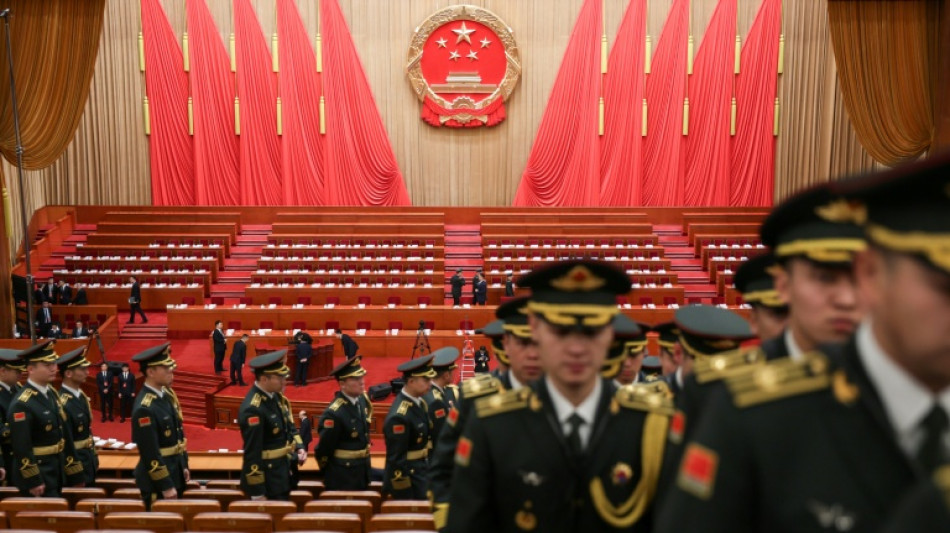
China announced a seven percent boost to its defence budget for 2026 on Thursday as it steadily increases spending to counter the United States and enforce its claims over Taiwan and the South China Sea.
The latest rise keeps China's spending at a third of that of the United States, but the Asian power is working to close the gap.
Beijing plans to spend 1.9096 trillion yuan ($276.8 billion) on defence, according to a report published at the opening of the annual "Two Sessions" parliamentary meeting.
Premier Li Qiang told delegates that China will aim to strengthen the military and "carry out major defence-related projects" over the next five years.
Analysts said the budget will finance military salary increases, training, manoeuvres around Taiwan, cyberwarfare capabilities and advanced equipment purchases, among other things, according to the report.
The increase marks a degree of continuity as Beijing pursues a sweeping anti-graft purge of the People's Liberation Army (PLA), which included the ousting of top general Zhang Youxia in January.
"China pursues an independent and self-reliant foreign policy. However, without robust military capabilities and technological prowess, our diplomatic stance would inevitably be subject to coercion or even dictated by certain nations, including the United States," military commentator Song Zhongping, a former Chinese army instructor, told AFP.
"China is unwilling to be a vassal state," said Song, who maintained that, by comparison, Japan and South Korea "only submit to American dictates".
The PLA must also strengthen its capabilities, he said, to "fully restore" Chinese jurisdiction over the disputed Spratly Islands, a chain of reefs and atolls in the South China Sea that are also claimed by the Philippines and where there are believed to be vast natural resources.
The United States is the world's biggest military spender, shelling out $997 billion in 2024, according to the Stockholm International Peace Research Institute (SIPRI).
- 'Proportionate' -
China has maintained a steady increase in military spending of around seven to eight percent each year since 2016.
However, its military spending as a percentage of GDP remains modest.
China's defence budget stood at 1.7 percent of GDP in 2024, well behind the US figure of 3.4 percent and Russia's 7.1 percent, according to SIPRI.
"That is proportional to its economy and legitimate defence needs," said Niklas Swanstrom, director of the Stockholm-based Institute for Security and Development Policy.
China claims its defence policy is solely aimed at protecting its territory, which it says includes self-ruled Taiwan.
It has only one military base abroad, in Djibouti, in contrast to the several hundred held by the United States.
"However, the absolute spending level (second globally) and rapid capability development concern neighbours," Swanstrom told AFP.
China's military buildup is fuelling an arms race in Asia and prompting some countries, particularly those with territorial disputes with China, to draw closer to Washington.
In Taiwan, leader Lai Ching-te wants to increase military spending in response to Beijing, which does not rule out the use of force to take control of the island.
The Philippines has also granted US access to more of its military bases.
Japan has been shedding its strict pacifist stance, with a record defence budget worth $58 billion approved in December for the coming fiscal year to expand its military capabilities.
- Beijing vs Washington -
The question of whether China could win a conflict against the United States remains unanswered.
The Chinese navy is considered to have more ships than any other country, but it lags behind the US Navy in tonnage, nuclear-powered submarines and aircraft carriers.
"The US remains the world's first-class armed forces both in terms of its military hardware and the hard operational experience of its personnel," said James Char, a Chinese military specialist at Nanyang Technological University in Singapore.
Swanstrom noted that the United States benefits from its superior global logistics, more advanced submarines and stealth technology, a larger nuclear arsenal, combat-experienced personnel and extensive alliance networks.
However, the balance would be radically different closer to China's shores if the US Navy were to intervene militarily, for example, to support Taiwan against Beijing.
"Most critically, neither side could 'win' meaningfully," Swanstrom said.
"Economic devastation, casualties, and nuclear escalation risks would be catastrophic for all parties."
D.Bachmann--VB