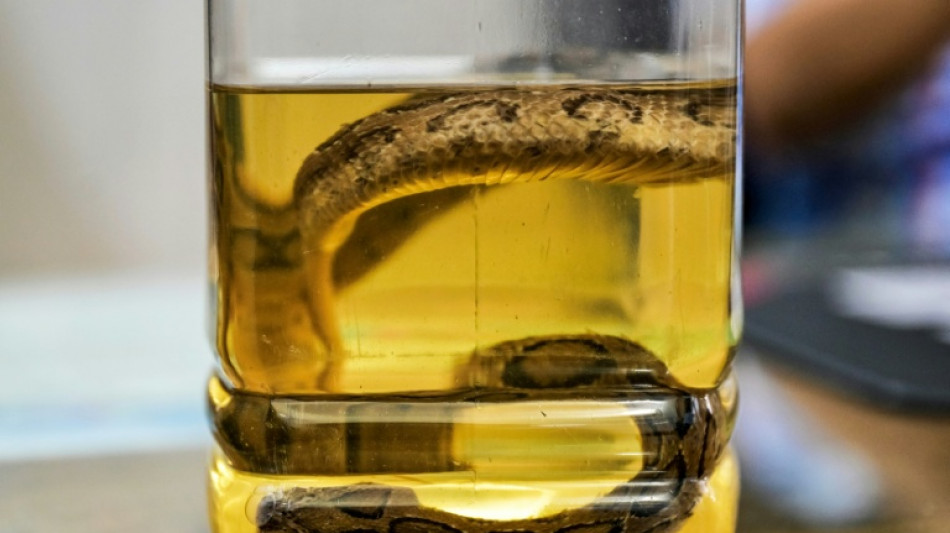
Snakebite surge as Bangladesh hit by record rains / Photo: © AFP

 Stock markets retreat after central bank rate hikes

 Russia labels director of Cannes Grand Prix winner a 'foreign agent'

 Macron warns of Russian 'hybrid' threat after meeting presidential hopefuls

 UN holds third informal poll for new chief

 Kulusevski return can spark Spurs: De Zerbi

 Shakira to cap off world tour with Madrid 12-gig run

 Isolated Syrian-Druze city blames Damascus for shortages

 Isolated Syrian-Druze city shortages

 Dutch drop Depay for Germany match in Xavi's first pick

 Ronaldo named in Portugal squad for Nations League

 Stock markets diverge after central bank rate hikes

 Anti-Assad music star makes triumphant return to Syria

 In-form Fernandez included in Spain Nations League squad

 Arteta buries hatchet with Hurzeler ahead of Brighton clash

 Alexander-Arnold and Palmer return to England squad for Nations League

 Russians vote as Ukraine war drags on for fifth year

 Backpackers fret over Australian visa crackdown

 Most Asian stocks track Wall St rally, yen drops after BoJ rate hike

 Russians begin voting in controlled election as war drags on

 Trump 'clearly' wants dialogue with Pyongyang: South Korean President

 Bank of Japan hikes rates to 31-year high to battle inflation

 Thailand's Muslim separatists vow to fight to the end

 Mideast turmoil, AI set to dominate UN gathering of world leaders

 Australia to detain tourists who overstay visa, minister says

 Championship rivals brace for renewal of bitter feuds

In the swamplands along Bangladesh's mighty Padma River, snakes slithering through villages have become an unrelenting menace, leaving residents terrified and hospitals overwhelmed with bite victims.
Doctors and experts warn snakebites are on the rise, driven by heavy rains, shrinking habitats and shifting farming practices.
Bangladesh -- among the nations most vulnerable to climate change -- has seen nearly 15,000 snakebite admissions this year, with 84 deaths reported so far.
Farmer Ananda Mondol broke down as he recalled how a snake bit his ankle while he was working in a rice field this year.
"I couldn't talk, I couldn't move," the 35-year-old from Nimtola, a village in the northern district of Rajshahi, told AFP.
"I vomited, lost control of my bowels, and saliva was coming out of my mouth."
He spent three days in intensive care, and is still plagued by sleepless nights and persistent muscle pain.
The father of four has not returned to the fields since.
His wife, Sunita Rani, a traditional healer, said the family cannot afford further treatment.
Across the villages of northern Bangladesh, similar stories abound.
"Sometimes, they even lie with us on the bed," said Rezina Begum, as she washed clothes by the river.
Another villager, Mohammad Bablu, told AFPhe dreads walking through the fields.
"My heart races," he said. "Only yesterday they killed seven snakes."
- 'Strong swimmers' -
The swamplands have always been a sanctuary for snakes, but floodwaters brought on by this year's extra heavy monsoon rains have pushed more of them from their natural shelters into human settlements.
And doctors say that has ramped up the deadly consequences.
At least 25 people have died from snakebites at the Rajshahi Medical College hospital since January, said professor of medicine Abu Shahin Mohammed Mahbubur Rahman.
The hospital treated more than 1,000 cases in nine months, including 206 bites from venomous species such as cobras, kraits and the feared Russell's viper.
"Many patients suffer acute kidney failure after snakebites," Rahman said.
Nationwide, authorities have recorded 84 snakebite deaths so far this year, alongside nearly 15,000 admissions.
That follows 118 deaths in 2024, one of the highest tolls in recent memory.
The once uncommon venomous Russell's viper has seen a resurgence in numbers since 2013, spreading panic.
Fatalities have risen steadily since.
A prolific breeder, Russell's vipers do not lay eggs -- they give birth to as many as 60 babies at a time, making them difficult to contain.
"They are strong swimmers and can float on water hyacinths," said Farid Ahsan, professor of zoology at Chittagong University.
This year's heavy rains have worsened the risk.
Rajshahi recorded 1,409 millimetres of rainfall between May and September, nearly a fifth higher above the seasonal norm of 1,175 mm.
- Boots and nets -
But experts say climate change is only part of the picture.
Gowhar Naim Wara, a disaster management specialist, blamed urbanisation and farming practices.
"Their habitat is gone, and they are now living in close contact with humans," Wara said.
Hospitals have scrambled to stock antivenom.
"We have sufficient antivenoms for the next three weeks," said Md Sayedur Rahman, special assistant at the Ministry of Health and Family Welfare, adding that more imports were on the way.
But experts caution imported antidotes are not always effective, as venoms vary by species and region.
Bangladesh is working on its own treatments, with progress on a Russell's viper antivenom — though rollout remains at least three years away.
In the meantime, villagers are adapting as best they can -- carrying sticks and torches at night, wearing jeans and boots in the fields, and sleeping under mosquito nets.
"It could be any of us next," said Bablu. "We live every day with that thought."
J.Marty--VB



