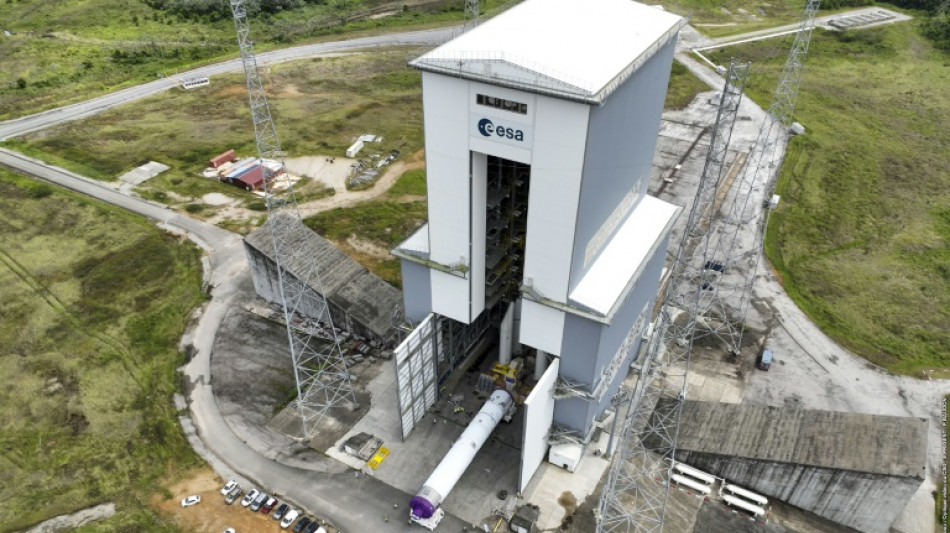
Europe to hold competition to build space cargo ship / Photo: © ESA-CNES-Arianespace/Optique/AFP/File

 India protest leaders to meet govt after Modi vows action
 Fear, arrests keep Cambodians quiet decade after critic's murder
 Over 80% of Mexican exports exempt from new US tariffs

 Is 'superstar' Pogacar's Tour de France domination boring?
 Iran ramps up executions under shadow of war
 Rosalia's Argentine fans up in arms over alleged World Cup snub
 Six candidates to lead UN take stage for televised debate
 King Charles opens slimmed down Commonwealth Games in Glasgow
 US unveils new tariffs on 60 partners as Trump rebuilds trade agenda

 WNBA viral star Cunningham wades into trans athletes row
 Hearn dismisses Fury talk of Joshua no-show for super fight
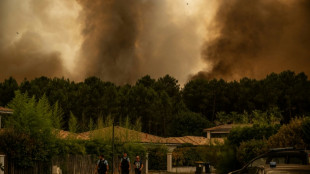 'Like a war zone': France evacuates 20,000 due to wildfires
 Ships avoid Ukrainian grain ports after Russian attacks

 Oil passes $100 a barrel again: why it's more serious this time
 Who are the six candidates vying to lead the UN?
 Hamilton proud of recovery after hitting rock bottom a year ago
 Carapaz eyes polkadot mountains jersey after stage win
 Fields medal awarded to four young mathematicians

 Carapaz claims Tour de France stage as Pogacar loses key team-mate
 Alonso welcomes Aston Martin upgrade, warns against unreal expectations
 Anderson declares Man City 'kings of Manchester' after £116 mn move
 Relieved Russell says Mercedes have solved his power problems mystery
 Oil soars above $100 as Middle East fears grow
 Venezuelans turn to scrap collecting in quake-hit beach 'paradise'

 Heptathlon champion Johnson-Thompson joins list of Commonwealth Games absentees

The European Space Agency announced Monday it would hold a competition between firms to build a ship to deliver cargo to the International Space Station, in a potential first step towards independent missions carrying astronauts.
The ESA's 22 member states, whose space ministers were meeting at a two-day summit in the Spanish city of Seville, also agreed to provide financial support for Europe's long-delayed Ariane 6 rocket.
The summit comes at a difficult time for European space efforts, as the Ariane 6 delays have left the continent without a way to independently blast its missions into space.
Europe also faces growing competition not just from the United States, but newer players China and India, as well as private companies such as billionaire Elon Musk's SpaceX.
ESA chief Josef Aschbacher told the summit that "a new economy is developing in low Earth orbit that will transform space exploration," adding that "private companies are revolutionising the landscape from launchers to exploration".
Aschbacher proposed "a competition between innovative European companies" to develop a ship that would transport cargo to the ISS by 2028 -- then bring it back to Earth.
The project will require "transport, docking and re-entry capability, something Europe does not possess today," he added.
"The service vehicle could later evolve to a crew vehicle and serve other destinations beyond low Earth orbit," he said.
Aschbacher also called on Europe to decide on the scale of its ambitions in space. In April, experts in a report commissioned by the ESA called for Europe to establish a "sustained presence" on the surface of the Moon.
- 'First step' -
A source close to the negotiations told AFP that "if we want to carry out manned flights, (the cargo ship competition) is the first step."
"You have to be able to send a cargo ship to a station and come back. That is the first brick," the source added.
Aschbacher said that 75 million euros ($80 million) had been secured to fund the first phase of the project, which companies would also contribute to.
The Exploration Company, a French-German start-up already developing a vehicle to deliver cargo to potential future private space stations, welcomed the news.
"This is a new ambition for Europe," the firm's CEO Helene Huby told AFP.
Huby said the ESA's "reasonable" approach followed the roadmap of SpaceX and the US, Russian and Chinese space programmes.
"One starts with the cargo ship and then sends people," she said.
The competition indicates a new approach by the ESA based on the model of US space agency NASA, meaning that for future missions it could buy a ride on the rockets of private companies rather than developing its own such programmes.
This idea seems to clash with the long-standing ESA principle of geographic return, which holds that each country's investment should result in a roughly equal industrial benefit for its companies.
Aschbacher suggested that this principle should be called into question.
- 'Launcher crisis' -
The summit also aimed to address Europe's "launcher crisis," which Aschbacher said was the "most serious" in the history of the continent's space efforts.
Already delayed by four years, Europe's next-generation Ariane 6 rocket is now not scheduled to make its maiden flight until next year.
Europe lost access to Russia's Soyuz rockets after Moscow invaded Ukraine last year, and its smaller Vega C launcher is still grounded after the failure of its first commercial flight in December.
The ESA announced at the summit that the Ariane 6 programme would receive 340 million euros ($365 million) following negotiations between France, Germany and Italy, the agency's three biggest contributors.
The Vega C rocket could be subsidised to the tune of 21 million euros a year from its 26th to 42nd flight, it added.
The ESA also announced it would "harness space for a greener future".
Last week, the ESA and the European Union agreed to join forces to accelerate the use of Earth observation missions to collect climate change data.
K.Hofmann--VB