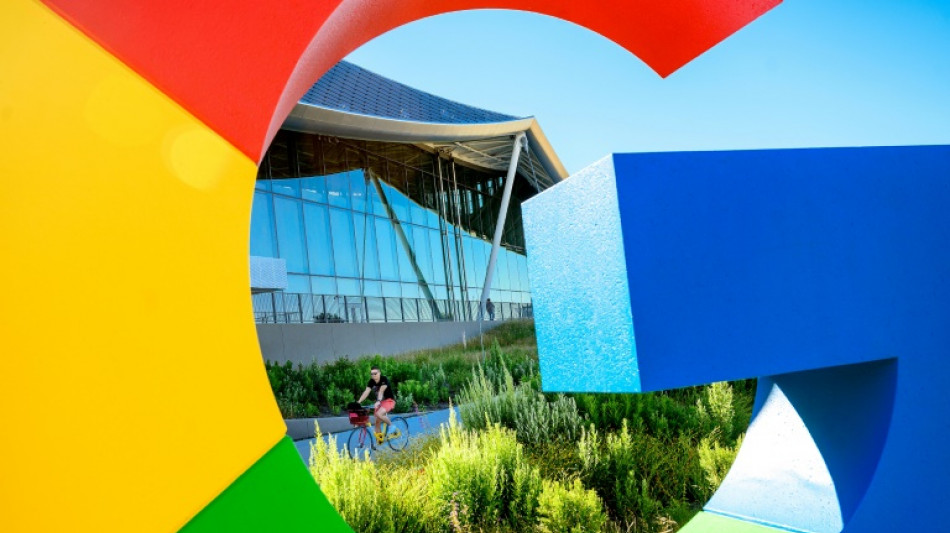
Tech giants jockey for position at dawn of AI age / Photo: © AFP/File

 India protest leaders to meet govt after Modi vows action

 Fear, arrests keep Cambodians quiet decade after critic's murder
 Over 80% of Mexican exports exempt from new US tariffs

 Is 'superstar' Pogacar's Tour de France domination boring?

 Iran ramps up executions under shadow of war

 Rosalia's Argentine fans up in arms over alleged World Cup snub

 Six candidates to lead UN take stage for televised debate

 King Charles opens slimmed down Commonwealth Games in Glasgow

 US unveils new tariffs on 60 partners as Trump rebuilds trade agenda

 WNBA viral star Cunningham wades into trans athletes row

 Hearn dismisses Fury talk of Joshua no-show for super fight

 'Like a war zone': France evacuates 20,000 due to wildfires

 Ships avoid Ukrainian grain ports after Russian attacks

 Oil passes $100 a barrel again: why it's more serious this time

 Who are the six candidates vying to lead the UN?

 Hamilton proud of recovery after hitting rock bottom a year ago

 Carapaz eyes polkadot mountains jersey after stage win

 Fields medal awarded to four young mathematicians

 Carapaz claims Tour de France stage as Pogacar loses key team-mate

 Alonso welcomes Aston Martin upgrade, warns against unreal expectations

 Anderson declares Man City 'kings of Manchester' after £116 mn move

 Relieved Russell says Mercedes have solved his power problems mystery
 Oil soars above $100 as Middle East fears grow

 Venezuelans turn to scrap collecting in quake-hit beach 'paradise'

 Heptathlon champion Johnson-Thompson joins list of Commonwealth Games absentees

Whether they sell smartphones, ads or computer chips, the heavyweights of Silicon Valley have everything to prove to investors looking to see who is best placed in the race to dominate the generative artificial intelligence market.
"If you're a company, and you don't have an AI message, you're not going to be in business very long," says independent industry analyst Jack Gold.
"Everyone is focused on AI right now. And everyone's trying to outmarket and out-hype everybody else. And there's room for a whole lot of players."
Over the past two weeks, tech's top companies released their corporate earnings reports for the July-September quarter.
Most of them beat analyst expectations, but on Wall Street, all eyes were on plans for generative AI, popularized by the ChatGPT chatbot, OpenAI's interface that was launched a year ago and dazzled the world.
The parent company of Google, the world leader in online advertising, saw its profit jump 42 percent in the third quarter to nearly $20 billion -- well above market estimates.
Shares in Alphabet however dropped more than 10 percent over two sessions because Google Cloud, though expanding, was seen as disappointing.
For Max Willens, an analyst at Insider Intelligence, while the division's credibility among AI startups could "bear fruit in the long run, it is not currently helping Google Cloud enough to satisfy investors."
- 'How fast it's changing' -
The cloud is where most generative AI systems -- which can deliver content as complex as a poem or scholarly essay in just seconds -- will be unfurled.
Generative AI, considered by many observers to be a seismic change similar to the advent of the internet age, is based on AI systems called large language models.
These models compile mountains of data that are the building blocks for "creating" content.
Microsoft -- a major investor in OpenAI -- along with Google and Meta have trained their own models.
Companies specializing in cloud services -- led by Microsoft's Azure, Amazon Web Services (AWS) and Google Cloud -- are beginning to monetize AI, though the costs remain high for now, says Yory Wurmser, another analyst for Insider Intelligence.
"The excitement is on what's possible, and how fast it's changing," Wurmser told AFP.
The main cost comes from the microprocessors needed to churn through the data.
Chipmaker Nvidia hit the jackpot by betting years ago on developing graphics processing units (GPUs), now a crucial pillar in the rapid development of generative AI.
But for Gold, one must understand "how AI is ultimately going to be used."
He says "probably 80 or 90 percent of all workloads will be inference workloads," meaning the usual functioning of AI models once they've been created.
US chip giant Intel has been working to catch up with its rivals, especially Nvidia, when it comes to powerful chips needed to handle AI's processing demands.
"The inferencing use of those models is what we believe is truly spectacular for the future," said Intel chief executive Pat Gelsinger.
"A huge amount of that is going to run right on Xeons," he said, referring to the company's processors.
- 'Nobody's late' -
Amazon, which plans to invest up to $4 billion in Anthropic, a rival to OpenAI, is insisting on the importance of Bedrock, its service for building generative AI applications.
"It's still complicated to actually figure out which models you want to use ... and trying to make sure you have the right results" while keeping costs in check, said Amazon CEO Andy Jassy.
"Bedrock just takes so much of the difficulty out of those decisions in those variables, that people are very excited about Bedrock," he said.
Even Apple, which is loathe to allow trends to dictate its agenda, was unable to escape questions about its AI plans.
"In terms of generative AI, obviously we have work going on," said Apple chief Tim Cook. "I'm not going to get into details... but you can bet that we're investing quite a bit."
Observers are expecting big things from Apple with respect to its digital assistant Siri, which has not evolved all that much in recent years. Amazon recently announced it would gradually add AI capability to its Siri equivalent, Alexa.
For Carolina Milanesi, an analyst at Creative Strategies, no one is behind -- yet.
"Nobody's late in a market that is just getting started and that will require investment and commitments," Milanesi told AFP.
"It starts first from an enterprise perspective before it starts from a consumer perspective."
C.Kreuzer--VB