Biden unveils AI order aiming to 'lead the way' on safety / Photo: © GETTY IMAGES NORTH AMERICA/AFP

 India protest leaders to meet govt after Modi vows action
 Fear, arrests keep Cambodians quiet decade after critic's murder

 Over 80% of Mexican exports exempt from new US tariffs

 Is 'superstar' Pogacar's Tour de France domination boring?
 Iran ramps up executions under shadow of war
 Rosalia's Argentine fans up in arms over alleged World Cup snub

 Six candidates to lead UN take stage for televised debate
 King Charles opens slimmed down Commonwealth Games in Glasgow
 US unveils new tariffs on 60 partners as Trump rebuilds trade agenda

 WNBA viral star Cunningham wades into trans athletes row

 Hearn dismisses Fury talk of Joshua no-show for super fight

 'Like a war zone': France evacuates 20,000 due to wildfires

 Ships avoid Ukrainian grain ports after Russian attacks

 Oil passes $100 a barrel again: why it's more serious this time

 Who are the six candidates vying to lead the UN?
 Hamilton proud of recovery after hitting rock bottom a year ago

 Carapaz eyes polkadot mountains jersey after stage win

 Fields medal awarded to four young mathematicians

 Carapaz claims Tour de France stage as Pogacar loses key team-mate

 Alonso welcomes Aston Martin upgrade, warns against unreal expectations
 Anderson declares Man City 'kings of Manchester' after £116 mn move
 Relieved Russell says Mercedes have solved his power problems mystery

 Oil soars above $100 as Middle East fears grow

 Venezuelans turn to scrap collecting in quake-hit beach 'paradise'

 Heptathlon champion Johnson-Thompson joins list of Commonwealth Games absentees

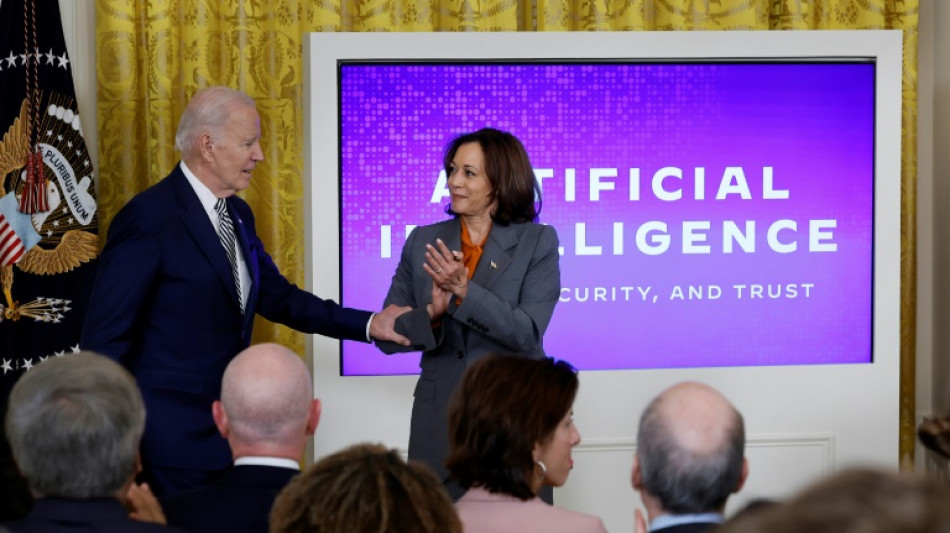
President Joe Biden issued an executive order Monday on regulating artificial intelligence, aiming for the United States to "lead the way" in global efforts to manage the technology's risks.
The "landmark" order directs federal agencies to set new safety standards for AI systems and requires developers to share their safety test results and other critical information with the US government, according to a White House statement.
"To realize the promise of AI and avoid the risk we need to govern this technology," Biden said before signing the executive order at the White House.
"There's no other way around it in my view; it must be governed."
The US will continue to work closely with allies on international rules for AI, Biden added during a ceremony with Vice President Kamala Harris.
The executive action relies on the Cold War-era Defense Production Act, which gives the federal government certain control over companies when national security is at stake.
The law was used early in Biden's tenure to speed up the federal response to the coronavirus pandemic.
The Executive Order on Safe, Secure, and Trustworthy Artificial Intelligence will also address risks to critical infrastructure and seek to protect against AI being used to develop dangerous biological materials.
With the rapid development of generative AI systems such as ChatGPT, the order also requires the development of new "guidance for content authentication and watermarking to clearly label AI-generated content."
Federal agencies will be required to use those tools "to make it easy for Americans to know that the communications they receive from their government are authentic."
- Global regulations -
Biden vowed that the US would lead the way in seizing the promise and managing the risks.
It faces competition from the European Union, which is seeking to set up an AI regulatory framework before the year's end, having already outpaced American regulators with landmark rules on data privacy and safety.
Harris is set to lead a US delegation to the UK this week for a global gathering on AI, alongside other foreign politicians, tech industry figures and academics.
The gathering -- which will focus on growing fears about the implications of so-called frontier AI -- will also be attended by UK Prime Minister Rishi Sunak, EU chief Ursula von der Leyen and UN Secretary-General Antonio Guterres.
Several tech companies, including US behemoths Microsoft and Google, have already pledged to submit their AI systems to government review.
Despite the lofty ambitions of the new executive order, the White House admitted that "more action will be required" on AI and pledged to "pursue bipartisan legislation" in Congress, where Republicans control the lower chamber.
While leaving the signing ceremony, US Senate majority leader Chuck Schumer said he was working with a bipartisan group and expected legislation to be ready in a matter of months to "cement" what Biden has done with the order.
Biden touted the executive order as "bold action," but called on Congress to pass legislation regulating AI; data privacy, and online marketing to children.
At a recent TED AI conference in San Francisco, Google DeepMind co-founder and chief artificial general intelligence scientist Shane Legg said the implications and consequences of this new technology are not fully understood.
"If I had a magic wand and I could slow things down, I would use the magic wand," Legg said during an on-stage conversation with TED curator Chris Anderson.
"We regulate powerful technologies all the time in the interest of society, and I think this is a very important thing that we should be looking at."
bur-aue-des-gc/st
L.Stucki--VB