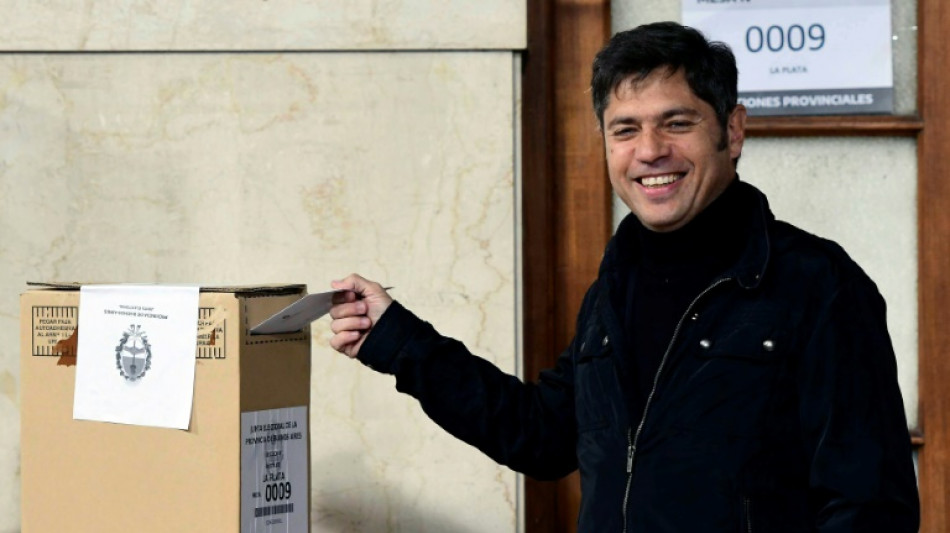
Kicillof, the Argentine governor on a mission to stop Milei / Photo: © AFP

 US Supreme Court rules on dragnet searches of cellphone location data
 South Korea fans target coach Hong with boos as World Cup squad returns
 Vaughan calls for England change after Stokes bows out with defeat
 Europe's deadly heatwave scorches east, Slovakia hits record
 French Open champ Andreeva sails into Wimbledon second round
 Shooter in custody dispute kills six at German family shelter
 Sinner survives scare and fall to reach Wimbledon second round

 Serena set for much-anticipated Wimbledon return
 Ex-NBA stars Malik Beasley, Ed Davis indicted in betting case

 EU, China bet on talks to avoid trade war
 Pyjamas and bets: Brazil YouTube channel reshapes World Cup viewing
 Queueing, strawberries and all white: it must be Wimbledon
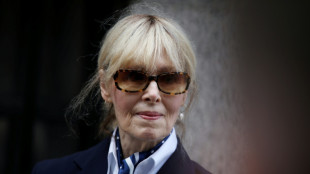
 Stokes backs Brook '100 percent' to succeed him as England Test captain
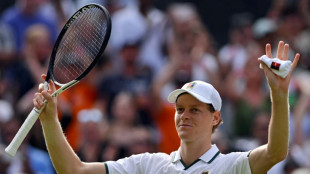
 Ebola outbreak in DR Congo spreads to fourth province

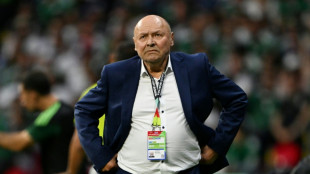 Czech Republic coach Koubek quits after World Cup flop

 French parliament adopts bill to regulate fast fashion
 Supreme Court boosts Trump's power to fire officials, but protects Fed
 Three things we learned from the Austrian F1 Grand Prix

 Burnham pledges radical devolution of UK govt if PM

 Polish businesses press Warsaw, Kyiv to end political rift
 Hovland beats Scheffler in playoff for PGA Travelers title
 New Zealand thrash England for series win as Stokes bows out
 Trump says Iran meeting to take place in Qatar
 Spain raises 2026 growth forecast despite Mideast war turmoil
 Kenya-US rare earths deal challenged in court over secrecy

An economist who champions the welfare state and nationalizations has emerged as libertarian, budget-slashing President Javier Milei's political nemesis in Argentina.
Buenos Aires governor Axel Kicillof's centre-left Fuerza Patria coalition trounced Milei's party in provincial elections last weekend that were seen as a test of Milei's support in the run-up to October mid-terms.
Fuerza Patria's nearly 14-point lead over Milei's La Libertad Avanza -- bigger than polls predicted -- made an instant star of Kicillof, who has become the embodiment of the left's comeback hopes.
"Se siente, se siente, Axel presidente! (Axel, president, you can feel it)," party activists chanted at Fuerza Patria's election night party.
The youthful-looking governor held up the results as a lesson to Milei that "you can't govern for outsiders, for corporations, for those who have the most."
"There is another path, and today we are starting to follow it," he said.
- Moving on from Evita, Cristina -
The 53-year-old father of two with Jewish and Ukrainian heritage hails from the Peronist movement, a long-dominant force for social justice in Argentina, which hemorrhaged voters to Milei in the 2023 presidential election, amid accusations of corruption and economic mismanagement.
He is the polar opposite of the libertarian 54-year-old Milei, who has downsized the state and imposed harsh austerity to try revive Argentina's ailing economy.
Kicillof is a proponent of Keynesian economics, which argues for increased state spending in a downturn, even if it means running up budget deficits.
Although his rise owes much to Peronist standard-bearer Cristina Kirchner, he has not shied from criticizing the movement founded by post-war president Juan Peron and his wife Eva and later by Kirchner and her husband Nestor.
After Milei's election win he called on Peronists to stop dining out on the memory of "Peron, Evita, Nestor and Cristina," even if, he said, their years in power "were the most glorious in our country."
For some die-hard Peronists, who vow unquestioning devotion to "Cristina," Kicillof's remarks smacked of treason.
But Kirchner's conviction for fraud, for which she is serving a six-year sentence under house arrest and is barred from holding public office, allowed Kicillof to emerge from her shadow.
By contrast with the tempestuous Milei, who has assailed him as a "dunce" and "Soviet dwarf," Kicillof is the picture of calm.
He is invariably seen clutching a mate -- the gourd from which Argentines sip herbal tea with a straw -- and mixes easily with voters.
In 2019, while campaigning for governor, he crisscrossed Buenos Aires province's towns and farming communities in a beaten-up Renault Clio.
On Sunday, he went to vote on foot, hand-in-hand with his wife, a literature professor.
Despite his relaxed demeanor, he is a "hard-working, austere" character with strong convictions, according to Carlos Bianco, one of his former students who is now a provincial minister.
- An 'honest' politician -
Kicillof, Timerman said, is the only Argentine politician who voters invariably describe as honest.
The son of psychoanalysts, he began his political career as a student activist at the University of Buenos Aires.
His former lecturer Pablo Levin recalled him in Perfil magazine as a very good student who was "not necessarily studious but very talented and creative."
He served as economy minister between 2013 and 2015, during the final years of Cristina Kirchner's presidency.
Kicillof negotiated the controversial 2012 renationalization of oil giant oil YPF and promoted price controls on basic goods to alleviate inflation.
But he also earned a reputation for pragmatism during negotiations with the Paris Club of creditors on clearing billions of dollars in overdue debt.
In 2019, he was elected governor of Buenos Aires, a province the size of Italy which accounts for more than 30 percent of GDP and which has served as a launchpad for several successful presidential bids.
A day after his victory over Milei, Kicillof began fielding questions about a run for the top job in 2027. He batted them away.
"That's not the issue right now," he said.
M.Schneider--VB