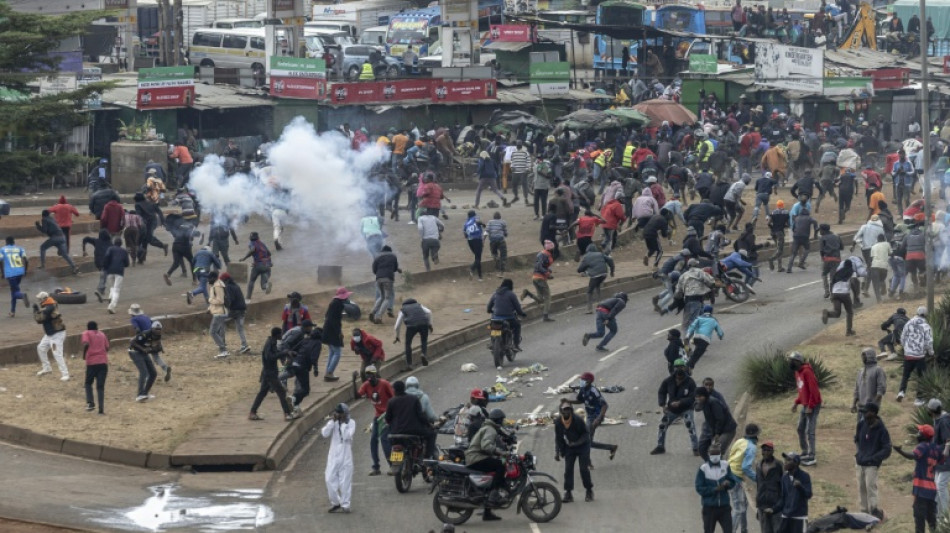
At least 10 dead in Kenya during protests after heavy police deployment / Photo: © AFP

 South African election results renew debate over identity-based voting

 South African voters report smoother local election but declining IEC trust

 Dolly Parton museum and Nashville hotel open after singer’s death

 George and Amal Clooney attend New York political-comedy reading

 British buyers pay substantial premiums for period-home appearance

 Thomas Markle released to house arrest after child-abuse-image charge

 Dawn of War 4 developers chose Adeptus Mechanicus for tactical variety

 Italy face unbeaten South Africa in Turin Nations Championship match

 ChatGPT interactive interface feature tested across six custom tools

 Freshways milk-price cut deepens pressure on UK dairy farms

 Labour and National remain virtually tied as New Zealand vote count advances

 The Good Daughter adapts Karin Slaughter thriller with Rose Byrne and Meghann Fahy

 Heavy-lift drone evacuates wounded Ukrainian soldier from frontline kill zone

 Morrison says West Brom recovered after pressure from successive derby losses

 Britain considers 2027 state visit for Ukraine’s Zelensky

 Arizona Democrats Secure Historic Trifecta with New Legislative Leadership

 Carney Welcomes U.S. Trade Reversal After Democratic Midterm Victory

 Armenian FM Discusses EU Accountability for Palestinian Rights in Madrid
At least 10 people died across Kenya and hundreds were arrested during anti-government demonstrations on Monday, a rights group and police said, following clashes between police and protesters in the capital Nairobi's outskirts.
The Kenyan National Commission on Human Rights (KNCHR) also accused the police of cooperating with criminal gangs, as a heavy deployment of the security forces kept much of central Nairobi deserted ahead of the annual marches to mark Saba Saba Day.
Meaning Seven Seven, the demonstrations commemorate July 7, 1990 when Kenyans rose up to demand a return to multi-party democracy after years of autocratic rule by then-president Daniel arap Moi.
The KNCHR said in a statement it "had documented ten fatalities, twenty-nine injuries" across 17 counties, but did not provide any further details.
A statement from the National Police Service (NPS) late Monday put the death toll at 11, with 52 police officers and 11 civilians wounded.
From around midday, AFP saw running battles with groups of anti-riot police who fired teargas at small gatherings, with some of the crowd throwing rocks back and engaging in destructive looting.
Young Kenyans, frustrated over economic stagnation, corruption and police brutality, are once again engaging in protests that last month degenerated into looting and violence, leaving dozens dead and thousands of businesses destroyed.
Protesters accuse the authorities of paying armed vandals to discredit their movement, while the government has compared June's demonstrations to an "attempted coup".
- 'Hooded gangs' -
On Monday, the streets of central Nairobi were quiet after police mounted roadblocks on the main roads, restricting entry to areas that were the epicentre of previous rallies.
Many businesses were closed for the day.
"I have never witnessed the city centre like this," security guard Edmond Khayimba, 29, told AFP.
While the centre remained deserted, groups gathered on the outskirts in the afternoon with AFP reporters witnessing two people wounded, as well as looting and vandalism.
Protesters on a major highway clashed with police blocking their entry into the city, with the small crowds chanting: "Ruto Must Go", a popular rallying cry against President William Ruto, and "wantam", meaning "one term".
Again, AFP saw looting and property destruction in the surrounding area.
In its statement, the KNCHR noted the presence of "criminal gangs wielding crude weapons, including whips, wooden clubs, machetes, spears, bows and arrows" during the protests in a number of counties, including Nairobi, where "these hooded gangs were seen operating alongside police officers".
In comments to AFP, NPS spokesperson Michael Muchiri said the KNCHR statements "may lack factualness many times over".
The spokesperson also reiterated that the NPS "would never work alongside individuals called 'goons' or criminal elements", using the name used for the armed men paid to disrupt demonstrations.
Muchiri said in a later statement that 567 people had been arrested during the protests, but did not provide any further details.
Kipchumba Murkomen, the interior cabinet secretary, said recent demonstrations had "been infiltrated by criminals out to cause chaos and destruction".
In a statement on X, he said the looting and violence had been "markedly reduced" by the officers' presence, but promised those responsible would be "investigated and charged".
- 'Ruto Must Go' -
Social media and rising economic expectations have fanned anger over inequalities in a country where around 80 percent are trapped in informal, poorly paid jobs.
But a crackdown by the police -- at least 80 people have died in protests since June last year while dozens have been detained illegally -- has scared many off the streets.
"What he has promised the country, (he) is not delivering," Onsomu said.
Since being elected in 2022, Ruto has forged an uneasy alliance with the main opposition leader Raila Odinga, leaving no clear challenger ahead of the next vote in 2027.
But each violent crackdown fuels further unrest, said activist Nerima Wako.
"Every time people organise a protest, they kill more people, so it just continues to feed off itself," she said.
The previous demonstration on June 25 -- intended to mark the peak of last year's deadly anti-government rallies -- turned violent and left 19 people dead, according to rights groups.
G.Frei--VB