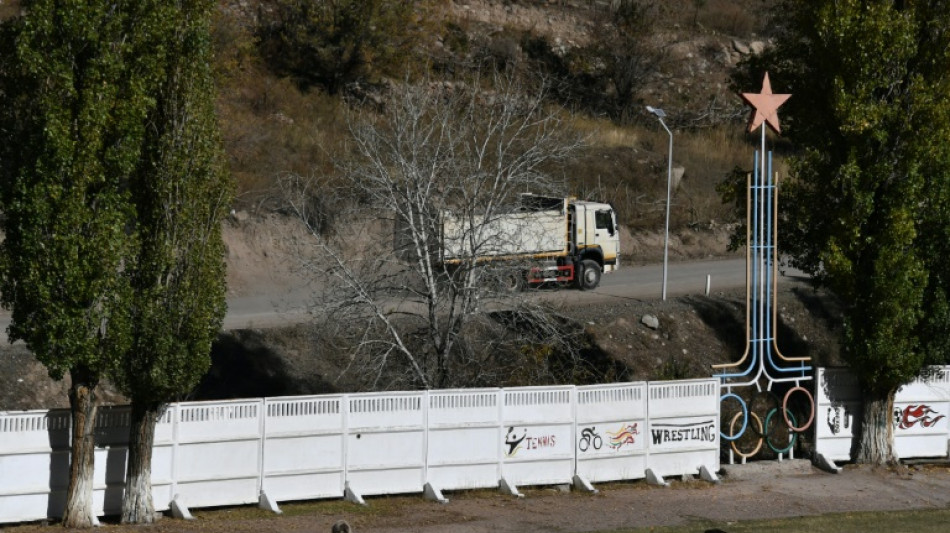
Toxic towns in Kyrgyzstan battling radioactive danger / Photo: © AFP

 Yamal double helps Barca beat Levante, Atletico triumph

 Sassuolo stun Juve, Lobotka eases pressure on Allegri with Napoli winner

 Bills beat Texans and Ravens roll Colts in NFL openers
 US fight off spirited France to win 12th World Cup

 Drivers give cool reception to new Madring circuit

 Maresca makes flawless Man City start to leave Man Utd trailing

 Dozens arrested in major anti-LGBTQ raids in Turkey

 Leftwing opposition seen leading Sweden election, far-right losing ground

 Senegal goalkeeper Mendy retires from international football

 Carrick 'worried' by decision to award Man City winner

 Lobotka eases pressure on Allegri with Napoli winner

 Trump watches as Lowry wins Irish Open in record-breaking style

 Poland, Ukraine slam Russian strikes near border as 'escalation'

 Haaland fires 10-man Man City to memorable win over Man Utd

 I miss the adrenaline, but it's not my moment - Bolt

 Championship leader Antonelli to 'keep pushing' for title

 Yamal double helps Barca edge Levante thriller

 Brighton run rampant against 10-man Coventry

 Late Mbappe goal sends Lille top of Ligue 1

 Five-star Brighton crush 10-man Coventry
 Team Europe beat United States to reclaim Solheim Cup

 US House Speaker warns curbing AI too sharply could leave China ahead

 張國榮70歲誕辰音樂會西九舉行 唐鶴德錄音致意

 Iran's economic ties to Dubai hard to break despite war

 iPhone 18預購後出現可疑扣款 四間銀行調查未授權交易
In a mask and a hazmat suit, Ermek Murataliyev drives a truck filled with Soviet-era radioactive waste along the winding mountain roads of Kyrgyzstan.
His is a hazardous mission: two such trucks crashed into ravines over the summer.
Drivers in this former Soviet Central Asian state are forbidden to stop until they reach their final destination -- a storage zone where the waste will be buried under thick layers of compacted clay and rock.
Murataliyev had to undergo a medical inspection and have regular health checks to get the job.
"I have been trained on how to keep myself safe," he said.
Three decades on from independence, Kyrgyzstan is still dealing with the consequences of the Cold War nuclear arms race, when Central Asia provided the Soviet Union with all of its uranium.
Kyrgyz authorities say there are now six million cubic metres of radioactive waste in 30 sites such as Min-Kush, which require complex and costly disposal measures.
"When the Soviet Union collapsed, Kyrgyzstan had neither the equipment nor the money to transfer the waste to safe sites," said Ilgiz Ernis, deputy mayor of the Min-Kush municipality.
"The process was badly delayed," he said.
The disposal work is now in its final stages and is being carried out by the Russian nuclear giant Rosatom as well as the European Union and the European Bank for Reconstruction and Development.
- 'Radioactive lake' -
Local resident Aiman Kishkenalina said "this problem is not just for Min-Kush but for all of Kyrgyzstan".
Kishkenalina is one of around 5,600 residents of the run-down uranium mining town -- a ticking time bomb with grave human and environmental consequences.
"Some experts with dosimeters found that the (radiation) level was too high in some places," she said.
Local officials say it is in fact up to six times higher than the norm.
Radioactive waste has also been found in the river running through Min-Kush that flows into the Syr Darya, the second-largest river in the region, potentially threatening up to 80 million people.
"The (radioactive) content of the water that passes under the disposal area breaches admissible norms," said Bakytbek Asankulov, who is in charge of radioactive security at the Kyrgyz emergency situations ministry.
Asankulov also warned of the risk of a landslide where natural disasters exacerbated by climate change are becoming more frequent.
He said a landslide triggered by either foul weather or the earthquake-prone country's tremors could block up the river and "create a radioactive lake".
If the water from such a lake were to burst out, it "would reach the Fergana Valley" -- the most populated part of Central Asia where Kyrgyzstan, Tajikistan and Uzbekistan meet.
- 'Hair falling out' -
Warnings from the authorities not to drink contaminated water from the river are ignored by some local inhabitants.
"We eat the livestock and we drink the milk of cows" that have drunk the water, said Perizat Berdaliyeva, a retired former accountant at the uranium mine.
Health risks from radiation were covered up in Soviet times but, unlike many other parts of the Communist bloc, atomic industry towns like Min-Kush had no food shortages.
"Everything was available," Berdaliyeva remembered.
Scientific studies have found an abnormal prevalence of illnesses such as cancer and depleted immune systems among people living close to nuclear waste sites.
"My two daughters' hair is falling out. They are often sick. My husband gets nose bleeds," said Nazgul Zarylbek, 25.
Her house was recently pulled down by the authorities because it was contaminated with radiation. She received 5,000 euros ($5,300) in compensation and was re-housed in a different part of Min-Kush.
Located in a picturesque valley at an altitude of 2,000 metres (6,500 feet), Min-Kush could appear relatively normal were it not for an electronic display outside the mayor's office showing the current radiation levels.
The town in central Kyrgyzstan wants to turn the page from its toxic past and local officials are even hoping that it could have tourism potential.
"The transfer of uranium waste to a safer area will allow Min-Kush to be taken off the red list for tourism," deputy mayor Ernis said.
S.Gantenbein--VB