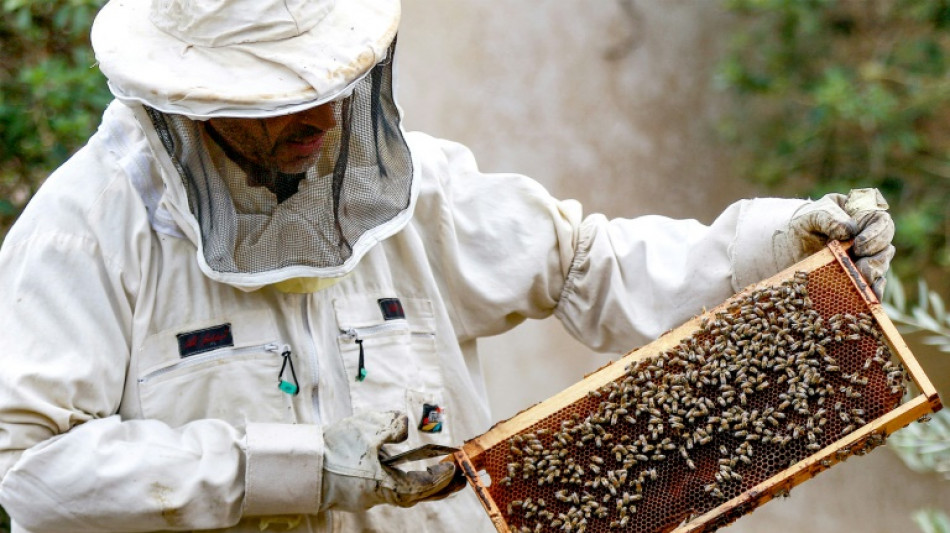
Sweet success: Jordan's beekeepers busy as honey demand soars / Photo: © afp/AFP

 Trump's beef policies irk Texas ranchers, testing their loyalty

 Nvidia, OpenAI CEOs to attend Xi dinner at White House

 Anthropic picks Accenture for in-house AI safety evaluation
 Balogun returns as Monaco beat Lens to continue strong Ligue 1 start

 'Pause' on overt repression in Venezuela, but reforms still needed: HRW

 Global stocks mixed as yen falls despite Bank of Japan rate hike

 Cuba hit with seventh major blackout of the year

 Murray out with concussion so Wentz will start for Vikings

 UN chief 'deeply regrets' US visa refusal to Abbas for annual meeting

 England quick Carse to face no charges over alleged nightclub assault

 Mancini brings nine newcomers into the first squad of his Italy comeback

 Czechs level Davis Cup tie against USA as South Korea eye Finals

 New France boss Zidane confirms Mbappe as captain after naming first squad

 California governor signs order to explore AI 'kill switch'

 Head leads run spree as Australia win Zimbabwe ODI series

 In-form Raphinha wants to finish career at Barcelona

 Warren Buffett steps down as Berkshire Hathaway chairman

 Carrick confident Man Utd can 'work through' tough time

 Mbappe ends Nike partnership to join Swiss brand On

 Liverpool boss Iraola puts Bournemouth love affair on hold
 'A disaster' if Man City do not win says Maresca after flawless start
 Kerry James Marshall: American 'blackness' painter celebrated in Europe

 Spain coach De la Fuente offers 'full support' to people of Ceuta

 Russia seizes assets of Nestle, French firms over West's Ukraine support

 England can build on World Cup 'spirit', says Tuchel

Jordan's key tourism industry may have been hammered by Covid, but the pandemic gave a boost to another sector, keeping its beekeepers busy as demand for honey has soared.
The country's 4,000 apiarists have ramped up output of the sweet and sticky golden substance long praised for its anti-inflammatory and other health benefits.
Even if there is no scientific consensus that honey helps fight Covid, many of those infected have used it to soothe symptoms such as sore throats.
"The Covid period in particular had a great, positive impact on us," said beekeeper Mutasim Hammad, 48, who retired 12 years ago from the public security directorate and turned his hobby into his main job.
"There was good demand for honey, and people got to know it," added Hammad, dressed in a white protective suit while checking on his 80 bee hive boxes on a property in Irbid 90 kilometres (60 miles) north of Amman.
"People have become more aware of the value of honey and are turning to the guaranteed locally produced honey," said Hammad, who sells about 400 kilograms (880 pounds) a year.
The kingdom of Jordan prides itself on its 19 different types of honey, including citrus, eucalyptus and maple varieties, depending on which plants the bees pollinate.
"We have about 2,500 flowering plants," said Mohammad Rababaa, head of the Jordan Beekeeping Association.
"This diversity distinguishes Jordanian honey and means that the therapeutic and nutritional value of this honey is expected to be better than other types."
Rababaa said the slightly bitter maple honey variety, for example, boasts "very high phenolic compounds and antioxidants compared to other types, which indicates that it has a higher value".
- Ecosystem service -
Rababaa also said that, since the Covid pandemic, "demand for locally produced honey has clearly increased".
He said the sector has a much bigger workforce than Jordan's official count of about 1,400 beekeepers.
"The reality is that the number of beekeepers is more than 4,000," said the professor of Natural Resources and Environment at the Jordan University of Science and Technology.
They produce about 700 to 800 tonnes annually, or about 70 percent of Jordan's annual domestic needs, he said.
"We are very close to self-sufficiency," said Rababaa, adding that "imports must be stopped".
A fellow enthusiast, Mohammad Khatib, 49, also pointed to the pandemic and lockdown periods, saying it "helped me and gave me enough time to learn about bees and take good care of them".
A French language professor at Al-Bayt University, he now works about 15 bee boxes in his garden, which he said earns him a nice side income.
"People are looking for reliable honey" and some customers place their orders a year in advance, he said.
Jordanian honey sells for 15 to 30 dinars ($21 to $42) per kilogram, depending on the type.
Rababaa said the economic benefit "is not limited to honey as it also produces pollen, royal jelly, wax, propolis and bee venom, which is included in many therapeutic compounds".
Crucially, healthy populations of bees and other insects provide an almost immeasurable ecosystem service by pollinating plants.
While the beekeeping sector generates about $28 million a year, Rababaa said, "the indirect value of crop pollination exceeds $100 million".
L.Dubois--BTB



