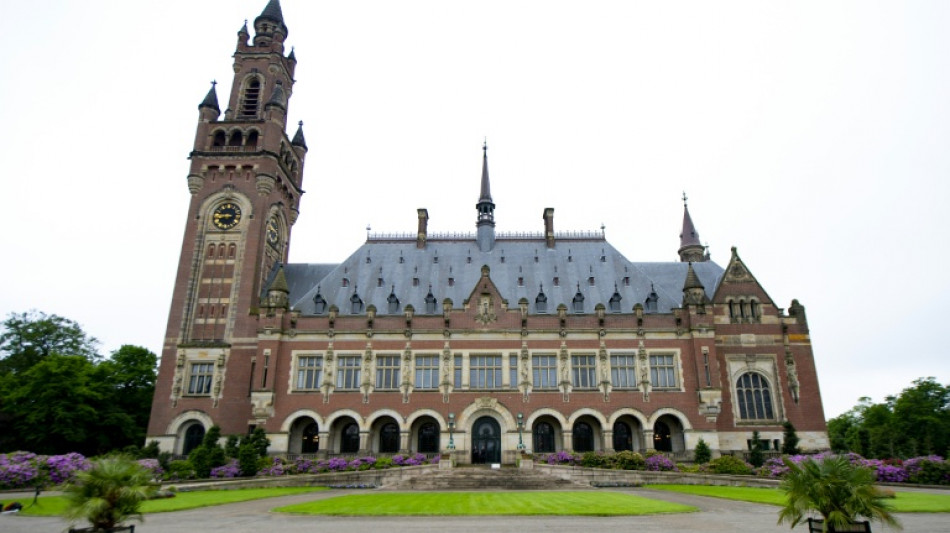
Venezuela to ICJ: Rights to oil-rich region 'inalienable' / Photo: © AFP

 Losing start in AFCON qualifying for 78-year-old coach Le Roy
 Italy bans burqas in schools, caps numbers of foreign students per class
 Israel policies threaten 'life and existence' of Palestinians, Abbas says

 Paolini steers Italy past China in BJK

 Zidane admits emotion on eve of first game as France coach
 Breetzke and Maharaj sink Australia in first one-day international

 Zelensky broke confidentiality with North Korea POWs disclosure: South's president
 Former Liverpool star Carroll reveals he was sexually assaulted
 Dominican Republic calls for Haiti force to be strengthened
 Dolly Parton's nephew ordered to stay away from estate staff, properties

 Early exit for Philippine darling Eala at Singapore Open
 Hurricane Polo triggers huge waves in coastal Mexican city
 What happens if the US bans diesel exports
 Macklemore hits back with 'Free Palestine Tour' after Sheeran split

 Met Opera to give New Yorkers free tickets in affordability push
 Top ECB official to resign to take up IMF role

 Xi and Trump call for peace in lavish White House state visit
 Five up-and-coming players looking to make mark in Nations League

 CNN, MS NOW, Politico request court hearing after White House access denied
 Eviction of pensioner puts Spain housing crisis in spotlight
 CNN, MS NOW, Politico say reporters still barred from White House
 Udinese sign ex-Real Madrid defender Alaba on free transfer
 Trump welcomes Xi to Washington with lavish praise
 Kane relishing chance to become England's most-capped player

 Average EU diesel price hits record 2.23 euros a litre: AFP analysis

Venezuela's rights to the oil-rich territory of Essequibo are "inalienable", its representative told the top UN court on Wednesday at hearings aimed at resolving a centuries-old border dispute with Guyana.
The International Court of Justice in The Hague is holding a week of hearings between the two countries over the row that has at times threatened to spill over into military action.
"Venezuela's historical rights are inalienable and Venezuela is determined to defend them peacefully," Samuel Reinaldo Moncada Acosta told the court.
The pair have been wrangling over the region since the 1800s, with the dispute intensifying after ExxonMobil discovered massive offshore oil deposits a decade ago, giving Guyana the largest crude oil reserves per capita in the world.
The Essequibo region comprises more than two thirds of Guyana, which currently administers it.
Neighbouring Venezuela, however, claims the territory, which runs roughly along the western side of an eponymous river over an area of 160,000 square kilometres (62,000 square miles).
ICJ judges have been asked to rule on the validity of the border established between the two countries in 1899 under British colonial rule.
Venezuela argues that the border should be drawn in accordance with a later document from 1966 signed before Guyana gained its independence.
It says that the Essequibo River, located much farther east than the current border, is the natural frontier, as it was in 1777 under Spanish colonial rule.
- 'Existential' case -
In testimony on Monday, Guyana's Foreign Minister Hugh Hilton Todd told judges the case had "an existential quality for Guyana" with more than 70 percent of its territory at stake.
"For the Guyanese people, it is tragic even to think about having our country dismembered by stripping from us a vast majority of our land, together with its people, its history, its traditions and customs, its resources and precious ecology," he said.
Venezuela's Acosta dismissed this argument.
"The characterisation by Guyana of an alleged threat to its territorial integrity or to its sovereign territory constitutes a flagrant misinterpretation. a deliberately misleading presentation of both facts and law," he told judges.
The ICJ, which seeks to resolve disputes between states, will hold hearings until Monday but a ruling is likely to take months if not years.
The court's decisions are binding but it has no power to ensure that they are upheld.
Acosta reiterated Venezuela's stance that the ICJ had no power to rule on the case.
"Our historical experience has taught us that delegating vital matters... to international judicial bodies has been detrimental to our sovereignty and our territorial integrity," he said.
"As a result, Venezuela has never agreed to submit this controversy to the court's jurisdiction."
L.Wyss--VB