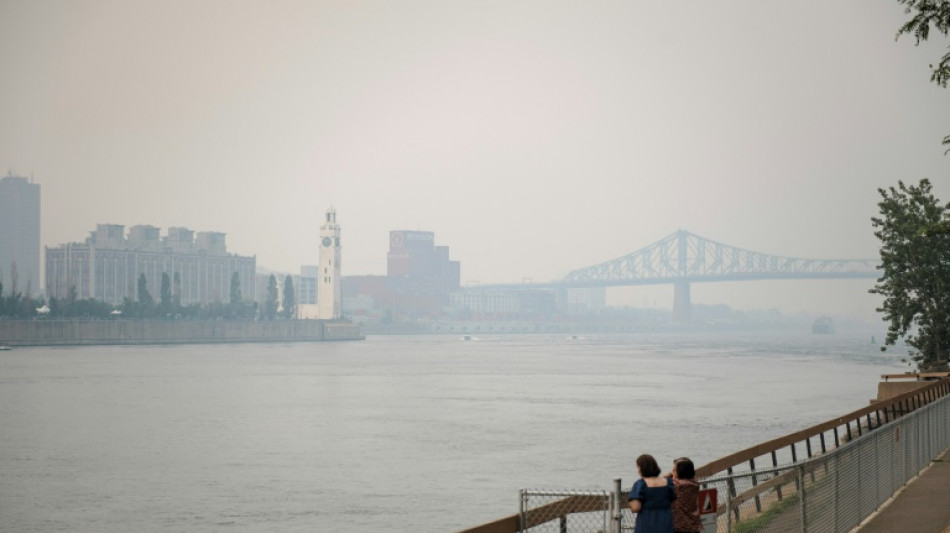
Canada wildfire smoke chokes millions in North America / Photo: © AFP

 Trump's beef policies irk Texas ranchers, testing their loyalty

 Nvidia, OpenAI CEOs to attend Xi dinner at White House

 Anthropic picks Accenture for in-house AI safety evaluation
 Balogun returns as Monaco beat Lens to continue strong Ligue 1 start

 'Pause' on overt repression in Venezuela, but reforms still needed: HRW

 Global stocks mixed as yen falls despite Bank of Japan rate hike

 Cuba hit with seventh major blackout of the year

 Murray out with concussion so Wentz will start for Vikings

 UN chief 'deeply regrets' US visa refusal to Abbas for annual meeting

 England quick Carse to face no charges over alleged nightclub assault

 Mancini brings nine newcomers into the first squad of his Italy comeback

 Czechs level Davis Cup tie against USA as South Korea eye Finals

 New France boss Zidane confirms Mbappe as captain after naming first squad
 California governor signs order to explore AI 'kill switch'

 Head leads run spree as Australia win Zimbabwe ODI series

 In-form Raphinha wants to finish career at Barcelona

 Warren Buffett steps down as Berkshire Hathaway chairman
 Carrick confident Man Utd can 'work through' tough time

 Mbappe ends Nike partnership to join Swiss brand On

 Liverpool boss Iraola puts Bournemouth love affair on hold

 'A disaster' if Man City do not win says Maresca after flawless start

 Kerry James Marshall: American 'blackness' painter celebrated in Europe

 Spain coach De la Fuente offers 'full support' to people of Ceuta

 Russia seizes assets of Nestle, French firms over West's Ukraine support

 England can build on World Cup 'spirit', says Tuchel

A deep orange-brown sun shined through hazy skies as smoke from Canadian wildfires spread across North America and beyond, choking millions of people and triggering severe air quality alerts.
Here's why the fires are so smoky and why people should be concerned.
- Why is there so much smoke? -
The number of fires and the amount of land scorched, as well as the amount of smoke emitted from the blazes, are unprecedented this wildfire season, and it is just the beginning, according to officials.
The fact that fires flared at the same time across the country is also unusual.
As of Wednesday, more than eight million hectares (20 million acres) of forests and grasslands had burned across Canada, breaking an annual record of 7.3 million hectares set in 1989.
And Canada has yet to reach the peak of the fire season, which is usually in July or August.
"We have a fire in northern Quebec which currently covers 700,000 hectares, for example. It's hard to fathom just how big it is," said Yan Boulanger, a fire specialist for the Canadian Ministry of Natural Resources.
A hot, dry spring resulted in a large fuel load -- dried vegetation and dead branches -- in Canada's boreal forest.
Smoldering humus fires that can burn deep underground produce a lot of smoke, resulting in higher carbon monoxide emissions, says Jack Chen of Canada's environment ministry.
The climate consequences are devastating as the boreal forest releases 10 to 20 times more carbon per unit of area burned than other ecosystems.
Hundreds of forest fires since early May have generated nearly 600 million tons of carbon dioxide, equivalent to 88 percent of the country's total greenhouse gas emissions from all sources in 2021, the Copernicus Atmosphere Monitoring Service (CAMS) reported.
- What are the health concerns? -
Wildfire smoke is more toxic than other types of smoke and can be more dangerous to human health than other sources of air pollution, for example.
The particles are fine and can travel deep into the respiratory tract.
Composed of ozone, sulphur dioxide, nitrogen dioxide, carbon monoxide, volatile organic compounds and PM2.5 fine particles, smoke from forest fires is a danger to all, according to experts and officials.
But it can be particularly dangerous for young children, pregnant women, smokers, seniors and those who suffer from chronic health problems, the Canadian government has warned.
"The particles are so small, particularly the ultra-fine ones, that they can get all the way down into your lungs and then cross over into your bloodstream and lead to inflammation," said Courtney Howard, an emergency room doctor in Yellowknife in Canada's Northwest Territories.
It also can have direct consequences on mental health, mood and anxiety, doctors say.
- What are the effects on wildlife? -
Wildfire smoke particles contain a higher proportion of carbon-based pollutants in various chemical forms that may be spread hundreds of kilometers (miles) from the fires themselves.
This smoke can lead to "acute or chronic health effects on wildlife," just like in humans, said Matthew Mitchell of the University of British Columbia in Vancouver.
"There's a whole suite of chemicals in the smoke that can affect gas exchange in the blood, lower the lung capacity of animals," he told AFP.
Weakened animals will tend to "rest more or try to reduce their activity. So they're not going out and feeding, looking for food or mates," he said.
"Even marine mammals such as whales and dolphins can be affected by the smoke when they come up to breathe," he said.
E.Schubert--BTB