Much still pending on how high seas sanctions will work / Photo: © AFP

 Trump's beef policies irk Texas ranchers, testing their loyalty

 Nvidia, OpenAI CEOs to attend Xi dinner at White House
 Anthropic picks Accenture for in-house AI safety evaluation
 Balogun returns as Monaco beat Lens to continue strong Ligue 1 start

 'Pause' on overt repression in Venezuela, but reforms still needed: HRW

 Global stocks mixed as yen falls despite Bank of Japan rate hike
 Cuba hit with seventh major blackout of the year
 Murray out with concussion so Wentz will start for Vikings

 UN chief 'deeply regrets' US visa refusal to Abbas for annual meeting
 England quick Carse to face no charges over alleged nightclub assault

 Mancini brings nine newcomers into the first squad of his Italy comeback

 Czechs level Davis Cup tie against USA as South Korea eye Finals

 New France boss Zidane confirms Mbappe as captain after naming first squad
 California governor signs order to explore AI 'kill switch'
 Head leads run spree as Australia win Zimbabwe ODI series

 In-form Raphinha wants to finish career at Barcelona
 Warren Buffett steps down as Berkshire Hathaway chairman
 Carrick confident Man Utd can 'work through' tough time

 Mbappe ends Nike partnership to join Swiss brand On

 Liverpool boss Iraola puts Bournemouth love affair on hold

 'A disaster' if Man City do not win says Maresca after flawless start

 Kerry James Marshall: American 'blackness' painter celebrated in Europe

 Spain coach De la Fuente offers 'full support' to people of Ceuta

 Russia seizes assets of Nestle, French firms over West's Ukraine support
 England can build on World Cup 'spirit', says Tuchel

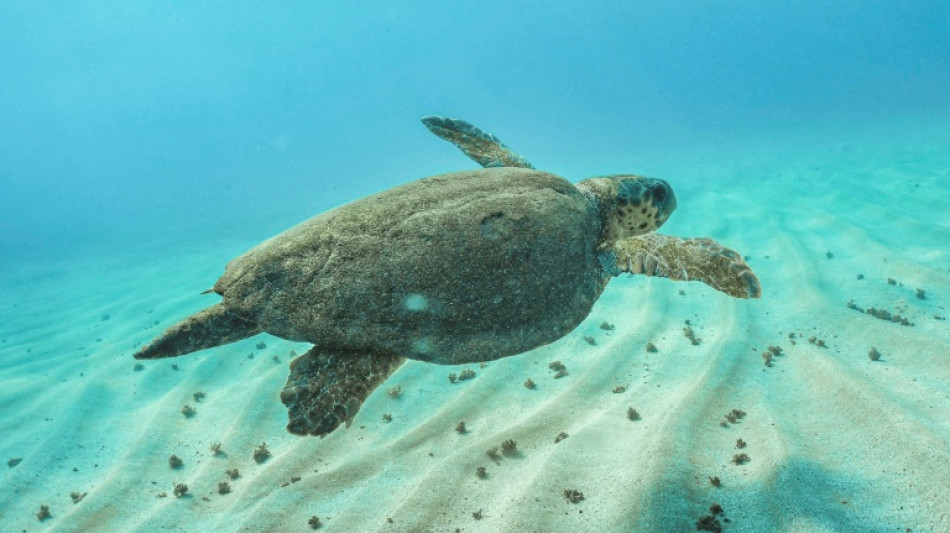
A new global treaty on the high seas will enable the creation of sanctuaries deemed vital for the oceans, but many questions remain unanswered. Among them: How can we protect marine areas far from the coast? Where will they be created, and when?
- Unique, fragile areas -
The text to be adopted at the United Nations on Monday provides for the creation of marine protected areas in international waters, in areas that are unique, particularly fragile or important for endangered species.
Biodiversity is a priority, "but it's not the only important criteria," Minna Epps of the International Union for Conservation of Nature (IUCN) tells AFP, referring also to "ecological functions" in areas conducive to plankton blooms.
One example is the "thermal dome" off the coast of Costa Rica. Each year, the upwelling of nutrient-rich deep-sea water causes an algae bloom, the first link in a food chain that provides a highly hospitable habitat for blue whales.
"You don't want to just protect one ecosystem," adds Liz Karan of the Pew Charitable Trusts, underlining the importance of a "network" that would allow corridors for migratory species.
The network ideally would link high seas marine protected areas with existing protected areas in national waters near coasts.
Based on such criteria, scientists and NGOs have already identified a dozen potential marine areas.
In addition to the "thermal dome," they include the Emperor seamounts that extend across the Hawaiian archipelago in the Pacific, the so-called "lost city" in the middle of the Atlantic with its many hydrothermal vents, and the Sargasso Sea.
Also noteworthy are the Nazca and Salas y Gomez ridges, off the coast of Chile, which could become one of the first sanctuaries established after the treaty.
- When will they be created? -
Not for several years.
"Four years would be very optimistic. Sadly, I think maybe five or six is more realistic," predicts Glen Wright, a researcher at the Institute for Sustainable Development and International Relations (IDDRI), while Epps reckons we won't see any before 2027.
Once adopted, the treaty must be signed and ratified by 60 countries to come into force and enable the Conference of the Parties (COP) to meet.
The COP will be empowered to create a sanctuary on the proposal of one or more states, whereas today it is mainly NGOs that put forward such proposals.
Only Chile has mentioned a formal project at Nazca and Salas y Gomez.
- Objective 30x30 -
Although it will take several years for sanctuaries to be established, the treaty is considered crucial to achieving the goal set by all governments of protecting 30 percent of the planet's land and oceans by 2030.
Without the treaty, "we're not going to achieve 30x30. It's as simple as that," says Jessica Battle of conservation group WWF.
Given the tight timetable, Wright cautions, the contribution of the treaty to 30x30 "may be limited."
- What kind of protection? -
On land and at sea, the degree of protection afforded to reserves of all kinds varies.
On the high seas, "I find it hard to imagine that there will be any large, strictly protected areas," says Wright, who thinks it more viable to create small areas with maximum restrictions (such as a total ban on activities) and others with limited measures -- perhaps seasonally enforced to protect breeding or migrating species.
- Monitoring and enforcement? -
With the oceans' vastness a major issue for enforcement, experts often talk about how technology, in particular satellites, will be used to monitor protected areas.
"The beauty of the high seas is it takes a lot of energy to get out there," says Battle.
"You have to have a boat and the boats will have... a transmitter and so you can track these vessels."
A mechanism to spot unauthorized activity could be set up, similar to one used to monitor global fishing.
The question then becomes how to finance this surveillance and how to force offenders to respect the rules.
Under the treaty, states are responsible for the activities of vessels flying their flag on the high seas. However, the state in question must be a signatory to the treaty.
The text also provides for a "compliance" mechanism, which remains largely undefined.
"If there is proof that a state is flagging a vessel that is behaving contravening the regulations in (a Marine Protected Area), that can be brought to the COP," Battle explains.
"States don't like that. They don't want to be criticized at the international level."
D.Schneider--BTB