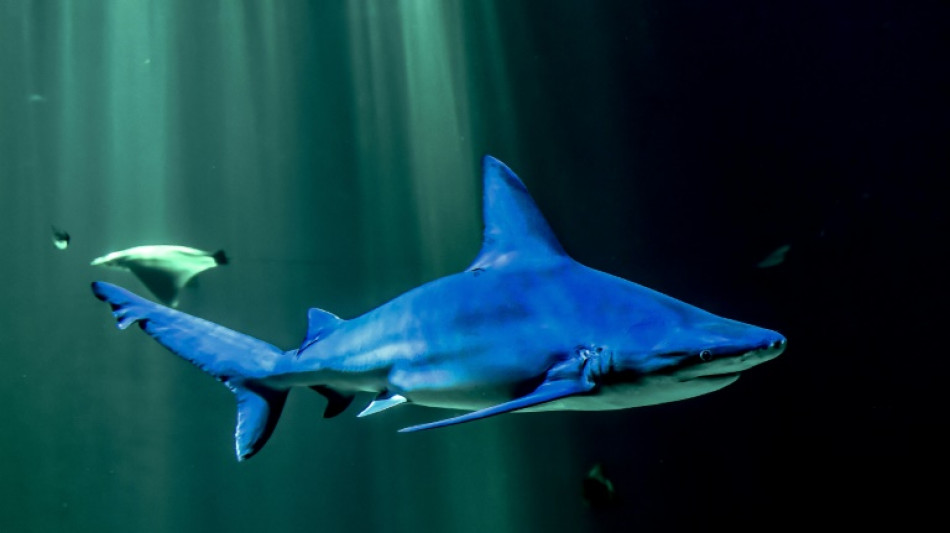
Overfishing pushes reef sharks toward extinction: study / Photo: © AFP/File

 Trump's beef policies irk Texas ranchers, testing their loyalty

 Nvidia, OpenAI CEOs to attend Xi dinner at White House

 Anthropic picks Accenture for in-house AI safety evaluation

 Balogun returns as Monaco beat Lens to continue strong Ligue 1 start

 'Pause' on overt repression in Venezuela, but reforms still needed: HRW

 Global stocks mixed as yen falls despite Bank of Japan rate hike

 Cuba hit with seventh major blackout of the year

 Murray out with concussion so Wentz will start for Vikings

 UN chief 'deeply regrets' US visa refusal to Abbas for annual meeting

 England quick Carse to face no charges over alleged nightclub assault

 Mancini brings nine newcomers into the first squad of his Italy comeback

 Czechs level Davis Cup tie against USA as South Korea eye Finals

 New France boss Zidane confirms Mbappe as captain after naming first squad

 California governor signs order to explore AI 'kill switch'

 Head leads run spree as Australia win Zimbabwe ODI series

 In-form Raphinha wants to finish career at Barcelona

 Warren Buffett steps down as Berkshire Hathaway chairman

 Carrick confident Man Utd can 'work through' tough time

 Mbappe ends Nike partnership to join Swiss brand On

 Liverpool boss Iraola puts Bournemouth love affair on hold

 'A disaster' if Man City do not win says Maresca after flawless start

 Kerry James Marshall: American 'blackness' painter celebrated in Europe

 Spain coach De la Fuente offers 'full support' to people of Ceuta

 Russia seizes assets of Nestle, French firms over West's Ukraine support

 England can build on World Cup 'spirit', says Tuchel

Overfishing is driving coral reef sharks towards extinction, according to a global study out Thursday that signals far greater peril to the marine predators than previously thought.
That matters to humans because the species act as managers of their marine ecosystems, maintaining delicately balanced food webs on which hundreds of millions of people rely.
The research, published in the journal Science, is the result of the Global FinPrint project, which collected more than 22,000 hours of video footage from reefs across Africa, the Middle East, Asia, Australasia and the Americas.
A team of more than 100 scientists found that five of the most common coral reef shark species -- grey reef, nurse, Caribbean reef, blacktip reef and whitetip reef -- declined by 70 to 60 percent.
The depletion data was derived from a computer model that estimated what shark numbers would have looked like without human pressures.
Sharks were entirely absent in 14 percent of reefs where they had been previously documented.
Lead author Colin Simpfendorfer of the James Cook University and the University of Tasmania told AFP that prior to the study, coral reef sharks -- unlike their bigger cousins that dwell in deep oceans -- were not thought to be doing badly.
"But when you sat down and looked at the overall results, it was quite stunning," he said.
- Ripple effects -
The findings should help update the International Union for Conservation of Nature (IUCN) red list, with more species qualifying for "endangered" status, an important step towards conservation action.
Simpfendorfer added that the overwhelming factor in the decline was overfishing, both targeting sharks for their fins and meat, and unintentionally killing them as bycatch.
In terms of impacts, the loss of sharks causes ripple effects down the food chain.
The prey they eat increases in number, but the next level down decreases, and so on -- creating unpredictable disruptions that risk human food security.
Reef sharks also keep herbivores in check, said Simphendorfer. When herbivores become more common, they eat more algae, which trap carbon for use in photosynthesis.
"Carbon sequestration on coral reefs without sharks is much lower than it is on reefs with sharks," he said, meaning there is an impact on global warming.
- 'Hope spots' -
Funding for the project came from the Paul G. Allen Family Foundation, which was responsible for the Great Elephant Census, a pan-African aerial survey of Earth's largest land animals.
In the shark study, scientists used baited remote underwater video stations (BRUVS) -- cameras with a small amount of oily fish hung placed on arm -- to draw out and observe sharks in deployments that lasted an hour.
In total, they surveyed 391 coral reefs in 67 nations and territories using 22,756 cameras -- generating three-years-worth of raw video.
Reefs with healthier populations tended to be in high-income countries with stronger regulations and greater levels of democratic participation, while lower-income countries generally had worse outcomes.
But the team also uncovered certain "hope spots" in developing countries, such as Sipadan Island in Malaysia and Lighthouse Reef in Belize.
"In and around them, things are fairly depleted -- but in those areas where you have strong MPAs (marine protected areas) and really good ways to enforce them, you have robust shark populations," co-author Michael Heithaus of Florida International University told AFP.
This, he said, offered hope that heavily depleted areas can be repopulated so long as a source population is intact and careful management programs are followed.
R.Adler--BTB