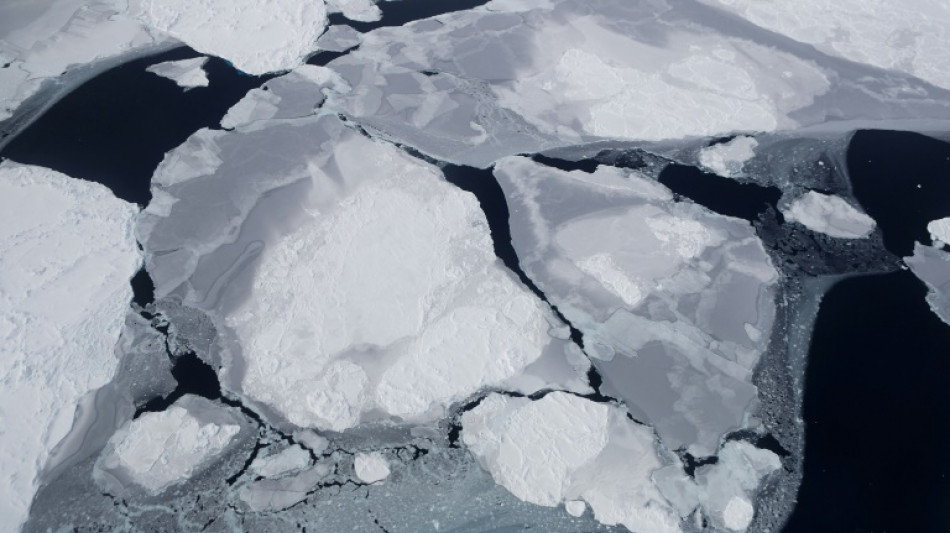
Ice sheets could retreat faster than expected: study / Photo: © GETTY IMAGES NORTH AMERICA/AFP

 Helicopters battle wildfire threatening Ecuador's capital

 Brentford batter Chelsea to undo Alonso's promising start

 Kane hits Bundesliga century as Bayern rout Union

 Trump says CNN, MS NOW, Politico banned from White House

 Hushing and hedging: US companies retreat on climate

 Springboks to face Fiji before 2027 Rugby World Cup

 Nigeria miners struggled to breathe in cell before 37 died: survivors

 McIlroy on the charge at PGA Championship as Reed withdraws

 McIlroy on the charge at PGA Championship

 Crisis-wracked Volkswagen warns of 10-bn-euro hit to profits

 Costa Rica's Grynspan tops third informal poll for UN chief: diplomat

 Stock markets retreat after central bank rate hikes

 Russia labels director of Cannes Grand Prix winner a 'foreign agent'

 Macron warns of Russian 'hybrid' threat after meeting presidential hopefuls

 UN holds third informal poll for new chief

 Kulusevski return can spark Spurs: De Zerbi

 Shakira to cap off world tour with Madrid 12-gig run

 Isolated Syrian-Druze city blames Damascus for shortages

 Isolated Syrian-Druze city shortages

 Dutch drop Depay for Germany match in Xavi's first pick

 Ronaldo named in Portugal squad for Nations League

 Stock markets diverge after central bank rate hikes

 Anti-Assad music star makes triumphant return to Syria

 In-form Fernandez included in Spain Nations League squad

 Arteta buries hatchet with Hurzeler ahead of Brighton clash

Antarctic ice-sheets risk breaking into the sea faster than previously thought in stretches of up to 600 metres a day, speeding up the rise in sea levels, new research indicates.
In a paper published Wednesday in science journal Nature, researchers studied traces left by retreating ice-shelves thousands of years ago on the seabed off Norway.
Ridges revealed how quickly the "grounding line" -- the point where an ice sheet starts to float -- had retreated during the transition from the last ice age: from 55 to 610 metres (667 yards) a day.
"These values far exceed all previously reported rates of grounding-line retreat across the satellite and marine-geological records," they wrote.
They calculated that similar low-lying ice sheets in the Antarctic such as around the so-called Thwaites "doomsday" glacier could retreat at a similarly quick rate under current climate conditions.
Global warming due to human-caused carbon emissions is reducing ice, raising warnings that dangerous "tipping points" could be reached, with sudden major melting driving sharp rises in sea level.
"Our study shows that pulses of extremely rapid ice-sheet retreat could occur across flat-bedded areas of Antarctica even under present-day rates of melting," lead author Christine Batchelor of Newcastle University told AFP.
"Whilst our findings cannot tell us when or if an ice-loss tipping point will be reached, they shed new light on which parts of ice sheets are vulnerable to retreat and how fast such retreat could occur."
J.Bergmann--BTB