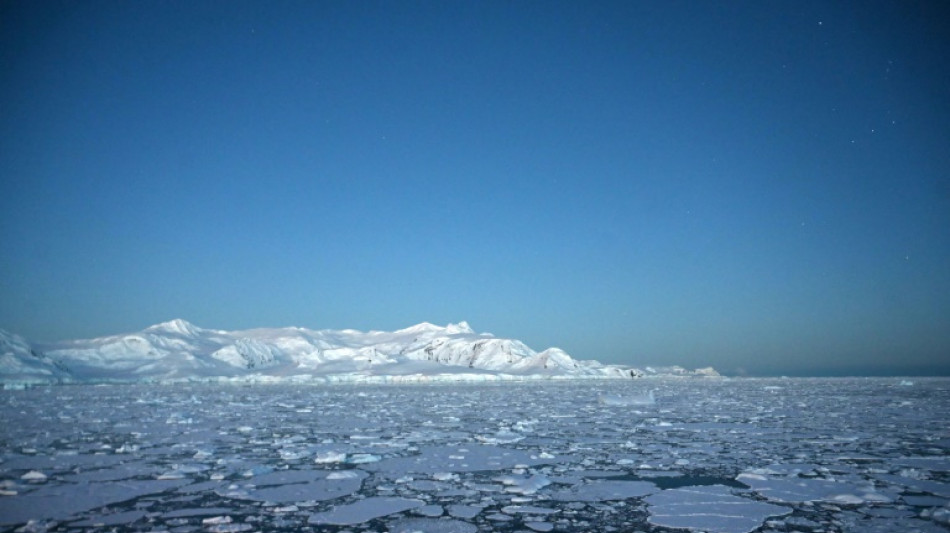
Antarctic sea ice cover at record low / Photo: © AFP/File

 Hushing and hedging: US companies retreat on climate

 Springboks to face Fiji before 2027 Rugby World Cup

 Nigeria miners struggled to breathe in cell before 37 died: survivors

 McIlroy on the charge at PGA Championship as Reed withdraws

 McIlroy on the charge at PGA Championship

 Crisis-wracked Volkswagen warns of 10-bn-euro hit to profits

 Costa Rica's Grynspan tops third informal poll for UN chief: diplomat

 Stock markets retreat after central bank rate hikes

 Russia labels director of Cannes Grand Prix winner a 'foreign agent'

 Macron warns of Russian 'hybrid' threat after meeting presidential hopefuls

 UN holds third informal poll for new chief

 Kulusevski return can spark Spurs: De Zerbi

 Shakira to cap off world tour with Madrid 12-gig run

 Isolated Syrian-Druze city blames Damascus for shortages

 Isolated Syrian-Druze city shortages

 Dutch drop Depay for Germany match in Xavi's first pick

 Ronaldo named in Portugal squad for Nations League

 Stock markets diverge after central bank rate hikes

 Anti-Assad music star makes triumphant return to Syria

 In-form Fernandez included in Spain Nations League squad

 Arteta buries hatchet with Hurzeler ahead of Brighton clash

 Alexander-Arnold and Palmer return to England squad for Nations League

 Russians vote as Ukraine war drags on for fifth year

 Backpackers fret over Australian visa crackdown

 Most Asian stocks track Wall St rally, yen drops after BoJ rate hike

Sea ice in Antarctica shrank to the smallest area on record in February for the second year in a row, continuing a decade-long decline, the European Union's climate monitoring service said Tuesday.
On February 16, the ocean surface covered by ice around the frozen continent shrank to 2.09 million square kilometres (800,000 square miles), the lowest level since satellite records began, according to figures provided to AFP by the Copernicus Climate Change Service (C3S).
"Antarctic sea ice reached its lowest extent in the 45-year satellite data record," said Samantha Burgess, Deputy Director of C3S.
US government scientists have also confirmed a new record last month but indicated an even lower figure of 1.79 million sq km, a difference Copernicus attributed to "different sea ice retrieval algorithms".
Sea-ice concentrations during the southern hemisphere summer were well below average in all sectors of the Southern Ocean.
Startlingly, the record lows this year and in 2022 are about 30 percent below the 1981-2010 average.
"These low sea-ice conditions may have important implications for the stability of Antarctic ice shelves and ultimately for global sea level rise," said Burgess.
"Polar ice caps are a sensitive indicator of the climate crisis."
Melting sea ice has no discernible impact on sea levels because the ice is already in ocean water.
- A new trend -
But diminished ice cover is nonetheless a major concern because it helps accelerate global warming, including in the Arctic region.
About 90 percent of the Sun's energy that hits white sea ice is reflected back into space. But when sunlight hits dark, unfrozen ocean water, nearly the same amount of that energy is absorbed instead, contributing directly to a warming planet.
Both the North and South pole regions have warmed by roughly three degrees Celsius compared to late 19th-century levels, three times the global average.
But unlike sea ice in the Arctic, which has diminished by three percent a year since the late 1970s, sea ice in Antarctica has remained relatively constant over the same period, albeit with large annual variations.
Until recently -- over the last eight years -- minimum sea ice extent in the Southern Ocean has consistently been below the average for the 1991-2020 period.
Antarctica encountered its first recorded heatwave in 2020, with an unprecedented 9.2C above the mean maximum. In March last year, a research centre in eastern Antarctica saw temperatures soar 30 degrees above normal.
Recent ice cover during the austral summer has shrunk most around West Antarctica, which is more vulnerable to the impacts of global warming than the far larger East Antarctica.
The record minimum sea ice extent in the Arctic -- 3.4 million square kilometres -- occurred in 2012, with the second- and third-lowest ice-covered areas in 2020 and 2019, respectively.
In 2021, The UN's IPCC climate science advisory panel forecast with "high confidence" that the Arctic Ocean would become practically ice-free in September at least once by mid-century.
I.Meyer--BTB