$860 mn pledge kicks off Our Ocean conference / Photo: © AFP/File

 Hushing and hedging: US companies retreat on climate

 Springboks to face Fiji before 2027 Rugby World Cup

 Nigeria miners struggled to breathe in cell before 37 died: survivors

 McIlroy on the charge at PGA Championship as Reed withdraws

 McIlroy on the charge at PGA Championship

 Crisis-wracked Volkswagen warns of 10-bn-euro hit to profits

 Costa Rica's Grynspan tops third informal poll for UN chief: diplomat

 Stock markets retreat after central bank rate hikes

 Russia labels director of Cannes Grand Prix winner a 'foreign agent'

 Macron warns of Russian 'hybrid' threat after meeting presidential hopefuls

 UN holds third informal poll for new chief

 Kulusevski return can spark Spurs: De Zerbi

 Shakira to cap off world tour with Madrid 12-gig run

 Isolated Syrian-Druze city blames Damascus for shortages
 Isolated Syrian-Druze city shortages

 Dutch drop Depay for Germany match in Xavi's first pick

 Ronaldo named in Portugal squad for Nations League

 Stock markets diverge after central bank rate hikes

 Anti-Assad music star makes triumphant return to Syria

 In-form Fernandez included in Spain Nations League squad
 Arteta buries hatchet with Hurzeler ahead of Brighton clash

 Alexander-Arnold and Palmer return to England squad for Nations League

 Russians vote as Ukraine war drags on for fifth year

 Backpackers fret over Australian visa crackdown

 Most Asian stocks track Wall St rally, yen drops after BoJ rate hike

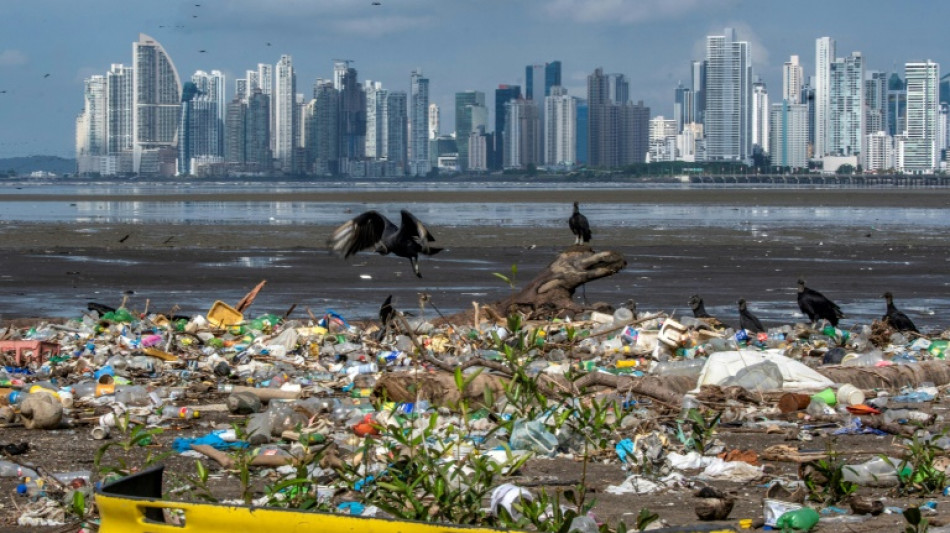
A global conference to save the world's oceans kicked off in Panama on Thursday with an EU pledge of more than $860 million for research, monitoring and conservation in 2023.
For two days, political and business leaders, environmental activists and academics are grappling with how best to address a multitude of threats facing the oceans -- from climate change and pollution to overfishing and mining.
The European Union used the stage of the Our Ocean conference to announce it would dedicate 816.5 million euros ($865 million) to ocean-related projects this year.
The bulk of the money, some 320 million euros, would go towards research to protect marine biodiversity and address the impacts of climate change on the seas, it said.
Another 250 million euros would go to the launch of the Sentinel-1C satellite to observe ice melt and monitor climate change effects, and 24 million euros to improving fisheries management.
"The ocean is part of who we are, and it is our shared responsibility," EU environment, oceans and fisheries commissioner Virginijus Sinkevicius said in a statement.
US climate envoy John Kerry attended Thursday's opening, where Panama President Laurentino Cortizo signed a decree to enlarge the Banco Volcan Marine Protected Area (MPA) from 14,000 to 93,000 square kilometers (about 5,400 to 36,000 square miles).
Panama will now be conserving more than 54 percent of the ocean inside its exclusive economic zone, said the country's environment minister Milciades Concepcion.
For Kerry, the conference is "incredibly important because it... is focused on action not on talk. It's about real commitments and real solutions."
- Ocean 'under pressure' -
On the eve of the conference, representatives of the European Union, the United States, Latin America and the Pacific Islands called for a treaty on the high seas, which has been under discussion at the United Nations for more than 15 years, to be signed as soon as possible.
Delegates have been meeting in New York since February 20 to conclude a text in the latest round of talks due to end Friday.
The high seas, which are not under the jurisdiction of any country, represent more than 60 percent of the oceans and nearly half of the planet.
UN Secretary-General Antonio Guterres called Wednesday for negotiators to conclude a "robust and ambitious" treaty on the high seas.
"Our ocean has been under pressure for decades. We can no longer ignore the ocean emergency," he said.
Other topics on the Our Ocean agenda include expanding Marine Protected Areas and developing a sustainable ocean-derived "blue economy."
Covering three-quarters of the Earth, the oceans are home to 80 percent of all life on the planet, and provide nourishment for more than three billion people.
- Mining and overfishing -
Since the first Our Ocean conference in 2014, participating nations have committed more than $108 billion and protected more than five million square miles of ocean, according to organizers.
Observers say the Our Ocean gathering is the only conference to address all ocean-related issues under one roof.
It also serves as a public stage for governments, through senior ministers in attendance, to put on a show of political will.
Conference delegates do not adopt agreements or vote on proposals, but rather announce voluntary "commitments" to ocean protection.
The meeting takes place as multinational companies eye minerals on the ocean floor.
These include so-called manganese nodules, settled on the seabed, that contain metals critical in battery production.
Environmentalists say harvesting them would be devastating for deep-sea ecosystems.
NGOs are also concerned about overfishing, pushing at the Panama conference for satellites to be used to monitor fishing fleets.
"A third of commercial (maritime) species are over-exploited," said Monica Espinoza of Global Fishing Watch, an NGO.
Governments must "require that their fishing fleets... are traceable full-time by satellite, so that we know that they are fishing honestly," Andrew Sharpless, executive director of the NGO Oceana, told AFP.
R.Adler--BTB