Chinese quadriplegic runs farm with just one finger / Photo: © AFP

 Mbappe says having Zidane as France coach 'like a film'

 Palmer, Rice out of England Nations League squad
 German auto workers stage mass protests in bid to save jobs
 Embattled Merz vows to keep ruling for 'democratic future' of Germany

 Merz vows to keep ruling coalition together for 'democratic future' of Germany
 Spain coach De la Fuente gets new deal after World Cup success
 Pressure grows on Germany's Merz after election defeats

 China's Zhang beats Japan rivals to Asian Games gymnastics gold

 Samlingen Haupt: Vad pengar avslöjar om oss människor

 Tens of thousands of German auto workers protest to save jobs

 हॉप्त् कलेक्शन: पैसा हमारे बारे में एक इंसान के रूप में क्या प्रकट करता है

 Συλλογή Haupt: Τι αποκαλύπτει το χρήμα για εμάς τους ανθρώπους

 TradersYard Shifts Focus to Futures Trading

 ハウプト・コレクション:お金が人間について明かすこと
 하우프트 컬렉션: 돈이 우리 인간에 대해 드러내는 것

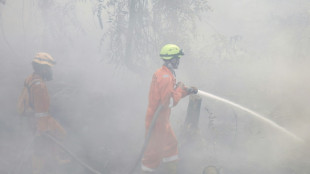 Indonesia doing 'everything' but struggling to curb fires
 Sbírka Haupt: Co o nás lidech prozrazují peníze

 North and South Korea fight out draw in niggly Asian Games clash

 Officials say man shot, wounded by ICE agent in Texas

 豪普特收藏:金錢如何揭露人類的本質

 Kolekcja Haupta: Co pieniądze mówią o nas, ludziach
 The Haupt Collection: What Money Reveals About Us as Human Beings

 Barcelona enter new era aiming to retain Women's Champions League crown

 US has deported 25,000 to third countries under secretive deals: report
 Three South Korean soldiers injured in DMZ blast: military
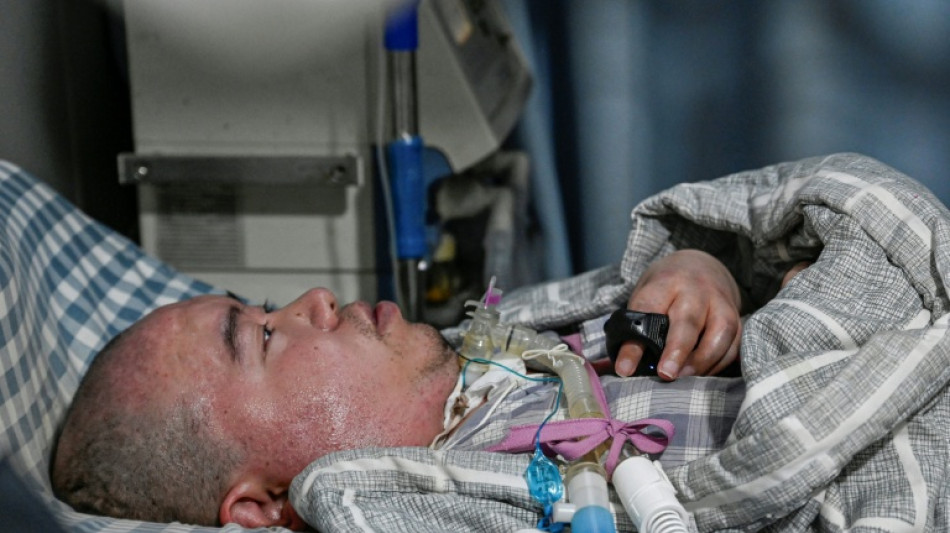
Quadriplegic and bedridden in a prefabricated home, 36-year-old Li Xia can only move one finger and one toe -- yet he runs a high-tech farm in southwestern China using sensors, cameras and a computer.
Li, who suffers from a genetic degenerative condition that progressively weakens muscles, relies on a ventilator permanently connected to his windpipe to breathe, but grows celery with the help of his 62-year-old mother.
From his bed, he operates four greenhouses that lie 10 metres (33 feet) away via a programme he created and a computer screen hanging above him on an adjustable arm.
"Through this microcomputer and the programme I developed, and a mobile app, I can monitor various data points from the farm, such as temperature, humidity, nutrient solution concentration, and pH levels," Li told AFP.
"With the cameras, I can see if the water pump is working or if the fans are running."
With the one finger he is able to move, he controls the on-screen cursor using a trackball.
"To click, I use a flex sensor attached to my toe," said Li from his home in Shiping village, near the southwestern city of Chongqing.
Duchenne muscular dystrophy (DMD), which he suffers from, is an incurable genetic disease that affects almost exclusively males, at a rate of one in 5,000 births.
Over the years, it causes muscles to weaken, increasing the risk of falls, before paralysis sets in, affecting cardiac activity and breathing.
Until the early 2000s, boys with the condition rarely lived beyond their teens. But with comprehensive care, survival into the 30s and even 40s is possible.
Li, who was once able to get around in a wheelchair, experienced a sudden medical crisis in 2020 when he was 30 years old. He fell into a coma, became incontinent and quadriplegic.
"I was devastated," he said.
"But after a few months, I pulled myself together and looked for things that made sense."
- A way forward -
He discovered hydroponics, an innovative cultivation technique where vegetables are grown not in soil, but in a solution of water enriched with essential nutrients.
Partially automated, it requires little manual labour, allows for crops to be precisely controlled and ensures good yields.
"I grew up in the countryside, so I've always been in contact with seeds, soil and vegetables," he said.
"I also love digital technologies and programming. I realised I could combine the two."
Li taught himself computer programming and learned how to design a circuit board.
His case is in many ways similar to others with severe neuromotor disorders, such as British physicist and cosmologist Stephen Hawking, who was confined to a wheelchair and could only communicate through a voice synthesiser.
Or Jean-Dominique Bauby, who was paralysed after a stroke and authored his 1997 book "The Diving Bell and the Butterfly" by blinking his left eye, the only movement he could still control.
For the farm tasks involving manual labour, Li is reliant on his mother Wu Dimei.
"She is my arms and legs, and I am her brain," he said.
- 'Quite happy' -
Li explains what needs to be done and supervises her work in the greenhouses via a video link to his smartphone.
Wu operates tools, measures out fertiliser, installs equipment and connects cables.
In addition to farm work, she provides for her son day and night, including cooking and cleaning the ventilation tube in his windpipe.
"I don't have time to rest," Wu told AFP.
Even with the help of her daughter, who regularly helps bathe her brother, Wu only sleeps three to five hours a night.
"But it's worth it," said Wu, who is divorced. "It may not seem like it, but our family is quite happy."
They mainly rely on the income of Li's sister, who works, and their mother's pension.
Li said he saw the high-tech farm as a "niche" with "great prospects", and hoped to provide his family with a livelihood.
"If I succeed, it would allow me to fulfil a dream, but also to earn money and improve our living conditions," he said.
They moved to a prefabricated portable home in 2022, and his celery is now sold to a local supermarket chain.
"We're not making a profit yet," said Li, who embarked on his venture in 2022
"But my dream is to expand this farm, turn it into a successful business, produce more and earn more.
"My motivation is to see our vegetables grow, be harvested, sold and end up on people's plates."
D.Schlegel--VB