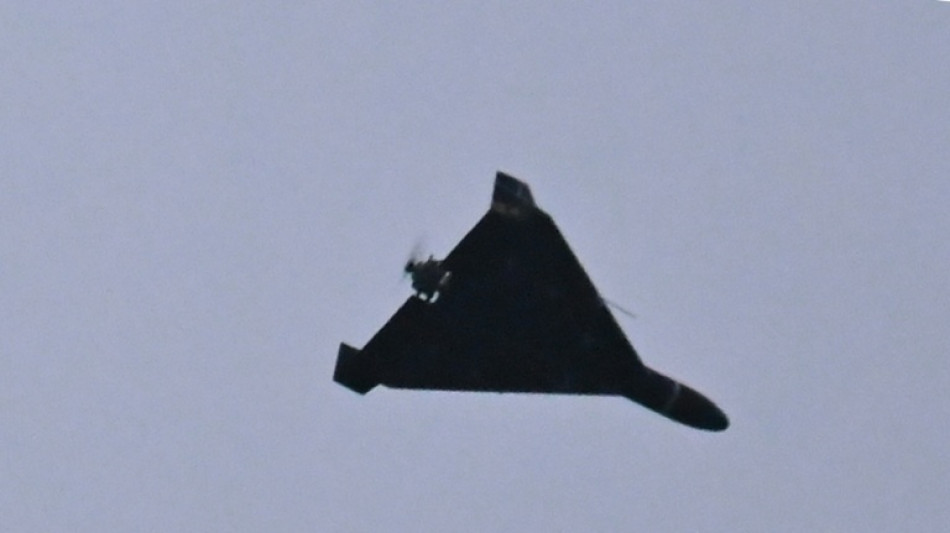
Why Iranian drones are hard to stop / Photo: © AFP/File

 Verstappen edges Russell in final practice in Azerbaijan

 English, Spanish, Italian, German football leagues call for FIFA reform

 Pope arrives in France on first official visit in 18 years

 Pope arrives in France on first state visit in 18 years

 Heavy fighting, internet disruption as Ethiopia conflict rages

 From transit to consumption: drug use surges in Mozambique

 Chicago teams, Guardians and Padres all book MLB playoff berths

 Bijan Robinson destroys Packers in 35-14 win for Falcons

 Harimoto hails new era as Japan dethrone table tennis kings China

 India rape cases turn focus back onto women's safety

 Rebellious Afghan taxi drivers defy ban on music

 Brazil candidates mount digital armies for fierce online campaign

 Nepal PM says floods 'a warning to the world' about climate change

 Trump hosts Xi for state dinner as pomp masks tensions

 Scheffler and Burns give US 3-2 Presidents Cup lead

 Hollywood stars among 100 arrested in NY anti-Netanyahu protest

 Klopp denied on Germany debut as Portugal win in Nations League

 Rich nations should foot climate bill, says Nepal minister

 Wellalage and Mendis star as Sri Lanka level England series in thriller

 Felix gives Portugal win over Wales as Ronaldo misfires

 Wellalage and Mendis star as Sri Lanka level England ODI series
 Guyana urges Venezuela at UN to respect ICJ's ruling on Essequibo region

 Argentina coach says Messi deserves to go out on own terms

 Xi sets red lines for Trump despite lavish White House welcome

 Cowboys, Ravens happy with footing for first Rio NFL clash

Cheap and deadly, Iranian-designed Shahed drones have inflicted major damage in the Middle East war, and have anti-jamming and other capabilities that make them difficult to stop.
- Offline navigation -
Designed to explode on impact, Shahed drones connect to GPS to register their location shortly before or after takeoff, then typically turn off their receivers, said Thomas Withington, a researcher at Britain's Royal United Services Institute (RUSI).
The drones then travel long distances towards their target using gyroscopes that measure their speed, direction and position -- known as an "inertial navigation system".
"GPS is going to get jammed by whatever is protecting the target," Withington told AFP.
"If you look at a map of GPS jamming at the moment in the Middle East, you see that there's a lot of jamming... By not using the GPS, you avoid that."
The drones can then return to GPS just before impact for a more precise strike, or remain offline.
"It's not always necessarily very accurate, but it's as accurate as it needs to be," said Withington.
- Anti-jamming mechanisms -
Russia has been making Shahed-style drones to use in its war in Ukraine.
The US-based Institute for Science and International Security found in 2023 that those drones used "state-of-art antenna interference suppression" to remove enemy jamming signals while preserving the desired GPS signal.
Anti-jamming mechanisms were found in the wreckage of an Iranian-made drone that struck Cyprus in the opening days of the Middle East war, a European industry source told AFP.
"They have put (the Shahed) together using off-the-shelf parts, but it has... many of the capabilities that US military GPS equipment has," Todd Humphreys, a professor of aerospace engineering at the University of Texas at Austin, told AFP.
Defending against them now requires sophisticated electronic warfare equipment.
"The Shaheds have been upgraded," said Ukrainian air force spokesman Yuriy Ignat.
- Stealth materials -
The Shahed is built from "lightweight radar-absorbing materials", such as plastic and fibreglass, a 2023 RUSI paper said.
Their small size and low altitude allow them to slip through aerial defence systems.
- Other positioning systems? -
Some experts think Iran is using multiple positioning systems, making it easier for its drones to dodge jamming.
Serhii Beskrestnov, a technology adviser to the Ukrainian defence ministry, said Iran is using the BeiDou system, a Chinese rival to the US-developed GPS.
And the Russia-made version of Shaheds uses both BeiDou and the Russian equivalent, GLONASS, he said.
Others suspect Iran may be using LORAN, a radio navigation system developed during World War II.
LORAN, which does not require satellites, largely fell out of use when GPS emerged.
But Iran said in 2016 it was reviving the technology, which requires a network of large ground-based transmitters, though experts have not confirmed it is active today.
- Counter-strategies -
Militaries have mainly defended against Shaheds by shooting them down with cannon fire, missiles and interceptor drones, with the United States and Israel also developing lasers.
But jamming can work, as Ukraine has shown, as can "spoofing", which involves hacking into the drone's navigation system to change its destination.
Ukraine used electronic warfare to neutralise 4,652 attack drones from mid-May to mid-July 2025 -- not far off the number it shot down in the same period, 6,041, according to AFP analysis of Ukrainian military data.
Its experts insist that electronic and conventional defences are often used in tandem against the drones.
M.Betschart--VB