Trump tariffs shake up China's factory heartland / Photo: © AFP

 Trump announces deal for huge US stake in Venezuelan oil reserves

 Kane confirms talks on Bayern extension

 Trump govt. mulls deal to give away part of Yosemite park

 Indian release of Sonia Gandhi memoir uncertain after publisher clarification

 Cities show cleaner transport policies can reduce severe air pollution

 Four patients harmed in Nashville hospital medication mix-up

 Essex council hires private guards as Wethersfield asylum centre expands

 Haakon VIII becomes Norway's king after Harald V dies at 89

 Six injured after sign falls at Christian festival in West Sussex

 Dubai airport expands scanners that keep laptops and liquids in bags

 Kuwait and Pakistan sign military cooperation agreement

 Ramos strikes as AC Milan beat Venezia

 Odisha faces very heavy rain as Sri Ganganagar reaches 41.4C
 Scammers in China exploit Microsoft Teams and other workplace apps to target victims

 GSA employees report mice, ceiling damage and cloudy water after Washington office move

 Cara and former scraper develop open-source tool to alert artists when work appears in AI datasets
 Google expands easier file sharing between Android phones and Apple devices

 UK chefs turn to induction cooking to reduce kitchen heat, energy use and pollution
 Restored Cheshire wetland becomes key UK breeding site for black-necked grebes
 Bayern steamroll Stuttgart in Bundesliga opener

 England pace quartet might keep Archer going until he is 40

 Driven by distraction? Trump steps up stunts as US midterms loom

 Springboks a wounded beast, warns All Blacks captain Savea

 Trump announces new US 'Space Academy'

 Best Laser Printers in India: Top Options from HP, Brother and Canon

In a drab office in China's industrial heartland, Andy Xiao frets over the future of his shoe materials business, now straining under sweeping tariffs imposed by Donald Trump.
The US president has targeted friend and foe alike since taking office a month ago, notably slapping additional 10 percent duties on products imported from China.
The move could affect hundreds of billions of dollars in trade and may worsen if the mercurial magnate follows through on his threats of even higher customs levies.
But for Xiao, the policy is already having "a major impact" on his firm, Weida New Materials.
Based in the southern city of Dongguan, the company makes artificial leather for shoe manufacturers, many of whom export to the United States.
The model leaves him vulnerable to downturns in shipments, a distinct possibility as Trump looks to upend trade rules.
"This has put a lot of pressure on us in China, and factories are also under pressure," said Xiao, adding that some shoe manufacturers have already requested lower prices in response to the new tariffs.
"There are definitely some concerns" about further hikes, he said, "but that is a matter of national policy –- it's not up to us".
Xiao said that if exports run into insurmountable hurdles, Weida may be forced to change its business model.
"If there is business (in the United States), we'll do it. If not, we can find other business domestically. We're not just targeting a single overseas customer, are we?"
Many suppliers in Dongguan -- home to a dense concentration of garment exporters -- have migrated operations to Southeast Asia in recent years, seeking lower labour costs and less stringent customs duties as trade frictions between Beijing and Washington persist.
But Xiao, who entered the industry in 2014, said he had resisted the trend as many companies ended up struggling with unforeseen challenges like getting paid for shipments on time.
"Firms have migrated in recent years, but feedback of many people that went there wasn't very good," said Xiao.
"They encountered many difficulties," he said, such as obstacles in settling payments with currencies other than China's yuan.
"The risks are great."
- When the levy breaks -
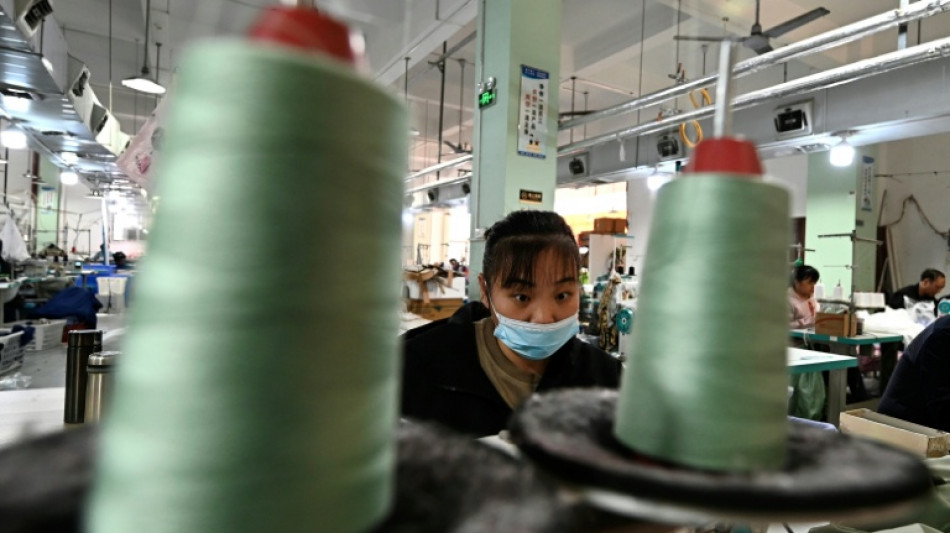
In a factory complex in the city of Guangzhou, rows of staff bend over clattering sewing machines, churning out heaps of clothes for bargain-seeking American online shoppers.
The workshops are among thousands to see orders surge in recent years by supplying hyper-efficient e-commerce platforms Shein and Temu, which have taken the United States by storm.
Those brands have built their models largely on a US policy known as the de minimis exemption, which allows goods with a value of $800 or less to enter the country duty free.
Trump has said the 10 percent tariff will also apply to those products –- but imports have continued as usual while authorities figure out the logistics of taxing the torrent of shipments.
Still, Zhu, a factory production manager in his late thirties whose company exports to the United States, said he was "relatively optimistic" about business prospects.
Zhu said he had noticed a significant uptick in orders in recent years, as the new low-cost e-commerce giants amass huge customer bases in developed countries.
"If you think about it, the United States definitely will not produce its own clothing," he said.
"They have become used to relying on manufacturing in Southeast Asia and China... so future prospects for the processing industry are still pretty good," he told AFP.
- No Trump slump, yet -
China has stated "resolute opposition" to Trump's fusillade of tariffs, responding with reciprocal measures and warning of further moves to protect its economic interests.
Beijing is battling long-term economic problems of its own, with slowing growth adding to a debt crisis in the property sector, low consumption and high youth unemployment.
The country's southern export belt provides jobs to millions of people, many of them migrants from deprived rural areas.
But workers in an area unofficially dubbed "Shein town" mostly shrugged off the tariffs -- at least while their impact remains bearable.
"Production is busy so we just focus on that," said Peng, Zhu's coworker, adding that it was a matter for senior management.
Zhong, a manager at a clothing factory in the nearby city of Zhongshan, told AFP while perusing local job boards he was not worried about trade frictions with the United States.
The manufacturing hub where he works has also been bustling in recent years, Zhong said, adding that he had come to "Shein town" to compare employment scenes.
"I think our government will be able to respond and figure out a solution," he told AFP, as hundreds of workers behind him walked back to the factories for afternoon shifts.
M.Schneider--VB