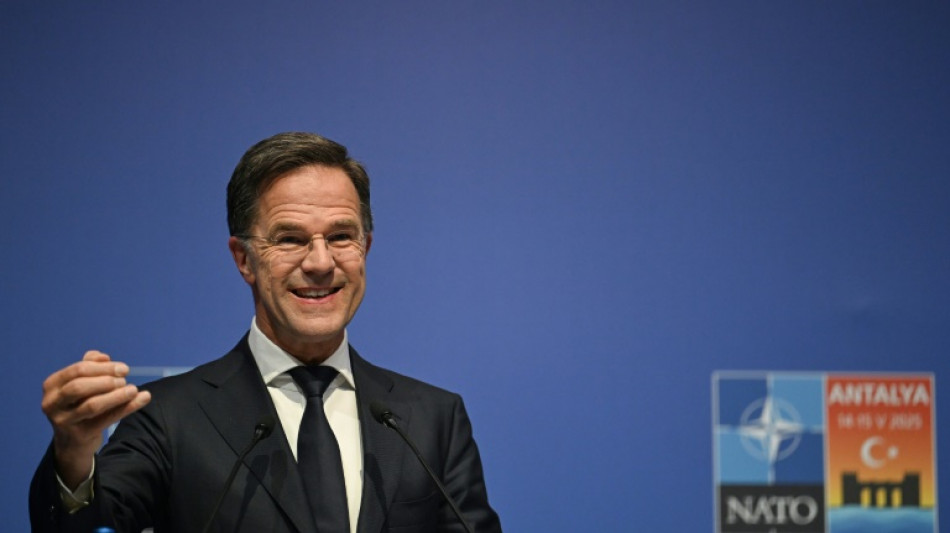
NATO on track to strike spending deal to please Trump / Photo: © AFP

 'American Doctor' shows brutality of conflict in Gaza
 New Zealand blocks lawsuits against firms over climate harm

 Aussie Rules club suspends five players amid police probe
 No.1 Sabalenka slams Wang to power ahead in Cincinnati
 Israel blames Turkey after strike on Syria air base
 Trump, Carney talk as Canada seeks to hold off new US tariffs

 NASA images reveal crater left by SpaceX rocket's Moon crash
 UN atomic watchdog says found tons of nuclear material at Syria site
 Ecuadoran diplomat enters race to be next UN chief

 US sanctions ICC chief Tomoko Akane of Japan

 US moves to open vast tracts of pristine forests to logging

 US sanctions International Criminal Court chief Tomoko Akane of Japan
 Meta hooked children and misled public: prosecutors

 France's first women's rights minister Yvette Roudy dies, aged 97
 French producer Nicolas Altmayer, Dior PR chief Favier die in car crash
 Bezos consortium bought nearly 40 percent of Liverpool: report

 Trump says no Iran talks planned, claims Hormuz 'new US territory'

 Canada seeks to avert new US tariffs as deadline looms
 US primaries test Democrat comeback hopes in Trump stronghold
 Scientists discover how narwhals grow nature's only straight tusk
 DR Congo Ebola outbreak 'far from being under control': WHO chief

 Firefighters in 'decisive' push to encircle Belgian wildfire
 Tribal Partners with ServiceNow to Empower Enterprise Teams to Build and Deploy Apps & Agents

 Fusion Markets Extends Negative Balance Protection to Clients Globally
 India close on victory in first Test against Sri Lanka
NATO appears headed for a compromise deal at a summit next month to satisfy US President Donald Trump's demand to spend five percent of GDP on defence, as heavyweights Germany and France got on board Thursday.
To make the volatile US leader happy, NATO chief Mark Rutte has floated a proposal for members of the 32-country alliance to commit to 3.5 percent of GDP on direct military spending by 2032, and an additional 1.5 percent on broader security-related expenditure.
That would hand Trump the headline figure he is demanding, while giving enough wiggle room to European allies that are struggling just to reach NATO's current spending target of two percent of GDP.
German Foreign Minister Johann Wadephul gave a major push to the plan at a meeting with his NATO counterparts in Turkey by saying Berlin was willing to "follow" Trump's call.
Wadephul said Rutte's suggestion would mean reaching "the five percent that President Trump demanded, which he considers necessary".
"And we follow him there," he said.
Fellow European big-hitter France's Foreign Minister Jean-Noel Barrot also gave a thumbs-up to outlines of the deal.
"The 3.5 target is the right amount for core defence spending," Barrot told journalists in Turkey.
The support from Germany and France will make it more difficult for other European allies and Canada to say no to the spending deal at the June NATO summit in The Hague.
The overall plan already has the backing of the United States.
- 'Quite confident' -
Rutte said he was "quite confident" for an agreement given that there was a widespread understanding of the need to do more in the face of Western estimates that Russia needs only three to five years to rebuild its forces.
The NATO chief declined to give details of the discussions, with six weeks of fine-tuning still to go before the summit.
But he said broader spending, such as on infrastructure like bridges needed to move military hardware around, had to "be taken into account", and that there needed to be a "credible path" set out for each NATO country to hit the figures.
Diplomats say Rutte's plan, which has not been made public, envisions ratcheting up direct defence spending by 0.2 percentage points each year over the next seven years until countries hit the 3.5 target.
The other 1.5 percent of more loosely defined spending could include a wide range of areas encompassing infrastructure, cyber defence, border controls and even support for Ukraine.
Trump has rattled European allies worried about the menace from Russia by threatening not to protect countries that, in his eyes, do not spend enough.
In a bid to avoid upsetting Washington, there was no sign of public dissent at the meeting in Turkey.
Italian Foreign Minister Antonio Tajani announced Italy had this week hit NATO's two-percent spending target.
"This is the first step. Then it's possible to do more, it's possible to increase the money for defence," he said.
He insisted Rome is keen to talk more broadly "about security, because security is not only weapons".
European allies have ramped up their defence spending since Russia's 2022 invasion of Ukraine, but only in the face of Trump are stragglers such as Italy, Spain, Belgium and Canada reaching two percent this year.
None of NATO's 32 countries, including the United States, currently spend five percent of GDP on defence.
Eastern members most worried about Moscow, such as the Baltic states and Poland, have already said they are willing to go beyond that level on direct military expenditures.
L.Stucki--VB