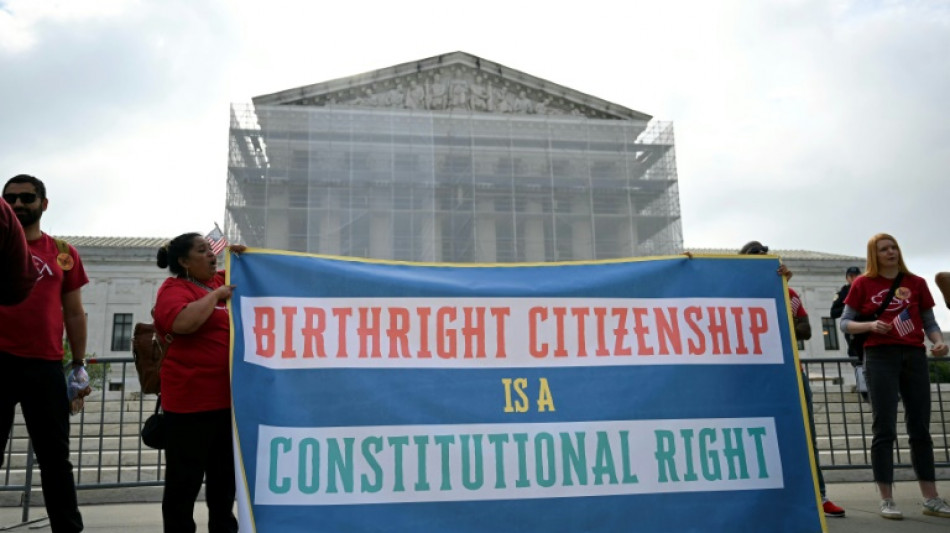
US Supreme Court weighs judicial checks on Trump with birthright case / Photo: © AFP

 'American Doctor' shows brutality of conflict in Gaza

 New Zealand blocks lawsuits against firms over climate harm

 Aussie Rules club suspends five players amid police probe

 No.1 Sabalenka slams Wang to power ahead in Cincinnati

 Israel blames Turkey after strike on Syria air base

 Trump, Carney talk as Canada seeks to hold off new US tariffs

 NASA images reveal crater left by SpaceX rocket's Moon crash
 UN atomic watchdog says found tons of nuclear material at Syria site

 Ecuadoran diplomat enters race to be next UN chief

 US sanctions ICC chief Tomoko Akane of Japan

 US moves to open vast tracts of pristine forests to logging

 US sanctions International Criminal Court chief Tomoko Akane of Japan

 Meta hooked children and misled public: prosecutors

 France's first women's rights minister Yvette Roudy dies, aged 97
 French producer Nicolas Altmayer, Dior PR chief Favier die in car crash
 Bezos consortium bought nearly 40 percent of Liverpool: report

 Trump says no Iran talks planned, claims Hormuz 'new US territory'

 Canada seeks to avert new US tariffs as deadline looms

 US primaries test Democrat comeback hopes in Trump stronghold

 Scientists discover how narwhals grow nature's only straight tusk
 DR Congo Ebola outbreak 'far from being under control': WHO chief

 Firefighters in 'decisive' push to encircle Belgian wildfire

 Tribal Partners with ServiceNow to Empower Enterprise Teams to Build and Deploy Apps & Agents

 Fusion Markets Extends Negative Balance Protection to Clients Globally
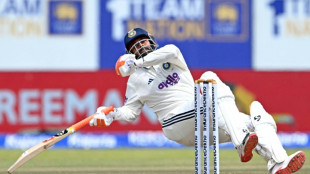 India close on victory in first Test against Sri Lanka
The US Supreme Court was hearing a case Thursday that could sharply curb the judiciary's ability to rein in Donald Trump and future American presidents.
The case before the top court involves the Republican leader's bid to end automatic citizenship for children born on American soil.
But the immediate question at hand is whether a single federal judge can block a president's policies with an injunction that applies nationwide.
Trump's executive order to end birthright citizenship has been paused by district courts in Maryland, Massachusetts and Washington state who deemed it unconstitutional.
Other Trump initiatives have also been frozen by judges around the nation -- both Democratic and Republican appointees -- leading the Justice Department to make an emergency appeal to the Supreme Court, where conservatives make up a 6-3 majority.
Arguing before the court for the Trump administration, Solicitor General John Sauer said universal injunctions hamstring the president and "disrupt the Constitution's careful balancing of the separation of powers."
"They operate asymmetrically, forcing the government to win everywhere, while the plaintiffs can win anywhere," Sauer said, and "create the ongoing risk of conflicting judgments."
Trump, in a post on Truth Social, personally railed against "unlawful" nationwide injunctions by "Radical Left Judges," saying they could "lead to the destruction of our Country!"
"These judges want to assume the Powers of the Presidency, without having to attain 80 million votes," he said, in reference to his 2024 election victory.
Past presidents also complained about national injunctions shackling their agenda, but such orders have sharply risen under Trump. His administration saw more in two months than Joe Biden did during his first three years in office.
Steven Schwinn, constitutional law professor at the University of Illinois Chicago, said there is a simple reason.
"The Trump administration is overreaching time and time again and the courts are doing what courts do, and that is restrain illegalities in a separation of power system," Schwinn told AFP.
- Uniformity of US citizenship -
The Trump administration is asking the Supreme Court to restrict the application of a district court's injunction solely to the parties who brought the case and the district where the judge presides.
Two groups challenging Trump's order -- CASA and ASAP -- said that makes no sense.
"The universal injunction in this case preserves the uniformity of United States citizenship, an area in which nationwide consistency is vitally important," they said. "Whether a child is a citizen of our Nation should not depend on the state where she is born."
Trump signed an executive order on his first day in office decreeing that children born to parents in the United States illegally or on temporary visas would not automatically become US citizens.
The three lower courts ruled that to be a violation of the 14th Amendment, which states: "All persons born or naturalized in the United States, and subject to the jurisdiction thereof, are citizens of the United States."
Trump's order was premised on the idea that anyone in the United States illegally, or on a visa, was not "subject to the jurisdiction" of the country, and therefore excluded from this category.
The Supreme Court rejected such a narrow definition in a landmark 1898 case.
Whatever the justices decide on nationwide injunctions, the actual question of whether Trump can legally end automatic birthright citizenship is expected to be back before the top court "probably sooner rather than later," Schwinn said.
K.Sutter--VB