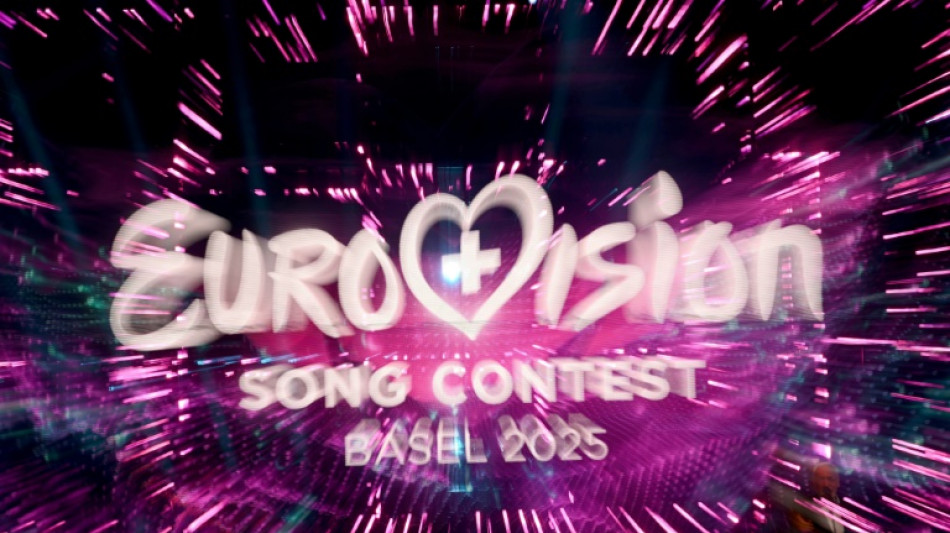
Eurovision voting: when politics and kitsch converge / Photo: © AFP/File

 'American Doctor' shows brutality of conflict in Gaza
 New Zealand blocks lawsuits against firms over climate harm
 Aussie Rules club suspends five players amid police probe
 No.1 Sabalenka slams Wang to power ahead in Cincinnati
 Israel blames Turkey after strike on Syria air base
 Trump, Carney talk as Canada seeks to hold off new US tariffs
 NASA images reveal crater left by SpaceX rocket's Moon crash
 UN atomic watchdog says found tons of nuclear material at Syria site
 Ecuadoran diplomat enters race to be next UN chief

 US sanctions ICC chief Tomoko Akane of Japan
 US moves to open vast tracts of pristine forests to logging
 US sanctions International Criminal Court chief Tomoko Akane of Japan
 Meta hooked children and misled public: prosecutors
 France's first women's rights minister Yvette Roudy dies, aged 97
 French producer Nicolas Altmayer, Dior PR chief Favier die in car crash
 Bezos consortium bought nearly 40 percent of Liverpool: report
 Trump says no Iran talks planned, claims Hormuz 'new US territory'

 Canada seeks to avert new US tariffs as deadline looms
 US primaries test Democrat comeback hopes in Trump stronghold
 Scientists discover how narwhals grow nature's only straight tusk
 DR Congo Ebola outbreak 'far from being under control': WHO chief
 Firefighters in 'decisive' push to encircle Belgian wildfire
 Tribal Partners with ServiceNow to Empower Enterprise Teams to Build and Deploy Apps & Agents
 Fusion Markets Extends Negative Balance Protection to Clients Globally
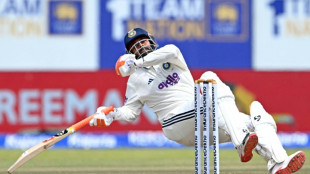 India close on victory in first Test against Sri Lanka
Groans and giggles typically greet votes at the annual Eurovision Song Contest, loved and mocked for its kitsch music and seemingly partisan outcomes.
But over time, what are the voting patterns, and what external factors help explain them?
Ahead of Saturday's final in Basel, AFP analysed all points distributed among around 2,300 possible pairs -- voting country/receiving country -- since 1957.
Patterns emerged, pointing to factors ranging from geopolitics and cultural affinities to the simple love of a good song.
- Good neighbours -
The various regional blocs in Europe taking part in the contest -- Nordic, ex-Yugoslavia, former USSR, Baltic -- broadly show solidarity with each other, allocating the majority of their points to those in their own bloc.
Norway, Finland, Denmark and Iceland have thus provided more than one-fifth of the points Sweden has received since it first took part in 1958.
But while blocs show clear patterns, discordances suggest other factors are also at play.
Political tensions persist in the Balkans, for example, "but the cultural connections seem to have trumped the political divisions", Dean Vuletic, author of "Postwar Europe and the Eurovision Song Contest" (2019), told AFP.
"I would say that this is because these countries do share a music industry."
On the other hand some countries stand out for the very low number of points exchanged.
Azerbaijan and Armenia, which fought two wars in Karabakh, have exchanged only one point -- in 2009 by Armenia to its neighbour.
- Best buddies -
Voting patterns also show distinct pairings of countries consistently voting higher than average for each other.
Striking examples here include Cyprus and Greece, which since 1981 have given each other between above eight points (when the maximum was 12, up to 2015) and above 18 (when it was 24, since 2016) more than what they get on average.
Romania and Moldova are another reciprocal pair, giving each other since 2005 between above nine and above 12 points more than their average score.
As neighbouring countries, geography helps explain this recurring behaviour, as does language, but also familiarity with performers.
"They intermix a lot," Nicholas Charron from the University of Gothenburg said to AFP.
"There's so much collaboration across borders in terms of songwriting, in terms of choreography, the professionals that worked in these countries."
- Unrequited love -
On the flip side, there are also examples of one-way traffic: a country giving higher-than-average points to another that does not respond in kind.
Cases include France, the country that has given more points to Israel than any other.
It over-votes for Portugal too, as soon as the public has had a say -- its average points allocated jumped from three to nine without reciprocity.
Since 1997 voting at Eurovision is split between juries and the public in each country.
From that date, and up to 2012, Germany showed a notable over-voting for Turkey, averaging 10 points when before it had allocated around 1.4, while no such chumminess was displayed from the Turks.
Labour laws and demographics can help explain this -- in 1961 onwards as part of a guest worker deal, around three-quarters of a million Turks came to Germany to take jobs, creating over time a large diaspora.
The diaspora vote, as soon as the public had a say in voting, would also seem to be at play in the French one-sided votes.
"My guess is there's a lot of Portuguese people living in France that are voting for their own country and there's almost no French people that either care or vote from Portugal," Charron said.
As for France to Israel, "this is indeed explained because France has the largest Jewish community in Europe," said Florent Parmentier at Sciences Po university in Paris.
- Volatile voting -
Flashpoint events can impact the vote in isolated years.
In 2022 for example, the year Russian tanks rolled into Ukraine, there was a huge upswing in votes for Kiev, which won the contest.
And the public vote swung it for them.
From 28 out of 39 countries, the public awarded Ukraine maximum points, while only five juries did. With 439 points out of a possible 468, no country had ever received so many points from the public.
Such a surprise win could be an example of "volatile" factors having an impact, Farid Toubal from the University of Paris Dauphine told AFP.
"The arrival in government of a dictator or a nationalist changes the dynamics with regard to (that country's) partners in Eurovision."
L.Maurer--VB