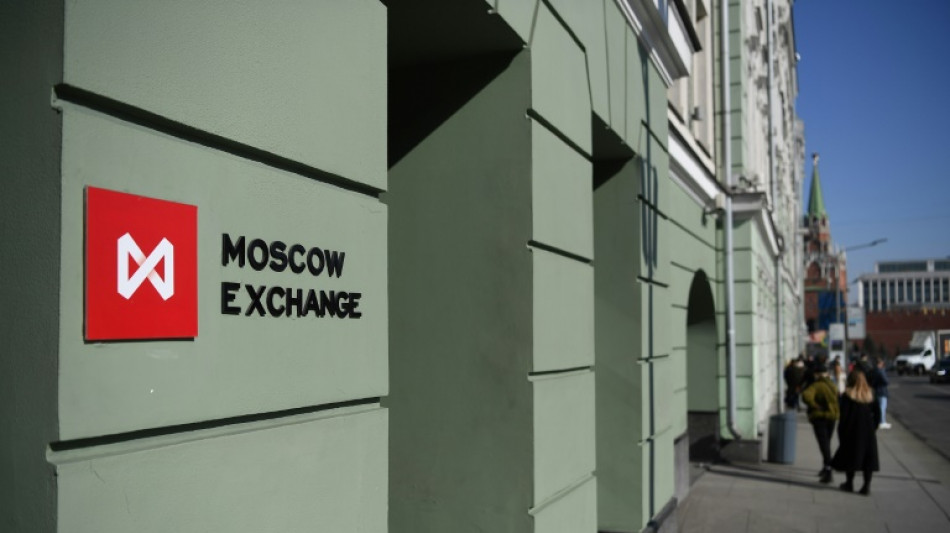
Russians shrug off sanctions on dollar, euro trading / Photo: © AFP/File

 Zuckerberg skewered again on screen in 'The Social Reckoning'
 Fiji urges 'just' climate transition, financing at pre-COP gathering

 Thailand's Jeeno overcomes late wobble to win Lotte Championship

 Brazil heads to run-off as Bolsonaro pulls off shock first place finish over Lula

 EU, China to hold Beijing talks to avert trade war
 Bolsonaro edges past Lula as nail-biter Brazil vote goes to a run-off

 Rubio visits Iceland as US boosts Arctic presence

 Bolsonaro leads Lula as nail-biter Brazil vote goes to a run-off
 Patriots inflict first Bills defeat as Chiefs keep winning
 Pacific nations take centre stage at 'pre-COP' climate summit
 Ronaldo can return to Portugal team if he wants: coach Jesus

 Portugal move into Nations League knockout stage, Germany held

 Ronaldo-less Portugal beat Norway to reach Nations League quarters

 Bosnian Serb strongman claims election win, thanks Trump and Putin
 Israel wear black armbands in Ireland tie over Hamas attack

 'I fear it could drag on': anxiety takes hold in Ethiopian city wrested from rebels

 Brazil's Lula and Flavio Bolsonaro face off in knife-edge election

 UK Green party adopts 'Zionism is racism' policy
 Rio favela residents vote with little hope
 Evenepoel puts worlds 'disappointment' to bed with European crown
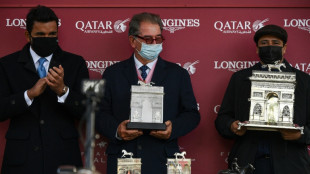 Two-time winning Arc trainer Rouget bows out in emotional farewell
 Battling Djokovic stuns top seed Zverev at China Open
 Spy chief Clayton, the Trump loyalist tech bosses trust on AI
 UK's Glastonbury festival tickets sell out in 45 minutes
 Two dead in Catalonia due to torrential rains: Spanish officials

Russians on the streets of the capital shrugged off new US sanctions on dollar and euro trading Thursday, claiming they had no need for Western currencies in their heavily targeted economy.
In the latest major financial punishment over Moscow's full-scale military offensive against Ukraine, the United States announced Wednesday it was sanctioning Moscow Exchange, the country's main stock market and foreign currency clearing house.
The move cuts the group off from Western financial architecture and forced it to suspend trading in both the dollar and euro.
"Given that we have sanctions and there are basically no trips abroad, we don't need dollars or euros," Yegor Danilov, a 36-year-old engineer, told AFP on Thursday, dismissing the impact the move would have on ordinary Russians.
The suspension of trading does not restrict Russian businesses, banks and citizens from buying and selling foreign currency.
But it stops deals going through the centralised exchange, pushing transactions into less liquid markets, such as direct bank-to-bank agreements or through specialised brokers and market makers.
That is likely to result in higher volatility, commissions and margins, analysts said.
London on Thursday also sanctioned the Moscow Exchange.
- 'Need to get stronger' -
Measures that target Russians' ability to buy and trade foreign currency have historically provoked a strong reaction in Moscow and throughout Russian society.
The exchange rate is seen as a key indicator of the health of the Russian economy.
When the West first hit Russia with sweeping financial sanctions in 2022, huge queues formed outside banks and ATMs ran out of dollars and euros as Russians scrambled to convert their savings into hard currency.
But two years of conflict and sanctions have somewhat limited the impact of further moves to isolate Moscow's economy.
Businesses are trading less with the West and Russians face arduous and expensive trips if they want to visit Europe or the United States, with direct flights banned.
Trades in the Chinese yuan already accounted for a majority of Moscow Exchange's foreign exchange dealings.
President Vladimir Putin has repeatedly touted Russia's strength and economic resilience in the face of Western sanctions -- a message that some in Moscow echoed on Thursday.
"Sanctions are getting stronger, but we also need to get stronger to come through this as a winner," said Valery Strakhov, a 53-year-old tour guide.
- 'Slower, more expensive' -
A few banks immediately hiked their exchange rates to as high as 200 rubles per dollar after the sanctions were introduced on Wednesday evening, spreading fear of a fresh currency crisis across social media.
But rates settled down quickly.
On Thursday, several banks had spreads -- the difference between the price at which they offer to buy and sell currency -- of between three to 10 rubles on Thursday, a typical rate.
The ruble had closed around 89 to the US dollar on Tuesday, the last trading day before the sanctions were announced.
"Everybody has been well-prepared for this, so the immediate effects are moderate," said Anton Tabakh, chief economist at Expert RA, a Moscow-based credit ratings agency.
"The exchange rate itself is unlikely to be affected much, except for the fact that in general it increases the costs in the economy. All operations with foreign currencies become slower, more expensive and more complicated," he added.
Those extra costs incurred by businesses would eventually be passed on to shoppers through price rises, he said, feeding already high inflation.
- 'Opportunity' -
Both the central bank and the Kremlin have also sought to calm nerves.
"Companies and individuals may continue to buy and sell US dollars and euros through Russian banks. All funds held in US dollars in accounts remain safe," the bank said Wednesday.
Putin's spokesman Dmitry Peskov said the regulator was "ensuring stability in all markets," state media reported.
He also said Russia was "thinking over" possible retaliatory measures to the United States over the latest sanctions.
Some Russians saw an opportunity in the volatility.
Student Ilya Mier said he "follows the political situation" for a chance to make a profit by trading dollars.
But for 18-year-old Yaroslav, also a student, it was those Western currencies -- not the ruble -- that carried the most risk.
"None of this really bothers me. It doesn't really affect prices, because I know that import substitution is a good thing," he told AFP, backing Moscow's drive to reduce its reliance on foreign goods.
He added: "And I don't invest in foreign currency, because it's questionable at the moment."
S.Spengler--VB