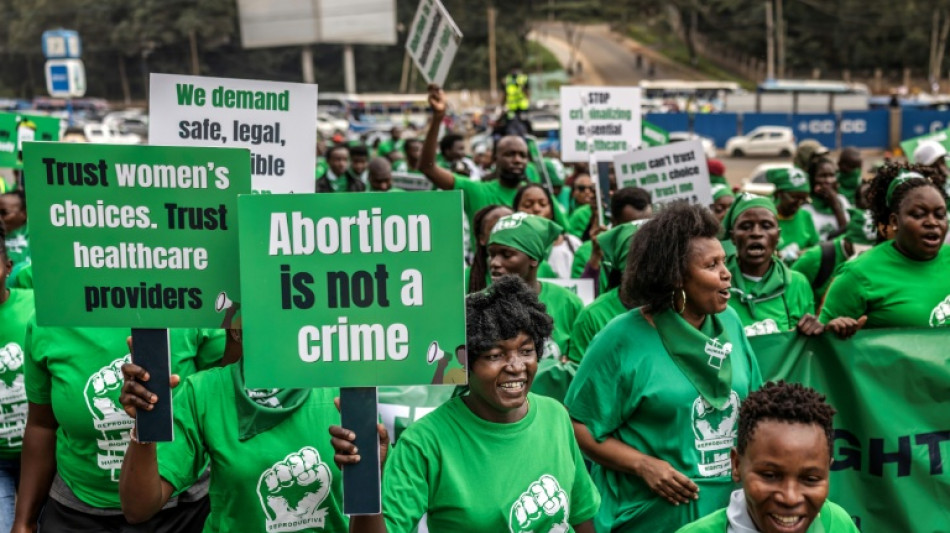
Kenya's abortion taboo is killing thousands of women / Photo: © AFP

 Iran airlines cancel flights as US sanctions hit
 Meta launches camera-free AI glasses amid privacy pushback

 Australian PM says OpenAI hacked government health website

 Xi arrives in US to personal Trump welcome

 Morocco elects new parliament amid social frustration, youth discontent

 Scheffler and Burns to face Im and Lee in Presidents Cup opener

 Crushing wins for Lyon and Barca in women's Champions League

 Rio breaks record for rainiest September amid powerful El Nino

 At UN, tech chiefs urge caution in AI development

 Russian strikes kill seven in Ukraine, Zelensky vows winter campaign

 Venezuelan shot by ICE needs urgent medical care, mother tells AFP

 Zelensky says Putin using fighters from 47 countries in Ukraine war

 Klopp calls on Germany to 'rise above ourselves' as new era begins

 Russian strikes kill seven in Ukraine as Russia vows no 'pause' to war

 ArcPoint Expands Globally with Institutional Intelligence Platform for Modern Investors

 Ronaldo focussing on 'present' ahead of Wales test

 Outgoing UN chief makes final climate push at New York summit

 Grief and pain flow at hearing for Canadian suicide poison vendor

 Ireland boss Hallgrimsson says timing of Israel remarks 'not clever'

 Weinstein resentenced to 15 years in prison for 2006 sex assault

 Fendi brings disco bling, Italian style, to Milan Fashion Week

 French court confirms rape trial for PSG and Morocco star Hakimi

 President tells Trump that Iran will never 'bend at the knee'

 أليكس بودي والبروفيسور الدكتور شتيفان هاوبت يتفقان على التعاون من أجل مجموعة فنية أسطورية في رومانيا

 U2 at 50: Irish rockers reveal anniversary album

Kenya has one of the highest abortion rates in the world, yet US and religious pressure means the government is afraid of discussing the issue -- a combination that causes thousands of maternal deaths, according to figures from the African Population and Health Research Centre (APHRC).
Abortion is illegal in Kenya, but allowed whenever "the life or health of the mother is in danger" -- a loophole wide enough for hundreds of private clinics to operate legally across the east African country.
But it remains taboo for many in the religiously conservative society, and the government refuses to even count how many abortions occur.
So there was shock last year when a study by the Nairobi-based APHRC estimated there were 793,000 abortions in 2023, based on data from health clinics, and interviews with doctors and patients.
Patchy data makes comparisons tricky, but that is likely one of the highest rates in the world.
The combination of high abortion demand and continued taboo has deadly consequences: the APHRC says more than 300,000 Kenyans resort to backstreet doctors and dangerous concoctions annually.
In 2023, it estimated 2,600 women died from unsafe abortions -- seven every day.
Physician Samson Mwita sees the terrible after-effects at his Nairobi clinic, where treats 60-90 abortion-related cases each month.
"You find patients presenting with a ruptured uterus, cervical tears, severe infections, anemia, some even starting to develop kidney failure," he said.
- Court battles -
The legal confusion also means doctors and nurses are frequently extorted by police. AFP spoke to four health workers who had paid bribes to drop cases related to abortions they said were legal.
The courts have yet to provide clarity.
In 2019, a 16-year-old girl and clinician were arrested in the coastal area of Kilifi after she sought help for severe post-abortion complications.
The High Court quashed the charges three years later, saying access to abortion was a constitutional right, only for that ruling to be overturned on appeal in April. The case will now go to the Supreme Court.
An influential anti-abortion lobby, led by the Kenya Christian Professionals Forum (KCPF), refuses to accept that abortion is so widely practiced.
Abortion is "abhorrent to the sensibility of the ordinary African," said Charles Kanjama, former KCPF chair, now president of the Law Society of Kenya.
He prefers data from the National Bureau of Statistics, which found there was only one abortion per 1,000 women aged 15-44 -- equivalent to around 11,000 abortions annually.
But the Bureau of Statistics itself rejected the number when asked by AFP, saying it was based on face-to-face interviews with women, creating "a strong likelihood of underreporting" and that the APHRC estimate of 793,000 was "more realistic".
- 'Bury our heads' -
Kenya's Ministry of Health approved the APHRC study, but largely refuses to discuss the issue.
Its officials did not respond to dozens of requests for comment, before finally one spoke to AFP for less than five minutes.
"We are developing post-abortion care guidelines to train healthcare workers," said ministry director-general Patrick Amoth, adding that it was also investing in family planning programmes to "reduce the chances of unwanted pregnancies that could lead to abortions".
"We cannot just bury our heads in the sand," he added, but when asked for details, he hung up the phone.
"The government will not robustly provide information. They would rather keep quiet, not offer the services in public health facilities, allow misinformation, intimidation and even harassment of providers to continue," said Martin Onyango, a lawyer for the Reproductive Health Network Kenya (RHNK).
That network is a lifeline for the sector, providing medical supplies to remote areas, and legal protection to abortion providers.
But Kenya's reliance on Washington for health aid is an obstacle to reform, since the United States prohibits funding to entities that provide abortions.
"Our leaders are always taking direct instruction from the US government," said Nelly Munyasia, RHNK's executive director.
"We have misaligned and archaic policies, and the government doesn't see the negative effects on women's health -- the stigma that exposes them to mortality risks. We need to face up to the reality," she added.
- 'Regular clients' -
Mwita sees that reality every day at his Nairobi clinic.
He recalls the first time a nun visited him.
"She told me the priest was in the car outside and he was going to pay," he said, adding that nuns had since become "regular clients", despite the church's opposition to abortion.
He draws a simple lesson from this: "People can be totally opposed to abortion -- until they need one."
C.Kreuzer--VB