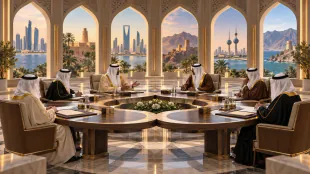
'Not easy, but not impossible': Iraq's film industry sees slow revival / Photo: © AFP

 After a long slog to the top, Zverev leaps to No. 1 ranking
 Kuwait traffic authority cautions against hazard lights while driving in rain
 Germany's Zverev becomes tennis world No. 1
 Grealish dropped for Everton's League Cup tie after disciplinary breach
 Kuwait National Guard official visits member injured during training

 Machado says Trump opened 'floodgate to freedom' for Venezuela
 CNN Global Perspectives prepares Doha debut with international speaker lineup

 Qatar Olympic Academy completes record sports management course
 Jazeera Paints showcases housing solutions at Build Your House 2026 in Qatar

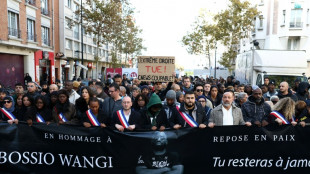 French shooting suspect targeted Muslims, Africans: prosecutor

 Es’hailSat and Arabsat agree broader satellite and broadcasting cooperation

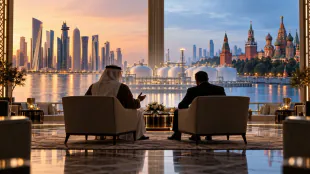 Qatar and Russia outline plans to expand strategic partnership
 Google drags down Wall Street stocks
 Nations accused of undermining science at UN nature talks
 ECB says has tools to calm markets as French debt worries rise

 ASEAN envoy ends Myanmar trip with no public Suu Kyi meeting
 Three dead in rock spire collapse at Turkey's touristic Cappadocia
 CAR tightens border checks as DR Congo Ebola cases rise
 Does White House ask AI to decide policy? Democrats want the receipts

 French businessman Roux de Bezieux takes over 2030 Winter Olympics after leadership turmoil
 Tech jitters pull down Wall Street stocks

 Alaska governor orders probe into election same-name 'spoiler'

 Gang-plagued Haiti sets election dates for 2027
 Neville warns managers can need sacking 'for their own good' as Carrick fights on
 French businessman takes over 2030 Winter Olympics amid leadership turmoil

In the heart of old Baghdad, legendary movie theatres stand abandoned and shrouded in dust, bearing witness to Iraq's once-vibrant cultural scene.
A few kilometres away, director Ali al-Bayati oversees his camera operators as they adjust their lenses for a scene in his upcoming horror film, which he hopes to showcase internationally as a new generation of Iraqi filmmakers drives an industry comeback.
Momentum is building, bolstered by recent international recognition for the Iraqi film "The President's Cake", which captures life under crippling sanctions during Saddam Hussein's rule.
"Reviving the cinema sector in Iraq is not easy, but it is not impossible either," Bayati told AFP.
For decades, Iraq's cultural and cinematic scenes flourished.
Film production in Iraq began in the 1940s -- notably with titles co-produced with Egypt -- reaching its peak in the 1950s.
Among the most celebrated productions of that era was Kameran Hosni's film "Said Effendi" (1956), a work recently restored as part of the Iraqi Cinematheque project supported by France, and screened at the Cannes Film Festival in 2025.
But then everything changed.
With Saddam Hussein's rise to power in the 1970s, cinema became a propaganda tool.
This was followed by decades of war, sectarian strife and jihadist insurgency after the 2003 US-led invasion that toppled Hussein, ultimately snuffing out the golden age of Iraqi cinema.
Baghdad's old movie theatres that once drew film enthusiasts are now barely standing, with their faded walls, old doors and broken signs.
Dilapidated shops crowd the entrance to the Granada Cinema, with clothes hanging directly on the street. Other theatres have been repurposed as warehouses, with a few old movie posters still clinging to their walls.
- The old and the new -
In recent years, a fragile stability has begun to revive Iraqis' appetite for entertainment and returned focus to Baghdad's cultural scene.
Authorities seized the opportunity last year, launching an initiative to support 58 film projects.
But the funding pool is just four million dollars, an amount that would fund only a single project in other countries, said Wareth Kwaish of the government-led initiative.
Authorities are also working to recover Iraq's historic cinema archive in the country and abroad.
And Baghdad has signed cinematic cooperation agreements with France to support its film industry.
Still, the industry remains short on funding and support, making every production a gamble.
Filmmakers rely on small grants, said Bayati, who hopes to market his movie in the US and European countries and is among those who benefited from government funding.
The key for him is gaining the trust of Iraqi audiences to "generate revenues that would lead to sustainability in work and production", he said.
Most Iraqi moviegoers today frequent multi-screen theatres in shopping malls where Hollywood and Egyptian movies dominate the screens, rather than the classic venues.
Syrian filmmaker Abdulhadi al-Rakeb, who made a documentary about Iraq's old movie theatres, said their closure has led to "the disappearance of a culture of watching films in theatres and, as a result, a decline in the very idea of filmmaking".
- 'Cautiously optimistic' -
Recently, "The President's Cake", the Iraqi film that won a prize at the prestigious Cannes Film Festival last year, finally started screening in Iraq.
The movie follows the story of a young girl selected to bake a cake for Saddam's birthday at a time when sanctions made it almost impossible to find the ingredients.
Although the movie was shot in Iraq, the production faced many challenges.
Director Hasan Hadi said a shortage of experienced Iraqi film crews forced him to bring in European professionals.
"The local crew were not aware of international standards," and the foreign crew were unfamiliar with the local cultural context, which created "more problems for us", he said.
According to Hadi, the lack of local crews is one of several reasons Iraqi filmmakers have been unable to work in their own country.
He believes the sector needs workshops to develop local talent, increased funding and better overall organisation.
"I am cautiously optimistic," Hadi said.
"There are more people who want to tell their stories and make films, but not enough resources."
R.Fischer--VB