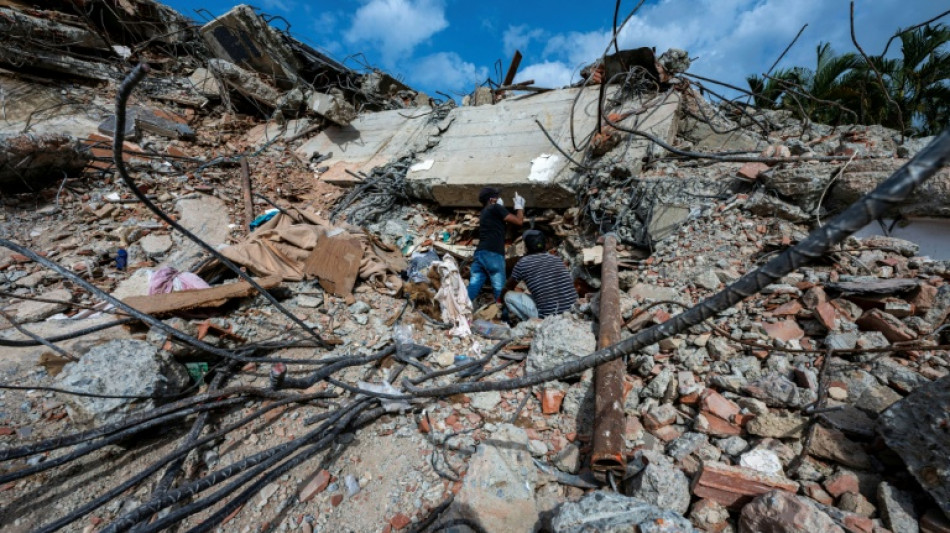
Hunt for last signs of life in Venezuela quake zone / Photo: © POOL/AFP

 Former Grand Slam winner Wawrinka ends tennis career

 Brazil's Flavio Bolsonaro flees to US after election loss
 'Faerie' nights: 'ACOTAR' fans finally get their book
 American woman convicted of getting military training from Islamic State

 Israel opposition holds narrow edge over Netanyahu in first projections

 Floriani hits maiden goal as Lazio go top
 Trump set to drastically loosen oil and gas sector's methane rules

 Storied Paris department store seeks bankruptcy protection

 Xhaka, Embolo can return to Swiss squad after fake Covid docs affair

 Allegri suspended for two Serie A games after red card

 Flight data, satellite images reveal growing US role at Ecuador base

 McInnes feels 'guilt' ahead of Hearts return with Rangers
 Brazil's Lula turns 81, vows to work '24 hours a day'
 Boeing releases cautious growth plan as shares fall sharply
 Exiled Russian dissident Navalnaya warns dictators becoming 'more cunning'
 Bayern 'risk' reaps huge reward for Ballon d'Or winner Kane

 Record turnout as Israeli voters deliver verdict on Netanyahu

 Iraola says Isak 'feels the trust' after Liverpool scoring streak

 French media protest manhandling of journalists at far-right party rally

 EU seeks deportation powers for beefed up border agency
 Two charged with UK security offences over airbase plot: police

 Maresca defends Donnarumma, Guehi after Man City defeat
 Nordic leaders call Putin as local truce begins in Ukraine

 Osaka unveils crane outfit in Tokyo before win over Paolini

 Ronaldo in line for Portugal return after fallout with coach

In the Venezuelan resort town of La Guaira, a group of rescuers watched as sensors that once detected life under the rubble now showed nothing, as silence gave way to resignation.
Friday -- the ninth day since the devastating double earthquakes that killed nearly 2,600 people and injured tens of thousands in the South American nation -- will be the last day in the search for survivors, some rescuers said.
After 30 hours of gruelling work with no rescue, their operation was called off. Nothing more could be done.
Chances of finding life in the rubble are highest in the first 72 hours, and diminish as each hour passes, with conditions such as temperature also playing a critical role.
The human body can survive up to seven days without water, one rescuer said.
Just hours earlier, another brigade saved a 43-year-old man in the coastal area of Catia La Mar who survived eight days under the rubble -- celebrated as a miracle after he was dug out from under a collapsed seven-story building.
Rescuers had provided him with more than ten liters of water to keep him hydrated via a hose and installed a tube to provide him with oxygen.
But in the oppressive heat of La Guaira, the team's latest assessment found no signs of life.
International aid has poured into Venezuela, with teams arriving from 27 countries.
A Mexican rescuer working in La Guaira said that their equipment could detect signs of life in another building, but they had not made contact, after digging through the rubble they found nothing.
They asked for silence. Police ordered the drivers traveling on the destroyed road to turn off their engines.
"We're rescuers, make some noise," one of them shouted, hoping to hear from survivors.
Nearby, a US brigade deployed search dogs and activated a highly sensitive sensor to detect sounds. Still nothing.
- 'There's no support' -
Marina Castillo waited for help to recover the body of her grandson, Alexandro de Guidice, a 24-year-old law student.
"It's been horrible, there's no support," Castillo, 67, said -- a common complaint among Venezuelans who decry government inaction.
"We got to his apartment, we saw all his law books, his files. It's terrible," Castillo said.
"What I want right now is for them to bring him back."
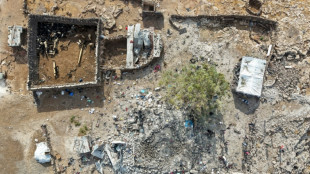
Nearly 200 buildings collapsed completely in the earthquakes that hit La Guaira and the nearby Venezuelan capital of Caracas, according to official figures.
Preliminary analysis of satellite data indicated the figure could be much higher.
Neighbors, relatives and volunteers rushed to help with picks and shovels, but their efforts were often not enough.
"Help, here's my dead mother," Mirosnel Gordon wrote in black paint on the green facade of a house.
The family placed lime on the body to slow the decomposition process while they waited for aid.
To support the search efforts, Jonathan Soto brought a backhoe from Anzoategui state, 500 kilometers (310 miles) from La Guaira.
When people pleaded for his help, he called for calm, saying, "You can't just go in there and jump in."
But desperation was widespread.
Outside the complex where Joan Manuel Lucena's mother-in-law was missing, rescuers found no signs of life.
"We're not going anywhere," Lucena said.
"We'll get them out dead or alive."
D.Bachmann--VB