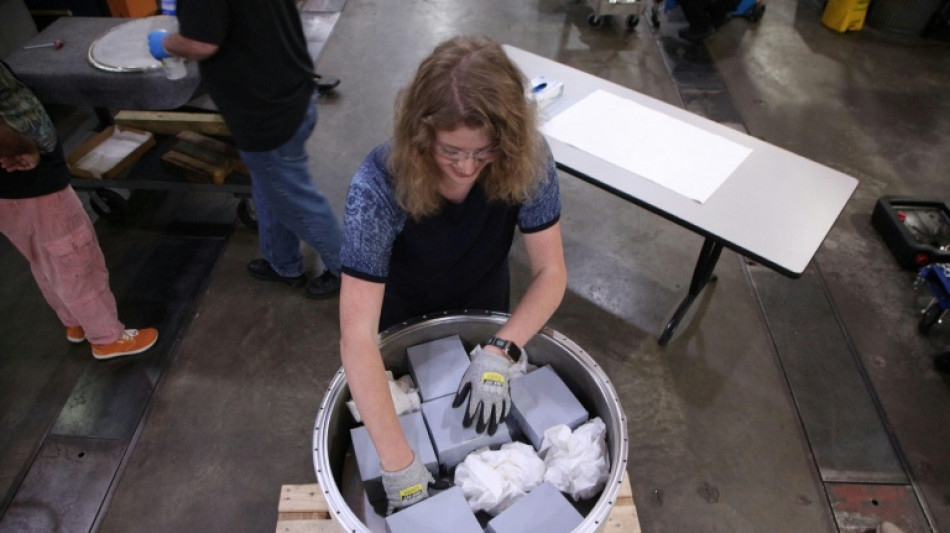
Do not open until 2276: US burying time capsule to mark July 4 / Photo: © National Institute of Standards and Technology/AFP

 Colombian judge bans strikes on guerrillas if minors are present

 Khachanov shocks ailing Auger-Aliassime, Swiatek and Osaka advance at US Open
 Lone juror blocking verdict in US mother's child murder trial: defense

 'Kinda chic' - Williams sisters set to launch US Open doubles bid

 Volkswagen says cutting 100,000 jobs by end of decade

 Russia slaps curfew on charity director over army criticism

 Ailing Auger-Aliassime upset by Khachanov at US Open
 Richarlison omitted from Tottenham's Premier League squad

 How El Nino is choking the Panama Canal

 Hamilton drives his Ferrari dream at Monza

 Senegal has an IMF loan, now what?

 Auger-Aliassime upset by Khachanov at US Open
 Hugging Face, the French start-up that became AI's warehouse

 World Cup winner Llorente retires from Spain team at 31

 Osaka squeezes into US Open third round
 Apple faces £2 bn lawsuit in UK over app privacy feature
 Former champ Swiatek eases into US Open third round

 DR Congo latest to promise moving Israel embassy to Jerusalem

 War criminal Mladic's body returns to Serbia with military honours

 Pierre Cardin museum brings designer's futurist style to Venice

 Slovenian rookie Omrzel triumphs as Mas extends Vuelta lead

 British, French leaders talk migrants, EU relations

 Heading for Ferrari's home race, Leclerc still dreams of world title

 Cafe at centre of Israel culture clash agrees to shut on Sabbath
 Spacecraft bound for Mercury begins 'tricky' arrival
Americans living in 2276 will get a taste of what their ancestors today think best represents the nation thanks to a time capsule to be buried this July 4.
The 900 pound (400 kilo) stainless steel cylinder will go into the ground Saturday, as the nation marks its 250th birthday, not far from where the Declaration of Independence was signed in Philadelphia.
It is not supposed to be opened for another 250 years, in 2276.
But it is not the only such gift for US people far off in the future. Another time capsule scheduled for opening when the United States turns 500 years old was unveiled a few days ago in Washington.
The contents of the Washington one are not widely known but the capsule due to be buried in Philadelphia near Independence Hall has spilled all its secrets.
All 50 states, five US territories such as Puerto Rico, plus an array of sporting and cultural organizations have made contributions to this collective national snapshot.
Together it all makes for "a representative record of the United States at 250 years," said Rosie Rios, chairwoman of America250, the official organization behind the national commemoration of the anniversary.
- Eagle feather and AI -
Wisconsin, for instance, has contributed a brown feather. It comes from a bald eagle known as "Old Abe" -- named for president Abraham Lincoln -- that served as a mascot to Union troops in over 30 battles in the US Civil War.
Ohio has offered a piece of fabric from the wings of the airplane built by Wilbur and Orville Wright, the pioneers who made aviation history in 1903 with the first powered, sustained flight.
From Maine comes a bone from the endangered North Atlantic right whale.
Other states opted for the stuff of modern life, such as California, which offers the response from the AI chatbot Claude to this prompt: "Write me a prediction of what California will be like 250 years from July 4, 2026."
America250 itself has chipped in a late-model orange iPhone.
Other pieces of Americana that made the cut: a bookmark made by the Wabanaki, a Native American tribe; a diamond from Arkansas; a recipe for anis-flavored cookies from New Mexico; and an Oklahoma City Thunder pin from when the team won the NBA basketball championship in 2025.
- Enduring underground -
Other ideas were discarded, like a leather American football, because of doubts it would endure 250 years underground.
Jay Nanninga, a National Institute of Standards and Technology mechanical engineer who designed the time capsule, had to address such storage issues. It was decided to bury the objects rather than insert them in a statue.
He considered different shapes for the container -- like a square or even a star -- but thought it best to avoid having seams and joints, so a stainless steel cylinder won the day.
The cylinder will be placed inside a metallic bell that leaves an air pocket that is supposed to keep moisture out of the inner chamber.
The cylinder itself is sealed with a thin protective layer of a soft, malleable metal called indium.
Papers destined to be read in 250 years are stored in a separate compartment inside the cylinder and sealed, while the other objects were placed in cardboard boxes.
Nanninga said engineers have watched how stainless steel aged over the 100 years it has been in use, and he thinks the material will hold up well in this national exercise of self-storage.
"I do think in 250 years all the stainless will be in really good shape," he said.
America has done this kind of thing before.
A time capsule buried in 1876 was opened in 1976.
Another capsule, created for that year's bicentennial, is stored at the National Archives, to be opened in 2076, said Rios.
She said when the new capsule buried in Philadelphia is finally opened in 2276, "we want future generations to have a clear, authentic window into who we were at 250."
"What we valued, what we built, and how we saw ourselves as a nation," she added.
es/llb/dw/msp
F.Mueller--VB