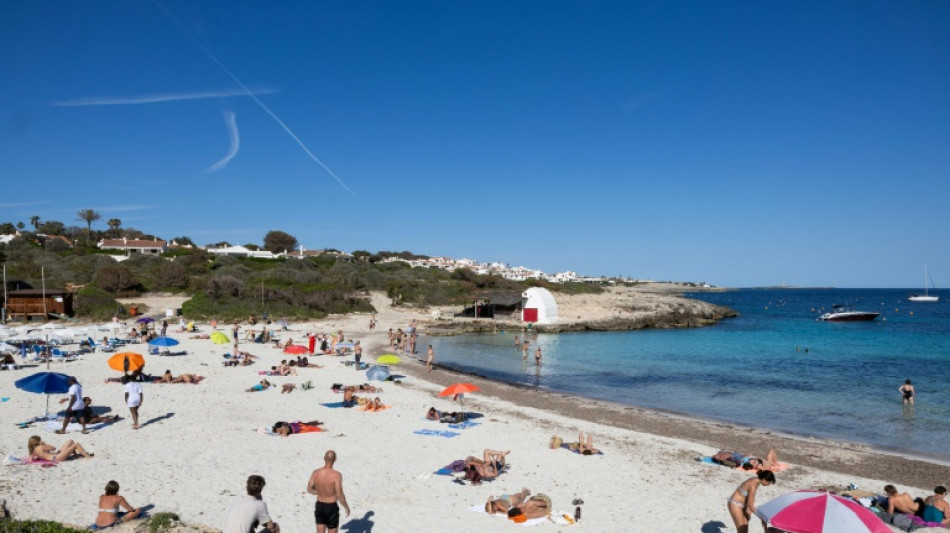
Tourism buoys southern Europe's 'Club Med' nations / Photo: © AFP

 ICC unseals arrest warrants for Taliban education ministers

 Modric hopes fans back Croatia against Spain after England shame
 Bolsonaro rides right-wing surge into Brazil's election runoff

 Turkey blocks X account of British reporter

 Ukraine says using AI robot guns to shoot down new Russian drones

 At Oct 7 memorial, Netanyahu says will be no Hamas rule in Gaza

 Ukraine blames Russia for deadly sinking of Turkish ship in Black Sea

 UN rights council slams Taliban's 'oppression' of women

 Norway eyes partial ban of smart glasses

 Two dead after ship catches fire, sinks in Black Sea

 Spain's PM calls snap election after housing bill defeat

 STARCARES Equips Seven Foster Homes for Children and Young People in Tanzania

 Alleged Indian leader of neo-Nazi child abuse ring goes on trial in Paris

 Euro, French stocks slide on France debt concerns

 Alcaraz advances to Japan Open final

 US-German trio win medicine Nobel for work on optogenetics

 Hundreds of French high schools shut as protests persist

 Spain PM calls early election after housing crisis defeat

 Stocks rally as 'Goldilocks' jobs data ease rate fears

 Myanmar says 10,000 migrants returned from Malaysia this year

 Big guns back for Australia's Rugby League World Cup defence

 Braves rock Dodgers to level series, Brewers win thriller

 Most Asia stocks rally as 'Goldilocks' jobs data ease rate fears

 Sunken Silk Road city reveals Central Asia's lost history

 Three years on, Israeli rescuer cannot escape October 7

Derided as "Club Med" nations during the European debt crisis 15 years ago, the economies of Spain, Greece and Portugal are now outperforming their northern peers thanks to a rebound in tourism.
The three nations had to endure harsh austerity measures in the early 2010s imposed by their European Union partners, who were quick to blame their fiscal laxity and lack of competitiveness for their economic woes.
But "the situation has changed" since the Covid-19 pandemic ended, said Zsolt Darvas, an economist at Bruegel, a Brussels-based think tank.
"Today, those countries are growing faster than the European Union average, they are no longer seen as black sheep."
Spain's gross domestic product (GDP) expanded by 2.5 percent last year, while Portugal's economy grew by 2.3 percent and Greece by 2.0 percent.
That compares to growth of 0.4 percent for the entire 27-member European Union, which was weighed down by Germany's 0.3 percent contraction, making it the world's worst-performing major economy in 2023.
The International Monetary Fund expects the three nations to continue to outperform this year, although at a more modest pace.
It sees growth this year of 2.4 percent in Spain, 1.7 percent in Portugal and 2.0 percent in Greece.
Spain's economy is taking off "like a rocket", Spanish Prime Minister Pedro Sanchez said recently. The country is "the locomotive" of job creation in the EU, he added on Thursday.
- 'Great efforts' -
Economists say this turnaround is largely due to a strong rebound in tourism, which reached record levels last year following the lifting of pandemic travel restrictions.
The sector is key for the three nations, accounting for almost 25 percent of Greece's economy, and 12 percent in both Portugal and Spain.
The trio of nations are also benefiting from the EU's massive pandemic recovery fund, whose mix of grants and loans in exchange for structural reforms will largely go to southern countries.
Spain -- the biggest beneficiary of the fund after Italy -- has so far received 38 billion euros, Greece 15 billion euros and Portugal eight billion euros.
The three nations have also made "great efforts to improve their economic attractiveness" with structural reforms that have boosted their competitiveness and improved their labour markets, said Darvas.
The reforms have helped draw foreign investment, especially in renewable energy and cloud computing.
Amazon's cloud computing division AWS announced last month it would invest over 15 billion euros to expand its data centres in Spain.
Many automakers such as Volkswagen and Stellantis, whose brands include Peugeot, Fiat and Jeep, have chosen to assemble their new electric vehicles in Spain, Europe's second largest automobile producer after Germany.
- Challenges remain -
The growth spurt in the three countries, however, is partly catching up after the steep falls in GDP during the financial crisis. Greece's GDP for example plunged 25 percent.
Economists warn they still face challenges.
While they have all seen joblessness fall, the unemployment rate in Greece and Spain sits above 11 percent, way above the EU average of 5.9 percent.
And former European economic and monetary affairs commissioner Olli Rehn told AFP that "deficits and debt levels remain large in some cases" even though "divergences between euro area countries have decreased compared to 10 years ago".
Portugal swung to a budget surplus of 1.2 percent of GDP last year while Greece's public deficit declined to 1.6 percent in 2023 from 2.5 percent in the previous year. The EU average is 3.5 percent.
This has helped its 10-year borrowing rate to drop to 3.5 percent from 13 percent during the financial crisis.
Darvas said the "convergence" of southerrn European nations with northern ones "is likely to continue" but at a "slower pace". Spain, Portugal and Greece still have "work to do," he added.
C.Stoecklin--VB