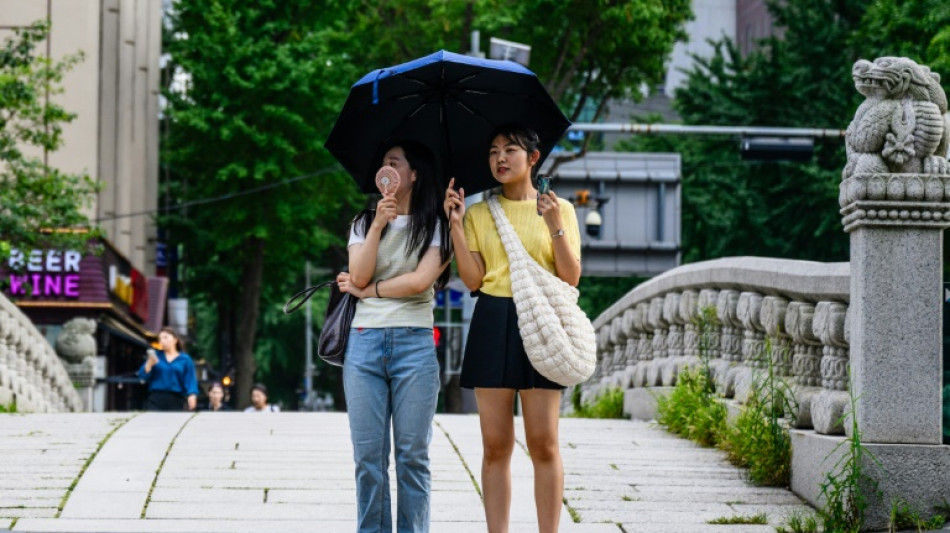
Seoul residents sweating with record 'tropical nights' weather / Photo: © AFP

 EU calls Russia 'reckless' after flares fired at Danish helicopter

 US Treasury chief says to meet Chinese counterpart at weekend

 Trump slams 'horrible' Supreme Court mail-in ballot ruling

 Brazil's crisis-hit Supreme Court probes judge's ties to jailed banker
 Sterling admits dangerous driving after Lamborghini crash

 Ambassador to Thailand plays down anti-Israeli protests

 BingX Evolves into a Multi-Asset Trading Platform, Connecting Users to Global Opportunities

 Flick supporting 'self-confident' Yamal Ballon d'Or bid

 As Ballon d'Or vote nears, stars campaign for the award

 Markets on edge as US Fed meets to tackle high inflation

 International Trading Institute Expands Professional Trader Development Beyond the Master’s in Trading

 Nairobi to host 2029 world athletics championships in African first

 Ukraine winemakers defy war to make a splash at home

 Prominent Greek neo-Nazi exits prison, vows return to politics: AFP

 Saudi Arabia vows to respond 'firmly' to Houthi attacks

 'We unleashed the beast': the world's fears and hopes about AI

 Carragher sees Manchester City’s winning start as challenge to Arsenal
 Oasis fans weigh ticket costs and reunion memories ahead of 2027 tour

 EastEnders previews Kat’s grief after Zoe’s death

 US military confirms Iran war has led to munitions shortfall

 SkySail Strategies Outperforms Wall Street's 30-Year Risk Standard With Proprietary AI Inference Model

 Canada ends refugee family sponsorship exemption over integrity concerns
 Berlin's run-down public spaces at heart of election campaign

 Ribeiro and Richie among celebrity birthdays for September 20–26

 Bob Mackie, costume designer for Cher and Madonna, dies aged 87

Residents of South Korea's capital are resorting to novel ways to beat the heat as a century-old weather record fell Friday following a 26th "tropical night" in a row -- when the temperature stays above 25 degrees Celsius (77 Fahrenheit).
"I take a cold shower before bed and tie freezer packs around my electric fan to cool the air," Lee Ji-soo told AFP Friday.
Overnight temperatures in Seoul have sizzled above 25 degrees Celsius for 26 days in a row, officials said Friday, marking the longest streak since modern weather observation began in 1907.
Such evenings are widely known as "tropical nights" in South Korea.
Much of the world is enduring a summer of sweltering weather, with UN Secretary-General Antonio Guterres warning last month of an "extreme heat epidemic", and calling for action to limit the impact of climate change.
The intense heat in Seoul is expected to continue, according to the met office, setting a record every day until next week.
"The cold air is not coming down from the north," Youn Ki-han, director at Seoul's Meteorology Forecast Division, told AFP.
"Usually around this time the temperature drops in the morning and evening... but currently we aren't seeing any signs of that yet," said Youn.
As temperatures soar, residents struggle to find ways to cope with the sweltering nights.
"I think I turn on my air conditioner 23 hours a day," said Kim Young-sook, who lives in Gangnam district, an affluent neighbourhood in Seoul.
"I'm worried my dogs will become too hot -- even during at night."
That isn't an option for Lee Ji-soo, who straps icepacks to her fan.
"I do have an air conditioner but I just can't afford the electricity bill," she said.
"The air is suffocating sometimes. I don't know how long I can live like this."
- Power hungry -
Data from Korea Power Exchange showed South Korea's electricity demand hit an all-time high on Monday as people battled the heatwave with air conditioners and fans.
Some 102.3 gigawatts were used, passing the previous record of 100.6 gigawatts set last August, the agency said.
According to the International Institute for Environment and Development (IIED), the number of days with temperatures reaching 35 degrees Celsius in the world's largest capital cities has surged by 52 percent over the past 30 years.
In 2018 alone, Seoul experienced 21 days with temperatures over 35 degrees Celsius -- more than the previous 10 years combined.
"In just one generation, there's been an alarming increase," said Dr Tucker Landesman, a senior researcher at IIED.
Climate activists in South Korea are calling for more government action.
"There's no chance that this will get better and it's bound to get worse," Youn Se-jong, an environmental lawyer, told AFP.
"Strengthening the goal of reducing greenhouse gas emissions should be the priority," he added.
South Korea currently has the lowest proportion of renewable energy in its power mix among all OECD countries and is the G20's second-highest carbon emitter from coal per capita, according to energy think tank Ember.
North Korea is also sweltering under a heatwave and issued a warning earlier this week, with central areas including Pyongyang affected.
"Severe heat of 33 to 37 (degrees Celsius) is foreseen in some areas," said Kim Kwang Hyok, an official at the State Hydro-Meteorological Administration.
P.Staeheli--VB